
How to Test a Mini Brushless Motor With a Multimeter—and What the Test Cannot Prove?

When a miniature brushless DC (BLDC) motor fails to start, runs erratically, or triggers a controller fault, an engineer’s first instinct is often to reach for a digital multimeter. This versatile tool is excellent for initial troubleshooting, allowing for quick checks on the motor’s basic electrical integrity without needing complex test benches. A multimeter can […]
Why 12mm Coreless Motors Are Widely Used in Compact Robotic Systems?

When designing a compact robotic actuator, engineers often face a critical trade-off between installation space, available output, dynamic response, and integration complexity. While many motor sizes exist, the 12mm diameter coreless motor is often worth evaluating as a practical starting point. This is not because 12mm is a magic number, but because it can represent […]
Why Equal Phase Resistance Matters When Testing a DC Brushless Motor?
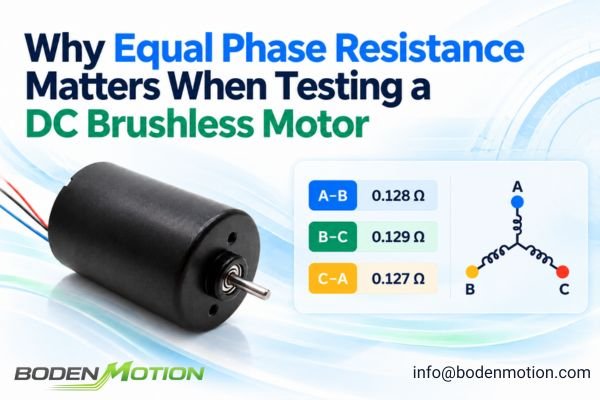
Phase resistance is a fundamental electrical parameter checked during brushless DC (BLDC) motor manufacturing and quality inspection. For a three-phase motor, engineers typically measure the resistance between three terminal pairs: A–B, B–C, and C–A. For a symmetrically designed winding, these readings are expected to be reasonably close. However, observing a small difference does not automatically […]
Why Coreless Motor Brush Life Changes With Current Density and Duty Cycle?
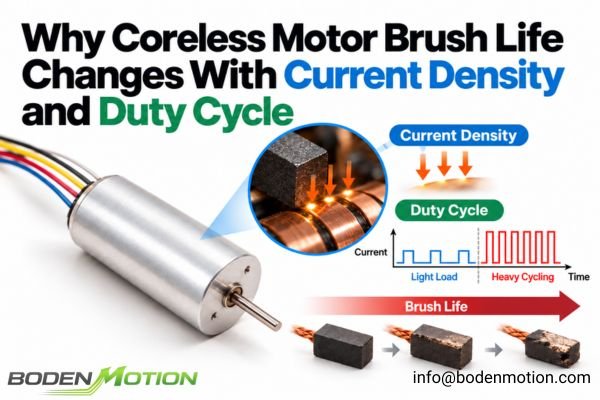
A coreless brushed motor may be rated for thousands of operating hours, but that number does not automatically predict its life in every application. Brush wear is not a simple function of time; it is an accumulation of electrical and mechanical stress at the brush-commutator interface. For OEM engineers specifying coreless motors, understanding these wear […]
How to Specify Acceptable Vibration for a High-Speed BLDC Motor?
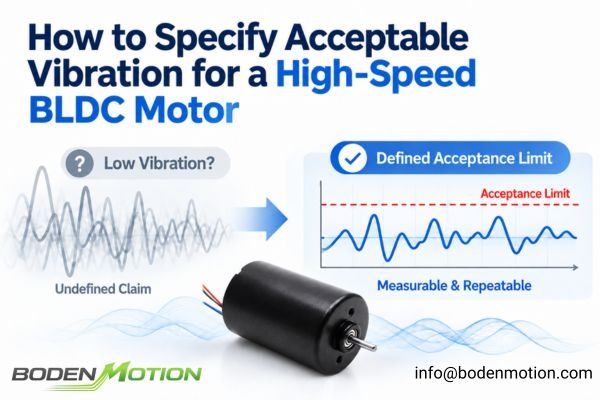
“Low vibration” is a common marketing phrase, but it is not an engineering specification. For any high-speed BLDC motor, excessive vibration can generate acoustic noise, increase bearing load, and degrade the performance of the equipment it’s installed in. A supplier’s claim of “low vibration” is insufficient for OEM qualification or quality control. A meaningful vibration […]
How Load Inertia Ratio Changes Miniature Coreless Motor Response?
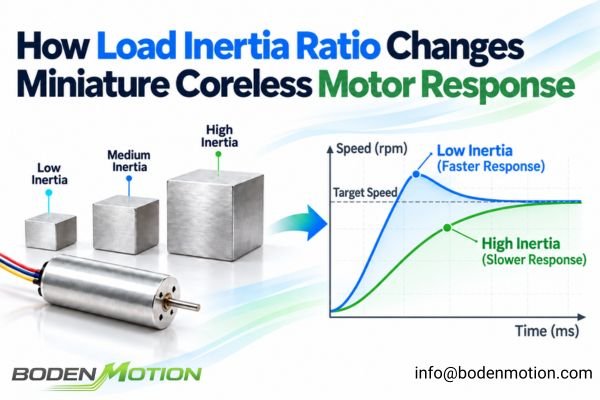
Miniature coreless motors are often selected for their low rotor inertia and rapid acceleration. However, this impressive no-load performance doesn’t always translate directly to the final application, as the system’s actual dynamic response is determined by the motor and the load working together. A coreless motor’s low rotor inertia is only half of the equation; […]
What Does an FG Signal Tell a Brushless Motor Controller?

An FG output seems simple, but it is only useful after its pulse definition and electrical interface are clearly understood. Many brushless motors with integrated drivers provide this signal, but receiving pulses does not automatically mean the controller knows the exact RPM. To convert an FG pulse train into reliable speed information, a brushless motor […]
Star vs Delta Winding in Miniature BLDC Motors?
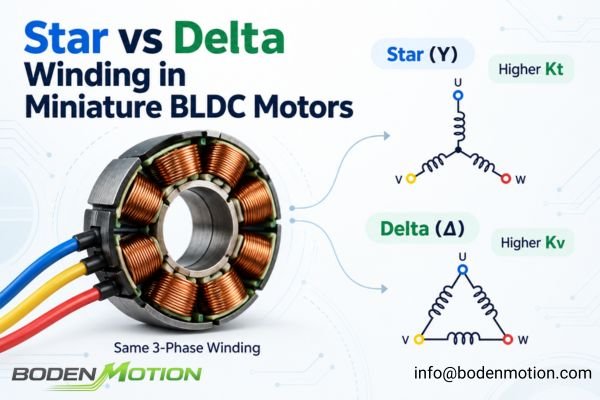
When selecting a three-phase miniature BLDC motor, engineers will encounter two primary winding configurations: Star (also known as Wye or Y) and Delta (Δ). A common rule of thumb is to associate Star with high torque and Delta with high speed. This rule can be a useful first approximation, but it becomes misleading when the […]
Encoder Resolution vs Motor Resolution in Coreless Motor Positioning Systems
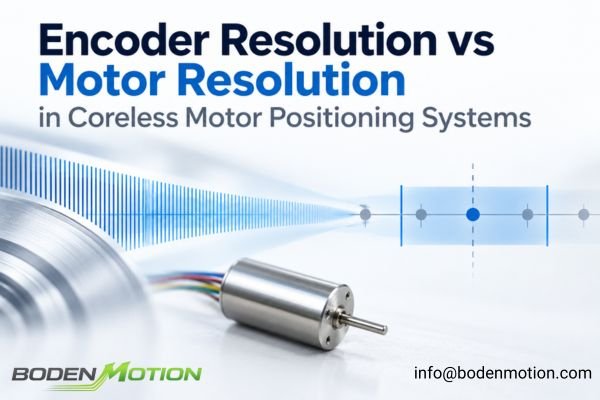
When designing a positioning system, engineers often start by selecting a motor and encoder combination. It is tempting to take the encoder’s counts per revolution (CPR), divide 360° by that number, and assume the result is the system’s achievable positioning accuracy. This calculation, however, only describes the theoretical measurement granularity of one component. Encoder counts […]
How Back EMF Sets the Speed and Torque Margin of a BLDC Motor?
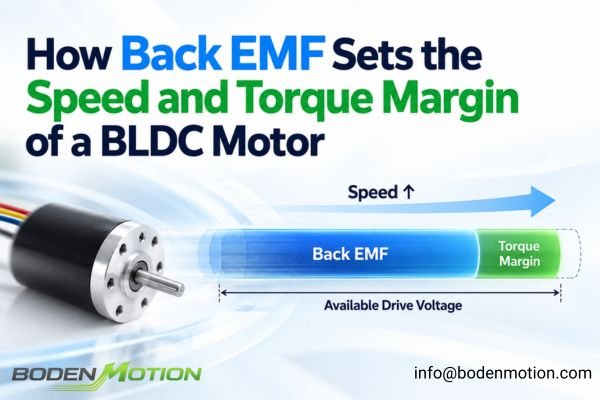
When selecting a brushless DC motor, engineers often focus on datasheet values like rated torque, peak torque, and maximum current. While critical, these parameters do not tell the whole story, especially for high-speed applications. At high rotational speeds, the motor’s performance may become limited not by its current rating, but by the voltage available from […]
Why Precision Coreless Motors Produce Smoother Motion at Low Speed?
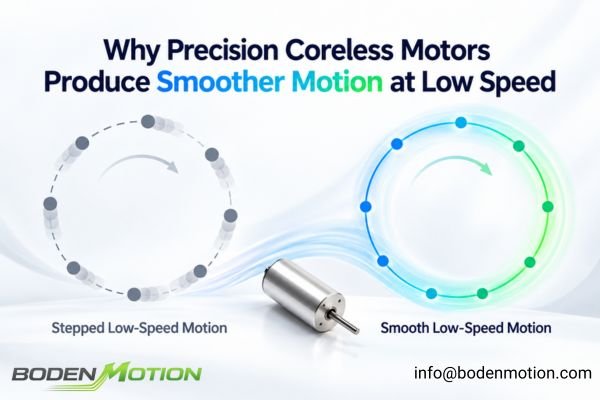
Precision coreless motors are often specified for applications requiring exceptionally smooth low-speed motion because their architecture structurally minimizes cogging torque, a primary source of low-speed disturbance in conventional motors. By removing or avoiding the conventional toothed iron structure responsible for slot-related magnetic attraction, periodic torque variation is greatly reduced. However, low cogging does not automatically […]
When Does a Mini DC Motor Customization Require Revalidation?
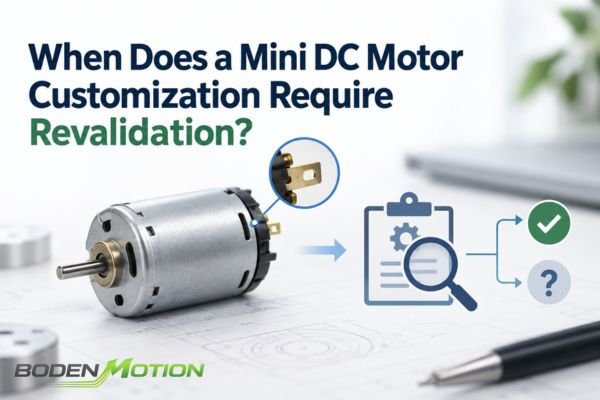
A mini DC motor customization requires revalidation when the change can affect a previously validated function, material property, interface, design assumption, or application risk. Whether the starting point is a standard DC motor or an existing OEM design, the key question is whether the original validation evidence still represents the modified configuration. Revalidation does not […]