
How Current Limiting Protects a Coreless Brushless Motor During Startup?
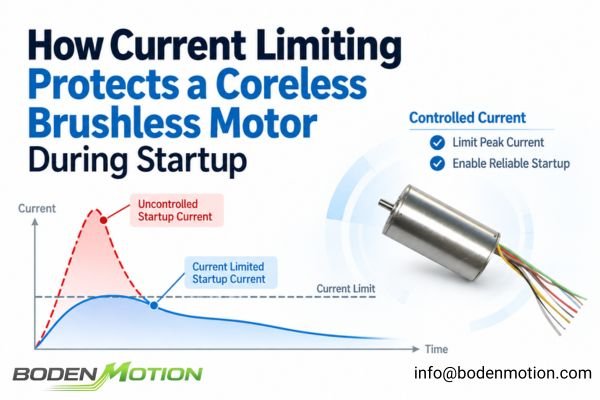
Startup protection for a coreless brushless motor is not just about setting a current ceiling; it’s a controlled energy-delivery problem. A coreless brushless motor’s startup current must be high enough to accelerate the load but low enough to avoid damaging the winding, driver, or power supply. Coreless brushless motors can respond very quickly due to […]
Small Diameter vs High Torque: The Real Trade-Off in Coreless Motors
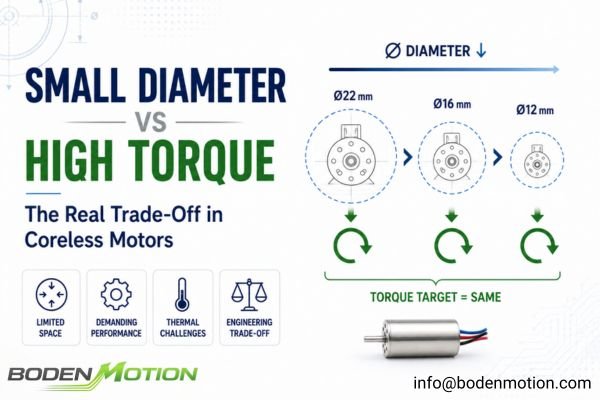
“Can you make the motor smaller but keep the same torque?” This is a frequent and understandable request in the world of compact OEM devices. A miniature coreless motor can produce high peak torque for short durations, but its continuous torque is fundamentally limited by thermal dissipation, creating a critical trade-off between size, sustained output, […]
How Winding Resistance Changes Coreless Motor Voltage, Current, and Speed?
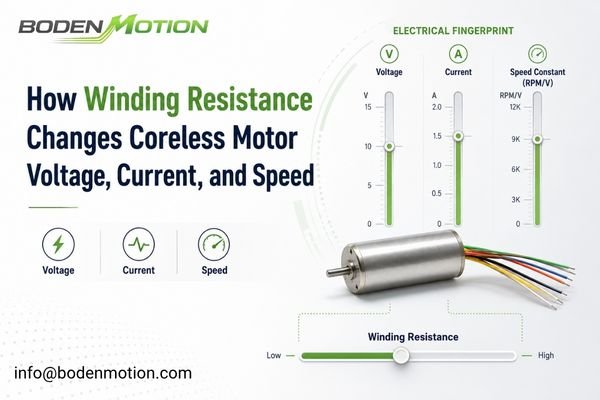
Two coreless motors with the same dimensions can behave very differently because their windings are different. This often leads to confusion and incorrect motor selection in OEM projects. Different voltage versions of the same coreless motor (e.g., 6V, 12V, 24V) have different winding resistances and motor constants, which fundamentally change their speed, current draw, and […]
Electrical vs Mechanical Time Constants in a Coreless DC Motor
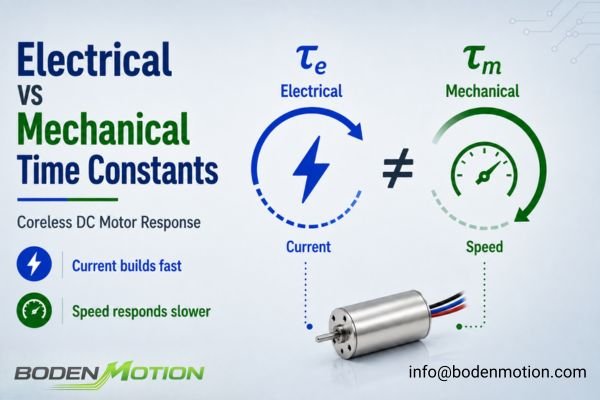
Engineers often select coreless DC motors for their “fast response,” but this term can be misleading. Current might rise quickly while the mechanical system still accelerates slowly, leading to unexpected performance issues. The reality is that a motor’s response involves at least two distinct dynamic time scales: the electrical time constant, which characterizes how quickly […]
Why Coreless Motors Are Popular in Precision Robotics?

Selecting a motor based on torque alone often leads to disappointing performance in precision robotics. The actuator might be strong, but it feels slow, overshoots its target, or struggles with rapid, repetitive tasks. This happens because precision robotics depends more on dynamic response than on raw power. Coreless motors are popular in these applications because […]
Why Continuous Torque in Hollow Cup Motors Is Usually a Thermal Limit?
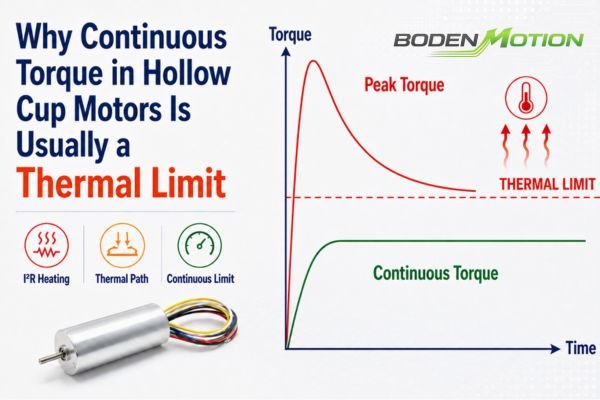
An OEM engineer selects a compact hollow cup motor with an impressive peak torque rating, but it fails to perform under continuous load. The motor gets hot, performance degrades, and the project hits a thermal roadblock. This common scenario arises from a fundamental engineering principle: peak torque is an electromagnetic question, but continuous torque is […]
Why Ironless Motors Have Low Inductance—and Why Drivers Care?
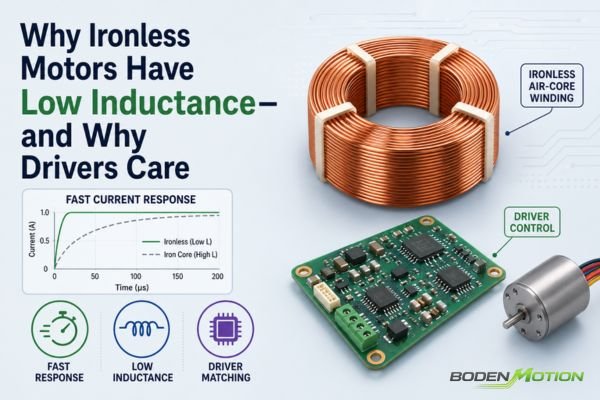
You chose an ironless DC motor for its fast response, but now your driver is overheating or the motor is noisy. The problem often isn’t a faulty component but an electrical mismatch, where the driver’s control capabilities are not well-matched to the motor’s rapid electrical dynamics. Ironless motors have low inductance because their windings lack […]
How to Select the Right Coreless Motor Size for Your Application
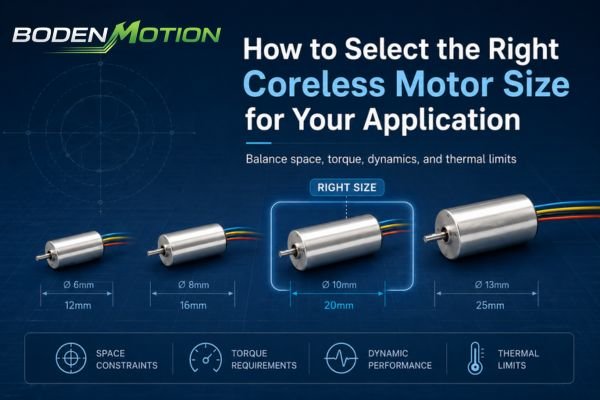
Selecting a coreless motor based on space constraints alone is a common path to system failure. The real goal isn’t finding the smallest motor; it’s finding the smallest one that can work reliably. The right coreless motor size is the smallest one that can reliably meet the application’s torque, speed, and duty cycle requirements while […]
Can a DC Coreless Motor Be Precisely Position-Controlled?
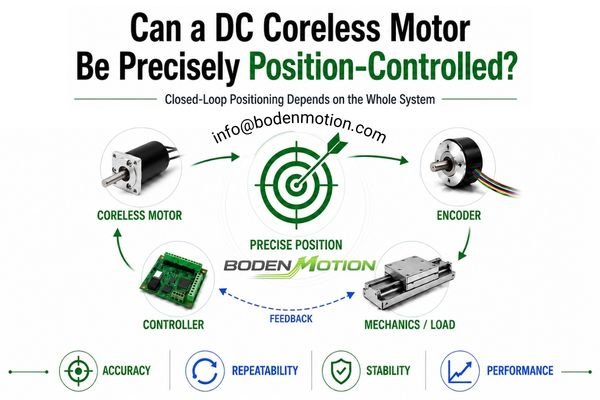
Many projects miss positioning targets because the DC motor is treated as the complete solution. The loop closes through feedback, mechanics, and control, not the rotor alone. A DC coreless motor can achieve precise position control, but accuracy, repeatability, overshoot, and settling time are determined by the complete closed-loop system and its integration quality, not […]
Why Do Coreless Motors Shake at High Speed?
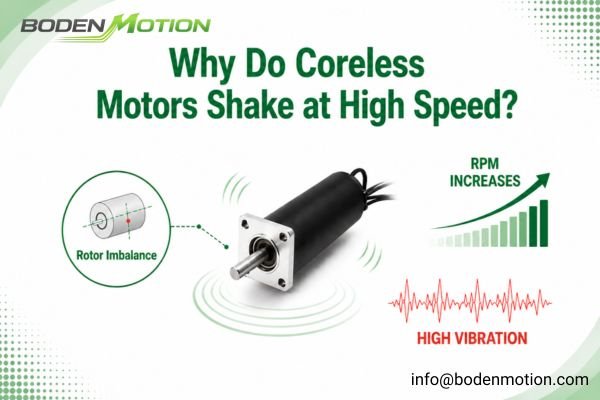
High-speed vibration is a frustrating problem. Your coreless motor system works perfectly at low RPM, but as you increase the speed, it starts to shake, generate noise, and lose stability. This high-speed vibration in coreless motors is rarely due to a single fault. It is typically a system-level issue where the motor’s low inertia makes […]
Why Coreless Motors Need Precise Balancing?
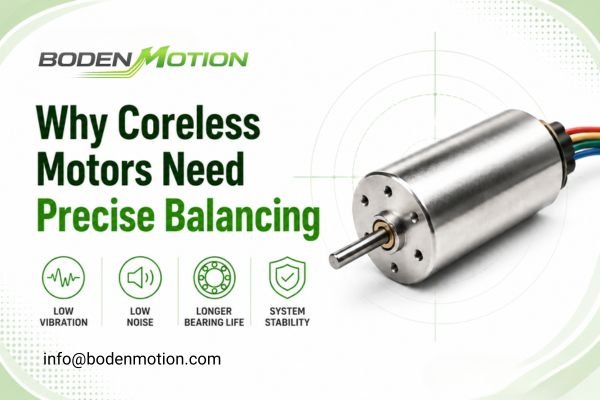
A coreless motor may feel smooth during a simple hand test, but in a high-speed device, even a small rotor imbalance can become a measurable source of vibration. Because coreless motors have extremely light rotors, minor mass imbalances can become amplified at high operating speeds, often in the 10,000–30,000 RPM range. The result may be […]
Why Do Coreless Brushed DC Motors Respond Faster?
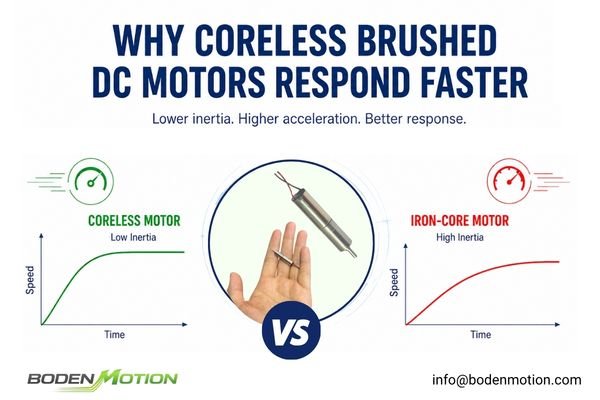
In precision motion systems, response speed can be more critical than peak power. Engineers often find that coreless DC motors respond faster than conventional motors for a simple mechanical reason. Coreless brushed DC motors respond faster because their ironless rotor has exceptionally low mass and rotational inertia, allowing for much higher angular acceleration for a […]