A coreless motor may feel smooth during a simple hand test, but in a high-speed device, even a small rotor imbalance can become a measurable source of vibration.
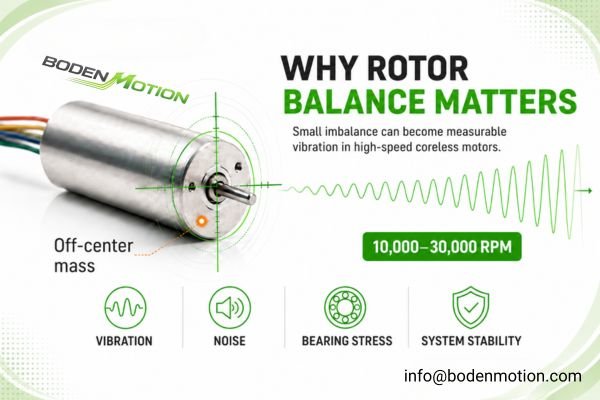
Because coreless motors have extremely light rotors, minor mass imbalances can become amplified at high operating speeds, often in the 10,000–30,000 RPM range. The result may be vibration, noise, bearing stress, and unstable system performance.
From an OEM integration perspective, rotor balancing isn't just a quality check; it's a fundamental design consideration. This article explains why precise balancing is so critical for coreless motors1 by examining their unique rotor structure, the physics of high-speed operation, and the system-level impacts on noise, bearing life, and overall reliability2.
What Makes Coreless Motor Rotors Different?
The key to a coreless motor's performance lies in its rotor, which is structurally distinct from that of a conventional iron-core motor.
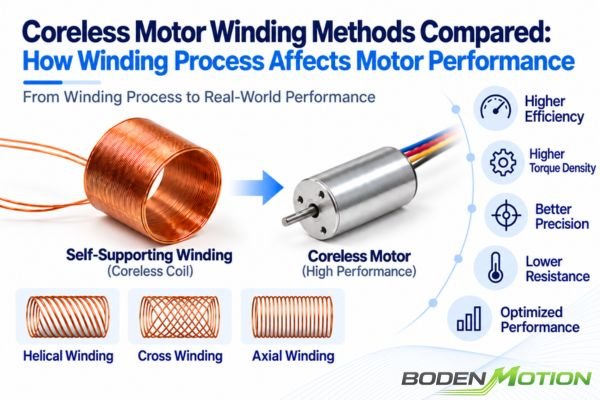
Instead of a heavy, laminated iron core, a coreless motor’s rotor is a self-supporting, cup-shaped winding of copper wire bonded with resin. This construction gives coreless motors their fast response, but it also leaves less physical margin for imbalance during high-speed rotation.
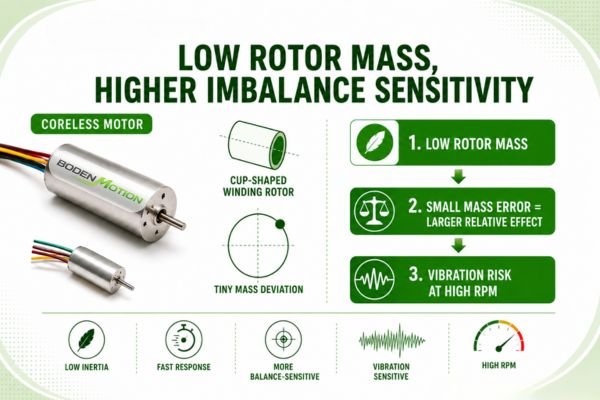
This unique structure results in several key characteristics:
- Extremely Low Rotor Mass: The rotor consists mainly of lightweight copper and resin.
- Minimal Inertia: This allows for very rapid acceleration and deceleration.
- Greatly Reduced Cogging Torque3: The absence of iron teeth interacting with the magnets results in exceptionally smooth low-speed operation.
- High Power Density: They can deliver significant performance in a compact volume.
- Sensitivity to Imbalance4: In an iron-core rotor, a small local mass deviation may represent a smaller percentage of the total rotor mass. In a coreless rotor, the same deviation can become more significant relative to the lightweight rotor structure.
This sensitivity means that every microgram of unevenly distributed adhesive or the slightest deformation in the winding can contribute to a dynamic imbalance that may become a system-level issue.
Why Low Rotor Mass Makes Balancing More Sensitive
While a coreless motor's lightweight rotor is a major advantage for responsiveness, it also makes the system more sensitive to mass distribution.
With very little total mass, even a tiny manufacturing deviation can shift the rotor's center of mass away from its geometric center of rotation. This eccentricity generates an unbalanced force that becomes more pronounced as speed increases. When the entire rotor weighs only a few grams, even 1–5 mg of misplaced adhesive or uneven winding material can represent a significant relative imbalance.

The unbalanced force is a function of the imbalanced mass, its distance from the center, and the square of the rotational speed. At speed, this can manifest as:
- High-frequency vibration felt through the device housing
- An audible whine that increases in pitch with RPM
- Increased load on the motor bearings
- A potential drop in overall system efficiency5
- Reduced long-term operational stability
System-Level Observation:
In one high-speed handheld device project, the engineering team was trying to solve a persistent "buzzing" vibration. After weeks of modifying the housing and driver settings, the issue was traced to batch variation in motor balancing. Some samples were within spec, while others were just outside the acceptable limit for that resonance-sensitive application.
How RPM Amplifies Rotor Imbalance
A coreless motor might perform well at low speeds, but that same motor can become a source of vibration when run at its target operational RPM.
The centrifugal force from a rotor imbalance grows with the square of the rotational speed. If the imbalance mass and eccentric radius remain the same, doubling the speed from 10,000 RPM to 20,000 RPM, for example, roughly quadruples the unbalanced force. This non-linear amplification is a common challenge in OEM integration.
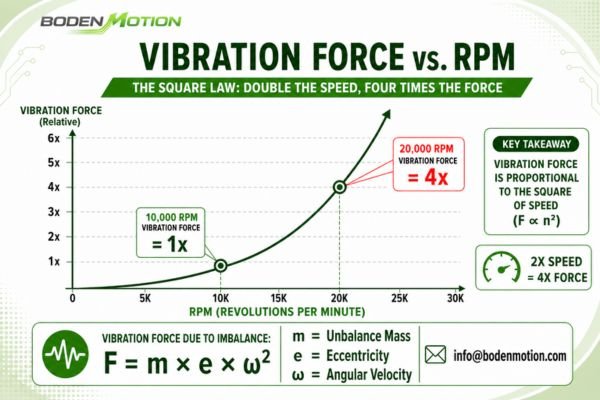
This physical principle introduces several risks in high-speed applications:
- Audible Noise: The vibration can radiate as a high-pitched whine, which may be unacceptable in medical or laboratory devices.
- Structural Resonance6: The motor's vibration frequency can match a natural frequency of the device structure, causing the entire product to resonate.
- Component Interference: In optical scanners or imaging systems, this vibration can affect image quality or sensor accuracy.
- Performance Drift: Over time, constant vibration may cause mechanical components to shift, loosen, or fatigue.
This is why evaluating a coreless motor should involve testing its vibration performance at the application's specific operating speed range, not just its no-load speed.
How Rotor Imbalance Affects Noise and Vibration
Once the imbalance force is generated inside the motor, the next question is how that force appears at the device level.
The periodic mechanical force from an unbalanced rotor vibrates the motor structure. This vibration then propagates through the bearings and motor mount into the device housing, which can act like a speaker, radiating the energy as audible noise. While noise and vibration are often closely related, it’s important to remember that other factors—such as bearing quality, mounting stiffness, and driver settings—also play a role.
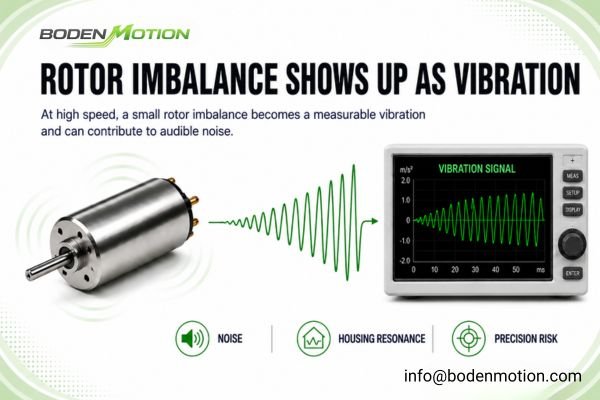
An unbalanced rotor can be one common source of these system-level issues7:
- Periodic Vibration: A consistent "buzz" that can be felt in the device.
- High-Frequency Noise: An audible whine that changes pitch with motor speed.
- Housing Resonance: The motor casing itself can vibrate, amplifying the sound.
- Vibration Transmission: The vibration can travel to the end-effector of a robot or the tip of a surgical tool, which may compromise precision.
In applications like handheld medical tools or robotics, this user-perceived vibration can be a more critical factor for product success than raw motor power.
How Rotor Balance Influences Bearing Life
A motor that seems to work fine but fails prematurely may have an underlying rotor imbalance issue. This dynamic imbalance doesn't just create noise; it can also put additional stress on the motor's bearings.
An unbalanced rotor exerts a continuous, cyclical radial force on the bearings with every rotation. While bearings are designed for specific loads, this high-frequency, unplanned force can accelerate wear and degrade the lubricant over time.
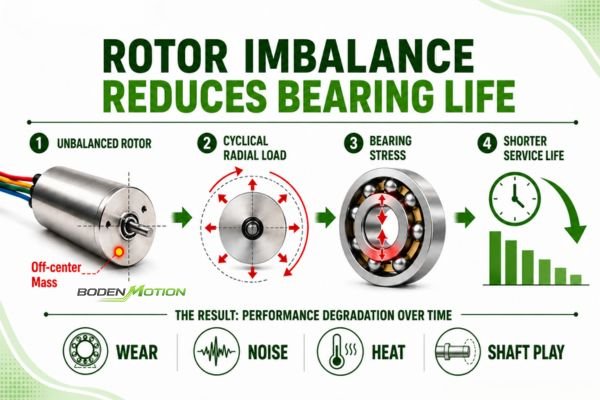
In the long term, this constant stress can contribute to a sequence of degradation:
- Accelerated Bearing Wear8: The repetitive load can fatigue the bearing raceways and balls.
- Increased Running Noise: As bearings wear, they can become a secondary source of noise.
- Higher Friction and Heat: Damaged bearings often generate more friction, increasing the motor's temperature.
- Reduced Rotational Stability: Worn bearings can introduce more shaft play, further degrading performance.
- Shorter Service Life: In severe cases, excessive imbalance can contribute to eventual bearing failure.
Design Trade-Off:
For many OEM applications requiring a long service life, investing in a higher grade of rotor balancing can be more cost-effective than simply specifying a more robust bearing. It is often better to reduce a destructive force at its source rather than trying to withstand it.
Manufacturing Factors That Influence Coreless Motor Balancing
A supplier's ability to maintain rotor balance is often visible in how they control each step of the rotor's construction. For coreless motors, balancing does not depend only on a final vibration test; it is affected by how consistently the rotor is wound, bonded, assembled, and verified throughout production.
This is especially important for lightweight cup-shaped rotors, where small variations in adhesive distribution, shaft alignment, or commutator positioning can become measurable sources of imbalance at high speed. In this sense, rotor balancing is closely connected to manufacturing process control, not just final inspection.
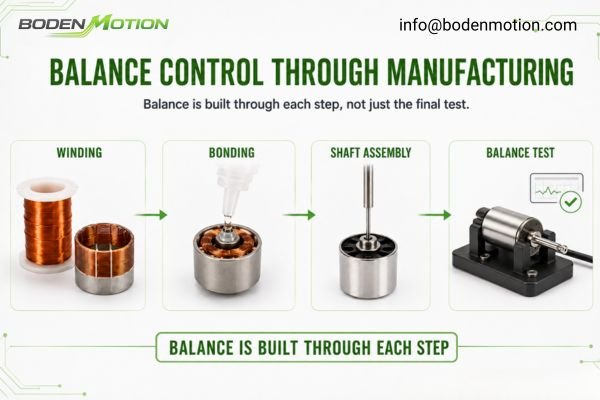
Several key manufacturing factors can influence the final balance of a coreless rotor:
- Winding Symmetry: The copper wire must be wound into a symmetrical cup shape.9
- Adhesive Distribution: The bonding epoxy must be applied and cured with uniform thickness and density.
- Commutator Concentricity: The commutator should be mounted with high concentricity to the winding cup.
- Shaft Straightness: The rotor shaft itself must meet tight straightness tolerances.
- Assembly Precision: The shaft, winding, and bearings must be assembled with high concentricity.
A supplier who can discuss their process controls for these factors is more likely to deliver motors with consistent batch-to-batch balance.
What OEM Buyers Should Ask About Rotor Balancing
Because balancing depends on both rotor design and process control, OEM buyers should not only ask for datasheet values. They should also ask how the supplier controls and verifies balance during production.
When selecting a coreless motor for an application sensitive to noise, vibration, or high-speed stability, it is wise to have a technical discussion about balancing with potential suppliers during the sample evaluation stage.
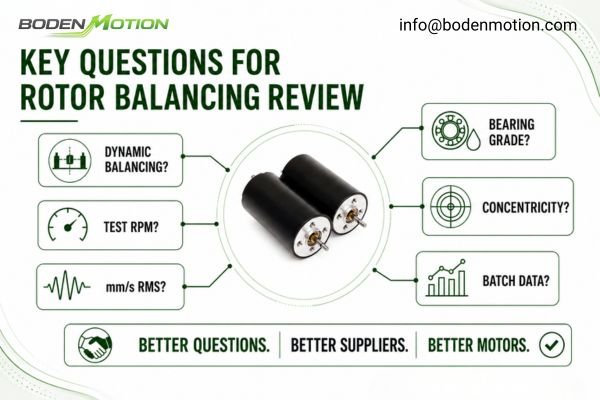
| Information to Provide Your Supplier | Key Questions to Ask Your Supplier |
|---|---|
| Your target voltage and speed range | Do you perform dynamic balancing on your rotors? |
| Your load profile (inertia, friction) | At what speed do you perform balancing and vibration tests? |
| Expected duty cycle and continuous run time | How do you measure vibration, such as mm/s RMS at a defined RPM? |
| Noise level requirements, including measurement distance such as 30 cm or 1 m | What bearing specifications (brand, grade, lubricant) do you use? |
| Acceptable vibration level for your device | What are your process controls for concentricity? |
| Mounting structure and stiffness | Can you provide batch consistency data for vibration? |
| Any connected components (gearbox, fan, etc.) | Is it possible to customize the balance grade for our application? |
This conversation helps gauge a supplier's technical maturity and process control. A transparent discussion about these topics is a good indicator of a reliable partner.10
Common Mistakes When Evaluating Coreless Motor Balance
OEM teams can sometimes fall into preventable traps when evaluating coreless motors, which can lead to integration challenges and project delays.
Evaluating a motor for a high-performance system requires a system-level approach, not just a simple bench test. It's helpful to be aware of these common oversights.
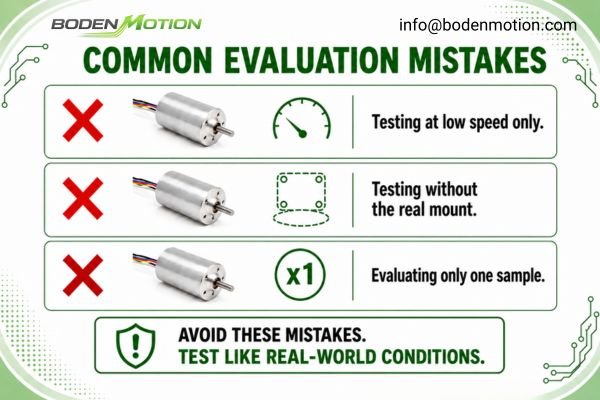
Here are a few mistakes to avoid:
- Focusing Only on No-Load Speed and Current: These parameters provide limited information about high-speed vibration, noise, or stability, as imbalance forces are often negligible at low speeds.
- Assuming Lightweight Rotors are Inherently Stable: A light rotor has low inertia, which is excellent for acceleration, but it also has less tolerance for relative mass-distribution errors. It can be more sensitive to imbalance, not inherently more stable.
- Testing the Motor in Isolation: A motor can be quiet on a test bench but cause resonance when mounted in your device. It's highly recommended to test the motor in a fixture that mimics your final product's mounting structure.
- Ignoring Long-Term Bearing Load: A motor that passes a short vibration test might still be putting enough stress on its bearings to affect long-term reliability.
- Evaluating Only One Sample: One "golden sample" does not guarantee production quality. Testing multiple samples from the same production batch—often 5–10 pieces during early evaluation—provides a better indication of consistency in vibration, noise, and other performance metrics.11
Conclusion
For high-speed OEM devices, rotor balance is one of the foundations of a stable and low-noise motion system. It's a critical factor that links manufacturing precision directly to real-world performance.
If you are evaluating coreless motors for a high-speed device, BODENMOTION can help review your speed range, load profile, mounting structure, and vibration sensitivity before sample selection to help you identify potential risks early in the design process. You can reach our engineering team at info@bodenmotion.com.
FAQ
Q1: Why do coreless motors need precise balancing?
Coreless motors typically have lightweight rotors and can operate at high speeds. This combination can amplify even minor mass imbalances, potentially causing vibration, noise, and increased bearing load, which may affect system stability and service life.
Q2: Does a lighter rotor always mean lower vibration?
Not always. While a lighter rotor reduces inertia, it can also be more sensitive to mass distribution errors. Precise rotor balancing is still a key factor for achieving smooth high-speed operation.
Q3: How does rotor imbalance affect motor lifetime?
Rotor imbalance can create a cyclical force on the motor's bearings. Over time, this stress may accelerate bearing wear, increase friction, and contribute to a reduction in the motor's operational lifespan.
Q4: Should OEM buyers test coreless motors with the real load and mounting?
Yes, especially for demanding applications where noise, vibration, service life, or precision stability matters. Testing the motor in a setup that simulates the final product's mounting and load conditions helps reveal system-level issues like resonance that may not appear in a simple bench test.
Q5: What information should I provide when asking for a coreless motor sample?
You should provide your target voltage, RPM range, load type, duty cycle, mounting direction, and any specific requirements for noise, vibration, and expected lifetime. Mentioning connected components like gearboxes or encoders is also helpful.
"Exploring Rotor Balancing in Micro Motors - Portescap", https://www.portescap.com/en/newsroom/blog/2024/05/exploring-rotor-balancing-in-micro-motors. A technical review of coreless motor design highlights that precise rotor balancing is essential due to the lightweight and high-speed nature of their rotors, which are more susceptible to vibration and imbalance effects than traditional iron-core motors. Evidence role: mechanism; source type: education. Supports: precise balancing is so critical for coreless motors. Scope note: The source may discuss general principles rather than specific OEM integration requirements. ↩
"[PDF] Rotating Machinery Rotor Balancing", https://rotorlab.tamu.edu/me459/Rotor%20Balancing/Rotating_Machinery_Rotor_Balancing.pdf. Engineering studies have shown that rotor imbalance increases vibration, which can lead to elevated noise levels, reduced bearing lifespan, and decreased reliability in electric motors. Evidence role: mechanism; source type: paper. Supports: Rotor imbalance affects system-level impacts on noise, bearing life, and overall reliability.. Scope note: The evidence may be based on general electric motor studies rather than specifically coreless motors. ↩
"Cogging torque - Wikipedia", https://en.wikipedia.org/wiki/Cogging_torque. A technical review of ironless (coreless) motors explains that the absence of iron teeth eliminates the primary source of cogging torque, resulting in smoother low-speed operation compared to iron-core designs. Evidence role: mechanism; source type: research. Supports: The absence of iron teeth interacting with the magnets results in exceptionally smooth low-speed operation.. Scope note: The source provides general mechanism explanation but may not quantify the reduction for all motor types. ↩
"Why Mini BLDC Motors Need Better Dynamic Balancing?", https://bodenmotion.com/mini-bldc-motor-dynamic-balancing/. Engineering literature on rotor dynamics notes that lightweight rotors, such as those in coreless motors, are more sensitive to mass imbalances because deviations constitute a larger proportion of total mass, increasing the risk of dynamic instability. Evidence role: mechanism; source type: education. Supports: In an iron-core rotor, a small local mass deviation may represent a smaller percentage of the total rotor mass. In a coreless rotor, the same deviation can become more significant relative to the lightweight rotor structure.. Scope note: The support is based on general rotor dynamics principles and may not address all specific motor designs. ↩
"Evaluating the influence of mechanical system vibration ...", https://www.sciencedirect.com/science/article/abs/pii/S0141635921001811. Research in mechanical engineering indicates that imbalance in rotating machinery can lead to increased friction, vibration, and energy losses, which may reduce overall system efficiency. However, the magnitude of efficiency loss depends on the severity of imbalance and system design. Evidence role: mechanism; source type: paper. Supports: A potential drop in overall system efficiency. Scope note: Efficiency loss due to imbalance is context-dependent and may not be significant in all systems. ↩
"Motor and Drive System Resonance Problems and Solutions", https://www.pumpsandsystems.com/article/motor-and-drive-system-resonance-problems-and-solutions/. Structural resonance occurs when the vibration frequency of a component, such as a motor, coincides with the natural frequency of the device structure, potentially amplifying vibrations and causing the entire product to resonate. This principle is widely recognized in mechanical engineering literature. Evidence role: mechanism; source type: encyclopedia. Supports: The motor's vibration frequency can match a natural frequency of the device structure, causing the entire product to resonate.. Scope note: The source may discuss resonance in general engineering contexts rather than specifically in coreless motors. ↩
"Rotating unbalance - Wikipedia", https://en.wikipedia.org/wiki/Rotating_unbalance. Engineering literature describes rotor imbalance as a primary cause of periodic vibration, noise, and resonance in motor-driven systems, supporting the claim that these issues can originate from an unbalanced rotor; however, specific effects may vary depending on system design and application. Evidence role: mechanism; source type: education. Supports: An unbalanced rotor can be one common source of these system-level issues: periodic vibration, high-frequency noise, housing resonance, and vibration transmission.. Scope note: The degree and manifestation of these issues depend on the specific motor and system configuration. ↩
"The Importance of Rotor Balancing in Electromagnetic Solutions", https://www.windings.com/post/the-importance-of-rotor-balancing-in-electromagnetic-solutions/. A technical review of bearing fatigue mechanisms confirms that repetitive loads, such as those caused by rotor imbalance, can induce fatigue in bearing raceways and rolling elements, leading to accelerated wear. This is generally supported in mechanical engineering literature, though specific rates of wear depend on operating conditions. Evidence role: mechanism; source type: education. Supports: The repetitive load can fatigue the bearing raceways and balls.. Scope note: The source may discuss general bearing fatigue mechanisms rather than specific rates for all motor types. ↩
"Coreless Motor Winding Machine: The Definitive Guide", https://www.honest-hls.com/coreless-motor-the-definitive-guide. Technical literature on coreless motor design indicates that symmetrical winding is essential for minimizing imbalance and vibration in rotors, as asymmetry can lead to uneven mass distribution. This is generally accepted in engineering practice, though specific manufacturing tolerances may vary by application. Evidence role: mechanism; source type: education. Supports: The copper wire must be wound into a symmetrical cup shape.. Scope note: The source may discuss general principles rather than specific manufacturing standards. ↩
"The Value of a Reliable Supplier - Dixon Valve", https://dixonvalve.com/en/news-and-events/news/value-reliable-supplier. Industry literature supports the view that transparent communication between buyers and suppliers is associated with improved reliability and quality outcomes, though this relationship may depend on additional factors such as supplier capabilities and contractual arrangements. Evidence role: expert_consensus; source type: education. Supports: A transparent discussion about these topics is a good indicator of a reliable partner.. Scope note: The correlation is generally supported but may not apply in all industries or supplier relationships. ↩
"Understanding Vibration Testing and Environmental Reliability", https://testrium.com/complete-guide-to-vibration-testing/. Manufacturing quality control guidelines recommend testing multiple samples from a production batch to assess consistency in performance metrics such as vibration and noise, with sample sizes of 5–10 commonly used in early evaluation phases. Evidence role: expert_consensus; source type: institution. Supports: Testing multiple samples from the same production batch—often 5–10 pieces during early evaluation—provides a better indication of consistency in vibration, noise, and other performance metrics.. Scope note: Sample size recommendations may vary by industry and product type. ↩