
Why High-Speed Coreless Motors Require Careful Size Selection?
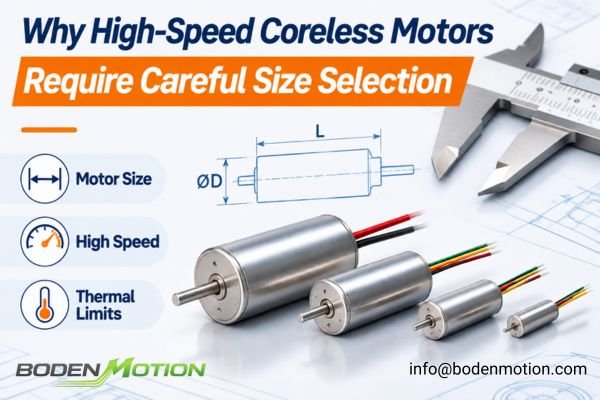
The demand for faster, more responsive motion systems is a constant driver in the design of precision automation, medical equipment, high-speed actuators, and portable electronic devices. Miniature Coreless Motors are often the preferred choice for these applications due to their low rotor inertia and high power density. However, pushing a motor into the high-speed operating […]
Why 12mm Coreless Motors Are Widely Used in Compact Robotic Systems?

When designing a compact robotic actuator, engineers often face a critical trade-off between installation space, available output, dynamic response, and integration complexity. While many motor sizes exist, the 12mm diameter coreless motor is often worth evaluating as a practical starting point. This is not because 12mm is a magic number, but because it can represent […]
Why Coreless Motor Brush Life Changes With Current Density and Duty Cycle?
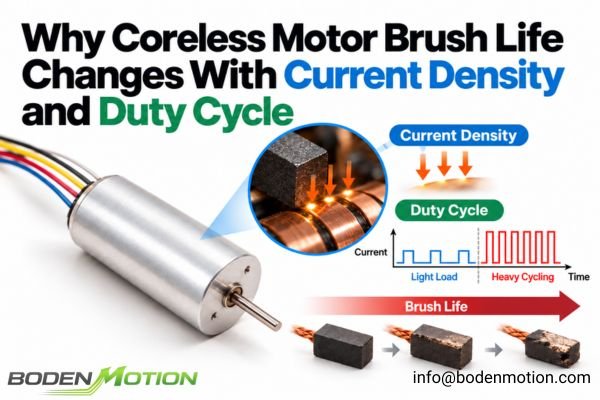
A coreless brushed motor may be rated for thousands of operating hours, but that number does not automatically predict its life in every application. Brush wear is not a simple function of time; it is an accumulation of electrical and mechanical stress at the brush-commutator interface. For OEM engineers specifying coreless motors, understanding these wear […]
How Coreless Motor Size Affects Cost, Performance and Customization?

When OEM engineers select a coreless motor, its diameter and length are often treated primarily as mechanical constraints. However, these dimensions also influence the motor’s electromagnetic design, component selection, manufacturing process, and overall cost structure. A smaller motor is therefore not automatically a cheaper one. Two motors with different physical dimensions can have very different […]
How Load Inertia Ratio Changes Miniature Coreless Motor Response?
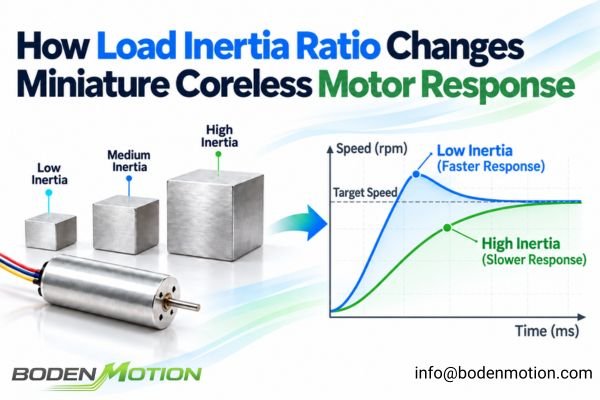
Miniature coreless motors are often selected for their low rotor inertia and rapid acceleration. However, this impressive no-load performance doesn’t always translate directly to the final application, as the system’s actual dynamic response is determined by the motor and the load working together. A coreless motor’s low rotor inertia is only half of the equation; […]
Why Precious-Metal Brush Coreless Motors Need Clean Low-Current Circuits?
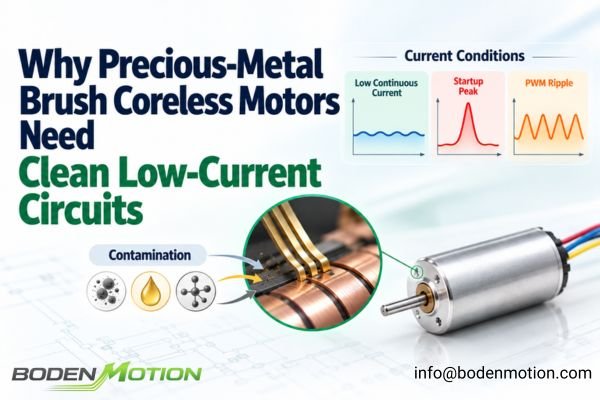
Precious-metal brush coreless DC motors are often chosen for their smooth operation and low starting voltage, but their long-term reliability depends heavily on the electrical and physical environment in which they operate. Performance can degrade if the drive circuit is not designed around the specific behavior of the brush–commutator contact. In a brushed coreless motor, […]
Encoder Resolution vs Motor Resolution in Coreless Motor Positioning Systems
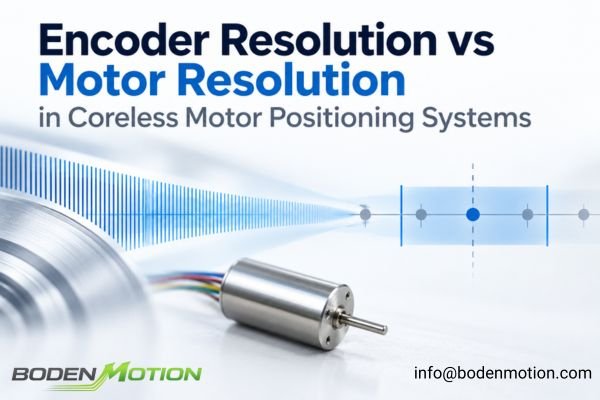
When designing a positioning system, engineers often start by selecting a motor and encoder combination. It is tempting to take the encoder’s counts per revolution (CPR), divide 360° by that number, and assume the result is the system’s achievable positioning accuracy. This calculation, however, only describes the theoretical measurement granularity of one component. Encoder counts […]
Why 10–20 mm Coreless Motors Are Used in Portable Medical Devices?
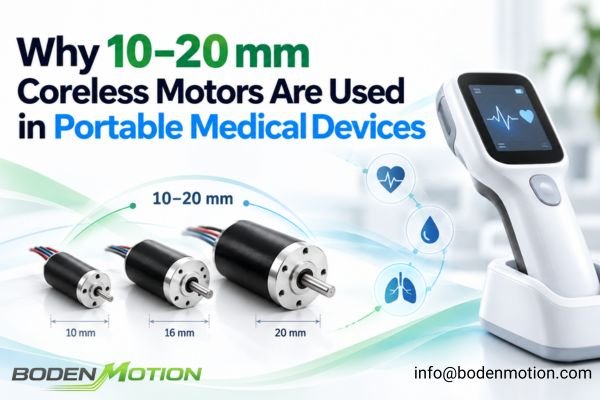
Designing motion systems for portable medical equipment requires engineers to balance limited installation space, low device weight, responsive motion, acoustic noise, vibration, thermal behavior, and battery constraints. This is why compact coreless motors, particularly those in the 10–20 mm diameter range, are frequently evaluated for handheld instruments, miniature pumps, diagnostic equipment, and other portable medical […]
Why Precision Coreless Motors Produce Smoother Motion at Low Speed?
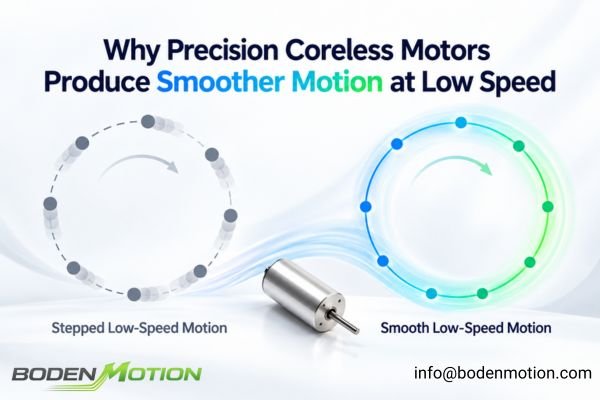
Precision coreless motors are often specified for applications requiring exceptionally smooth low-speed motion because their architecture structurally minimizes cogging torque, a primary source of low-speed disturbance in conventional motors. By removing or avoiding the conventional toothed iron structure responsible for slot-related magnetic attraction, periodic torque variation is greatly reduced. However, low cogging does not automatically […]
How Axial and Radial Loads Affect Micro Coreless Motor Bearings?
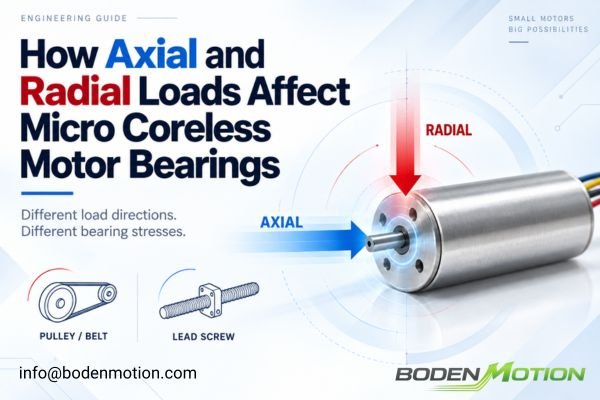
In mechanically demanding applications, a micro coreless motor can fail prematurely even when operating well within its electrical limits. In these cases, the bearing system, not the winding, can become the critical failure point. External forces from pulleys, gears, and lead screws are transmitted through the motor shaft into the bearing system. If not properly […]
Coreless Motor Winding Methods Compared: How Winding Process Affects Motor Performance?
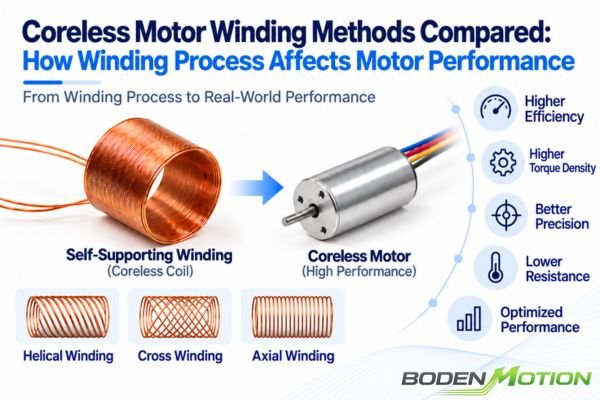
A coreless motor winding is more than an electrical conductor arrangement; it is a key electromechanical structure whose geometry and manufacturing process influence resistance, torque production, thermal behavior, mechanical stability, and production consistency. The coreless motor winding process directly influences electromagnetic performance, copper utilization, thermal behavior, dimensional stability, and manufacturing consistency. In brushed coreless motors, […]
6mm vs 12mm vs 16mm Coreless Motors: How Engineers Choose the Right Size?
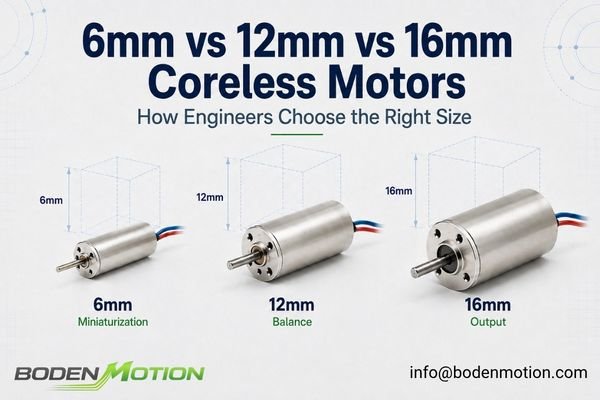
“Should I use a 6mm, 12mm, or 16mm coreless motor?” This is a common starting point for many OEM projects. But selecting a motor based on diameter alone often leads to integration problems. The final choice between a 6mm, 12mm, or 16mm coreless motor depends on the required torque, speed, load inertia, and thermal limits […]