When OEM engineers select a coreless motor, its diameter and length are often treated primarily as mechanical constraints. However, these dimensions also influence the motor's electromagnetic design, component selection, manufacturing process, and overall cost structure. A smaller motor is therefore not automatically a cheaper one.
Two motors with different physical dimensions can have very different manufacturing economics, even when their performance requirements appear similar. The critical question for an OEM project is not simply "What is the smallest or cheapest motor?" but "Which motor size provides the required performance while remaining practical to manufacture, customize, and produce consistently at the target volume?"

For OEM projects, understanding the relationship between motor dimensions and manufacturing cost is essential for both engineering and procurement decisions. A configuration that appears ideal in a CAD model may become commercially impractical once tooling, customization, production yield, and expected order volume are considered. The objective is to find a workable balance between performance, installation space, development investment, and long-term production cost.
What Actually Determines Coreless Motor Manufacturing Cost?
Understanding how motor size affects price starts with identifying the main sources of manufacturing cost. Material consumption is important, but it represents only one part of the total cost of producing a finished motor.
A coreless motor's manufacturing cost depends on its materials, production processes, inspection requirements, manufacturing yield, and applicable tooling or engineering investment. These costs do not necessarily increase or decrease in proportion to the motor's dimensions.

The main cost components include:
- Materials: Copper winding wire, permanent magnets, shafts, bearings, housings, and components associated with the motor's commutation system.
- Manufacturing Processes: Machine time, winding preparation, coil forming, bonding, precision assembly, and other production operations.
- Quality and Yield: Inspection, functional testing, process monitoring, rejected components, and rework.
- Tooling and Engineering: Winding fixtures, assembly tools, component molds, development activities, and design validation.
The manufacturing structure also depends on the motor technology. Brushed coreless DC motors generally use a self-supporting ironless rotor winding with mechanical commutation, while brushless designs use stationary windings and electronic commutation. The difference between mechanical and electronic commutation affects component selection, assembly methods, and the electrical requirements of the complete drive system.
For otherwise comparable designs, larger dimensions may require more copper, magnetic material, and housing material. However, reducing dimensions can increase the difficulty of winding, assembly, and inspection. As a result, manufacturing cost should be evaluated from the complete production process rather than estimated from material weight alone.
Why Smaller Coreless Motors Are Not Always Cheaper
A common assumption is that reducing motor size should reduce its price because smaller components require less material. This can be true within certain established product families, but it does not account for the manufacturing difficulties introduced by miniaturization.
Reducing motor dimensions can lower material consumption while increasing the precision, equipment capability, and process control required to manufacture acceptable units. At very small sizes, these manufacturing requirements may offset or exceed the savings in materials.
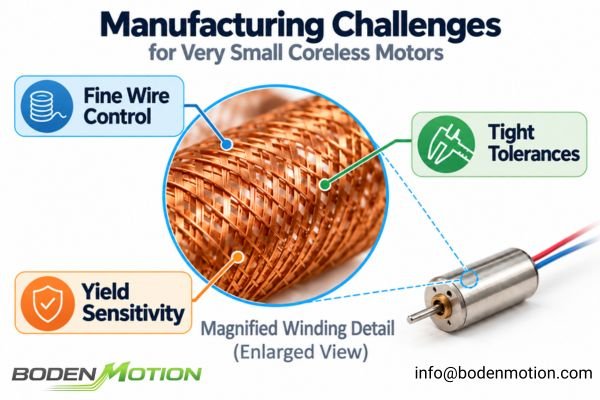
Several factors can influence the cost of highly miniaturized motors:
- Winding Complexity: Small coil geometries may require finer wire, specialized forming methods, and tighter control over wire tension, positioning, and insulation integrity.
- Precision Assembly: Bearing installation, shaft alignment, rotor clearance, and component positioning become increasingly sensitive to dimensional variation.
- Production Yield: A small deviation in winding geometry or assembly alignment may affect friction, no-load current, vibration, or other acceptance criteria.
- Inspection Requirements: Small components and narrow tolerances may require more sensitive measurement systems and carefully controlled inspection procedures.
These challenges depend on the specific motor construction. For example, self-supporting coreless windings eliminate the conventional iron rotor core1 but introduce their own manufacturing requirements. Developing different winding geometries, particularly for compact motors, can place high demands on winding processing technology and the equipment used to maintain consistent coil formation.
This illustrates why manufacturing difficulty cannot be predicted from diameter alone. The winding topology and production method are equally important.
An established miniature motor platform may already have specialized equipment, validated processes, and stable production yields. Under those conditions, a very small standard motor can still be produced economically.
The cost problem becomes more significant when an OEM application requires dimensions or performance characteristics outside the manufacturer's existing production capabilities.
How Motor Diameter and Length Affect Performance and Manufacturing Cost
Motor diameter and length are closely related to electromagnetic performance, but they influence design and manufacturing in different ways. Treating them as separate variables helps engineers identify where dimensional changes may create additional development or production costs.
Diameter influences the available electromagnetic radius and radial component arrangement, while length affects the space available for active components and supporting structures. Neither dimension determines performance or manufacturing cost independently of the motor's internal design.
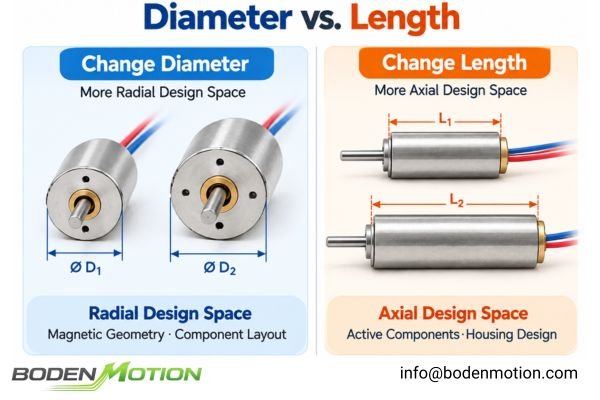
The Role of Motor Diameter
Motor diameter affects several important design parameters:
- Effective electromagnetic radius for torque generation.
- Available space for winding and magnetic components.
- Bearing and shaft dimensions.
- Mechanical clearances and housing geometry.
- Available surfaces and internal paths for heat transfer.
Increasing diameter can provide more freedom for electromagnetic and mechanical design, potentially supporting higher torque capacity. However, the actual improvement depends on magnetic flux density, winding configuration, current capability, and thermal limitations.
Motor constants are influenced by active length and diameter, winding geometry, and magnetic flux density2, which explains why motors with similar external dimensions may still have substantially different torque and electrical characteristics.
From a manufacturing perspective, changing diameter may require different winding fixtures, component tooling, assembly fixtures, or inspection methods.
However, a different diameter does not automatically require a completely new production line. Manufacturers may use adjustable equipment, modular fixtures, or multiple established product platforms.
The actual cost depends on whether the requested diameter falls within an existing manufacturing capability.
The Role of Motor Length
Increasing motor length can provide additional axial space for windings, magnets, bearings, or other structural components.
In suitable electromagnetic designs, greater active length may support increased torque or output capability3. However, the benefit depends on how the additional space is used.
For example, BODENMOTION lists Ø12 mm coreless motors with different overall lengths, including the BDCM1219 (Ø12 × 19 mm) and BDCM1235 (Ø12 × 35 mm).
These examples illustrate dimensional variety within a nominal diameter category, but they should not be interpreted as evidence of identical internal construction, common tooling, or a proportional relationship between length and torque.
From a manufacturing standpoint, modifying the length of an existing motor design may be less disruptive than introducing a completely new diameter. Nevertheless, substantial length changes can still require redesigned windings, magnets, housings, or assembly tooling.
For OEM engineers, the practical question is whether the desired dimensions can be achieved through an existing validated design or require a new electromagnetic and mechanical configuration.
How Motor Size Creates Cost–Performance Trade-Offs
Multiple motor sizes may satisfy an application's basic speed and torque requirements, but they can produce different results when evaluated as part of the complete drive system.
The lowest motor purchase price does not necessarily produce the lowest total system cost. Engineers must evaluate electrical efficiency, thermal capability, mechanical integration, and required control performance at the actual operating point rather than comparing motor dimensions or nominal ratings alone.
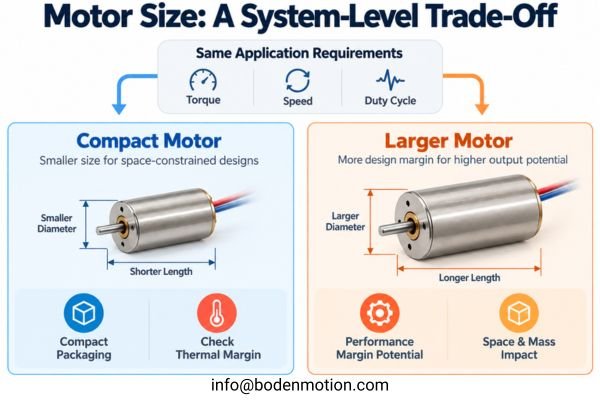
Consider two motor options for a compact robotic actuator.
Option A: Smaller Motor Operating Near Its Limits
A smaller motor may reduce overall dimensions and moving mass, making it attractive for space-constrained mechanisms.
However, if the required continuous torque approaches the motor's thermal capability, winding temperature and operating losses become important concerns. Depending on the winding characteristics and motion profile, the design may also require changes to current limits, gearing, duty cycle, or thermal management.
Option B: Larger Motor With Greater Performance Margin
A larger motor may provide additional electromagnetic and thermal design capacity. If properly selected, it may operate with greater thermal margin at the required load.
However, the additional mass and dimensions can affect mounting, inertia, packaging, and total system cost. A larger motor is not necessarily more efficient or easier to drive at every operating point.
Comparing the required torque, speed, and load inertia helps engineers identify a suitable motor size without unnecessarily oversizing or undersizing the drive system4.
Motor thermal behavior requires separate evaluation. Winding losses, installation conditions, and the motor's thermal resistance and thermal capacitance influence temperature rise during continuous and intermittent operation.
Therefore, it is not technically correct to assume that a smaller motor always needs a higher-current driver or that a larger motor necessarily runs cooler.
The appropriate comparison should consider:
- Required continuous and peak torque.
- Operating speed and acceleration profile.
- Motor torque constant and winding resistance.
- RMS and peak current requirements.
- Thermal resistance and installation conditions.
- Gearbox, driver, and power supply requirements.
- Total mechanical envelope and system cost.
The preferred configuration is the one that meets these requirements with adequate engineering margin and reasonable manufacturing economics.
How Customization Requirements Affect Motor Cost
Many OEM applications require modifications to a standard motor, such as a different winding, shaft, bearing, connector, or mechanical interface. These changes can improve integration, but they may also introduce engineering and manufacturing costs.
The cost of customization depends strongly on how far the requested design deviates from an existing, validated motor platform. It is useful to distinguish one-time development investment from the recurring cost of manufacturing each customized unit.
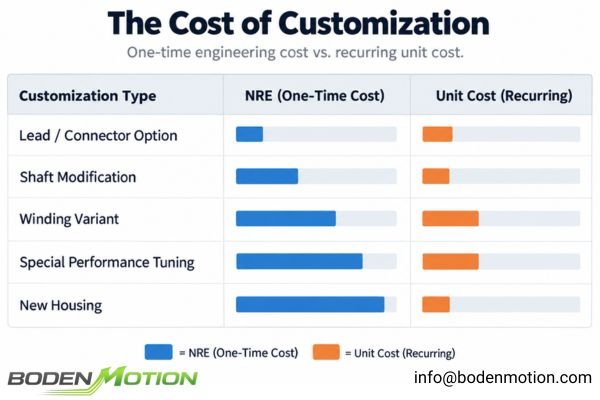
Two cost categories are particularly important.
Non-Recurring Engineering (NRE) Costs
These are development-related costs that do not normally recur for every manufactured unit, including:
- Electromagnetic or mechanical design work.
- Prototype development and engineering samples.
- New winding fixtures or assembly tooling.
- Component and process qualification.
- Performance validation and testing.
Recurring Manufacturing Costs
These are the costs associated with producing each unit or batch, including:
- Materials and purchased components.
- Machining, winding, and assembly.
- Inspection and functional testing.
- Recurring production setup and quality-control activities.
The relative impact varies by customization type.
| Customization Type | Potential NRE Impact | Potential Recurring Cost Impact |
|---|---|---|
| Winding Variant | Winding design, fixtures, and validation if existing options are insufficient | Wire specifications, winding cycle time, and yield |
| Shaft Modification | Drawings, machining setup, fixtures, and dimensional validation | Machining and inspection |
| Special Bearing | Supplier qualification and application testing | Component sourcing and assembly |
| Custom Connector | Interface validation or new assembly fixtures | Connector materials and installation labor |
| New Housing | Mechanical development and possible tooling | Housing manufacturing and inspection |
| Gearbox / Encoder | Integration engineering and functional validation | Additional components, assembly, and testing |
A winding adjustment within an established manufacturing capability may require relatively limited development. However, a new winding geometry or a demanding performance target may require new fixtures, trial winding batches to assess production yield, and additional validation before the design can enter stable production.
Similarly, a shaft modification may appear mechanically simple but become more expensive if it requires new tooling, tight tolerances, or specialized inspection.
For OEM procurement, the important distinction is whether customization changes only a component specification or requires substantial redesign and requalification of the manufacturing process.
A supplier quotation should therefore clarify how much of the proposed solution uses an existing platform, which elements need new development, and whether NRE is quoted separately or incorporated into the unit price.
Why Manufacturing Maturity and Production Yield Matter
Two motors with similar dimensions, materials, and nominal performance can have different manufacturing costs because their production processes are not equally mature.
A validated manufacturing process with consistent quality and stable yield can reduce scrap, rework, inspection uncertainty, and production disruption. However, the economic advantage depends on production volume, equipment utilization, component sourcing, and the costs associated with maintaining that process.
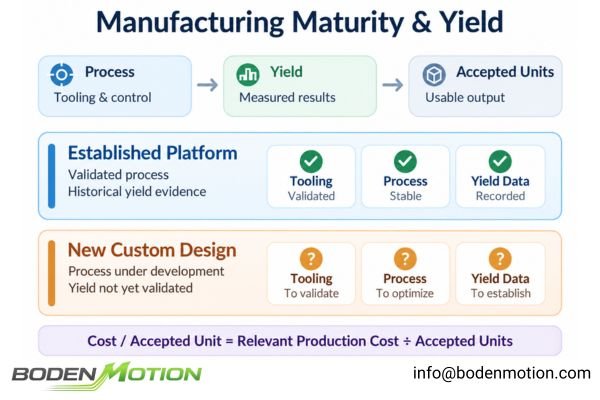
An established production platform may benefit from:
- Available and validated production tooling.
- Stable winding and assembly processes.
- Qualified component suppliers.
- Established inspection methods.
- Known motor performance characteristics.
- Historical process and quality information.
A new custom design may require additional development before these conditions can be achieved.
Production yield is especially important because the cost of rejected components and completed motors must ultimately be accounted for in the manufacturing process.
A low-yield process consumes resources without producing the expected number of accepted units. Repeated defects also create additional inspection, handling, and production requirements. This is why reducing process variation and minimizing rework and scrap are important objectives in manufacturing process control.
A simplified way to understand the effect of yield is:
Effective manufacturing cost per accepted unit = Total relevant production cost / Number of accepted units
This relationship is useful as a basic cost-accounting concept, although a real manufacturing cost model must also consider rework recovery, fixed overhead, inspection, and the stage at which defects occur.
For example, a winding defect detected before final assembly may have a different cost impact from a completed motor that fails final testing.
The value of a mature platform is therefore not limited to producing fewer rejected units. It also includes more predictable manufacturing processes, reduced development uncertainty, and better control over repeat production.
For an OEM project, these factors may justify selecting an existing motor configuration even when a newly developed alternative appears attractive on paper.
How Order Quantity Changes Custom Coreless Motor Pricing
Order quantity is a major factor in OEM motor procurement. Producing a small number of development samples has a different cost structure from manufacturing the same design in stable production batches.
Higher production volumes can spread setup, tooling, and engineering investments across more units, but the resulting price reduction is not linear. The commercial benefit depends on the motor's material costs, manufacturing complexity, process efficiency, and the way development expenses are allocated.

The cost structure changes across different production stages.
| Production Stage | Main Cost Considerations | OEM Evaluation Priority |
|---|---|---|
| Prototype | Engineering effort, sample preparation, manual setup, and testing | Validate feasibility and performance |
| Pilot Production | Process validation, repeatability, inspection, and yield stabilization | Confirm production readiness |
| Volume Production | Material purchasing, production efficiency, yield, and batch planning | Control recurring unit cost |
When dedicated tooling is required, its upfront cost can be distributed across the expected production quantity.5
For example, the initial investment in an injection mold for a motor housing can be significant. However, the tooling cost allocated to each molded component decreases as production quantity increases.
This principle applies to relevant manufactured components rather than providing a complete pricing model for a coreless motor, which also includes winding, assembly, testing, and other production costs.
The relationship between NRE and unit price also depends on commercial arrangements. A supplier may charge development costs separately, distribute them across a committed production volume, or incorporate part of the investment into the quoted unit price.
For this reason, OEM buyers should distinguish between:
- Sample Quantity: Units required for initial engineering evaluation.
- Production Batch Size: Units manufactured in an individual production run.
- Annual Volume: Expected total demand across the year.
- Project Lifetime Volume: Estimated demand over the complete product lifecycle.
A project involving several small orders may not achieve the same production economics as one involving larger, regularly scheduled batches, even when annual quantities are similar.
Similarly, high annual demand does not guarantee a large price reduction if the design depends on expensive components, intensive manual assembly, or specialized testing.
The most useful quotation comparison separates development investment from recurring manufacturing costs and evaluates both against realistic production forecasts.
How OEM Buyers Should Balance Motor Size, Customization and Quotation Requirements
Selecting a commercially practical coreless motor requires more than matching voltage, speed, and external dimensions. OEM engineers and procurement teams must determine whether the proposed configuration can meet performance requirements while remaining suitable for repeatable manufacturing.
A well-defined technical and commercial specification allows the motor manufacturer to evaluate whether an existing design, a modification to a validated platform, or a newly developed configuration offers the most appropriate balance of performance, cost, and development risk.
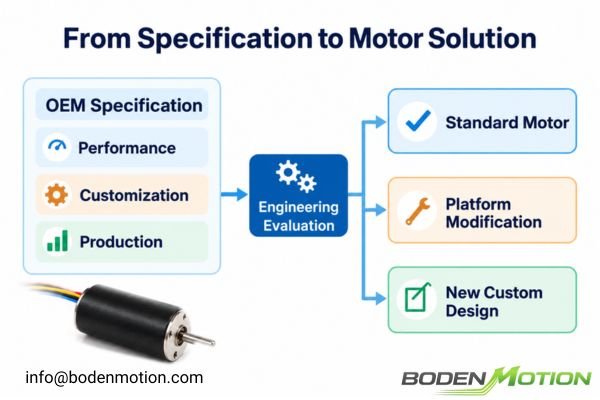
Before requesting a quotation, OEM customers should define three groups of requirements.
1. Performance and Operating Conditions
- Maximum motor diameter and installation length.
- Rated voltage and available power supply.
- Required speed and continuous torque.
- Peak torque, acceleration, and starting conditions.
- Duty cycle and expected operating hours.
- Ambient temperature and thermal constraints.
- Expected service life and reliability requirements.
2. Customization and Mechanical Integration
- Whether an existing motor configuration is acceptable.
- Shaft dimensions and mechanical interfaces.
- Required winding characteristics.
- Bearing and mounting requirements.
- Wiring, connector, or terminal specifications.
- Gearbox, encoder, or other integration requirements.
3. Commercial and Production Requirements
- Initial sample quantity.
- Estimated annual demand.
- Expected production batch size.
- Project development schedule.
- Target production timeline.
- Applicable tooling or development cost constraints.
The appropriate evaluation direction depends on the project.
| OEM Requirement | Recommended Evaluation Direction |
|---|---|
| Existing motor meets performance and size limits | Prioritize a validated standard configuration |
| Only electrical characteristics need adjustment | Evaluate winding options within an established platform |
| Installation space must be reduced | Review electromagnetic, thermal, and manufacturing trade-offs |
| Higher continuous torque is required | Compare suitable motor dimensions and alternative configurations |
| Special mechanical interfaces are necessary | Identify component modifications and potential tooling requirements |
| Strict unit-price target applies | Review customization scope, production volume, and total system requirements |
For example, when installation space is the primary constraint, reducing diameter may appear to be the obvious solution. However, adjusting motor length, winding characteristics, or the surrounding mechanical design could offer another approach.
Likewise, when the primary concern is unit cost, modifying a validated platform may be more economical than developing a new motor geometry.6
These alternatives should be evaluated using actual performance requirements and supplier manufacturing capabilities rather than general assumptions about motor dimensions.
Sharing drawings, target specifications, operating conditions, and realistic production forecasts at an early stage helps the manufacturer identify technically feasible configurations and provide a more meaningful quotation.
Conclusion
Coreless motor size affects far more than installation space. Diameter and length influence electromagnetic design, component selection, manufacturing complexity, thermal capability, and production cost. Smaller motors may reduce material consumption but require more demanding manufacturing processes, while larger designs may provide additional performance potential at the expense of space, mass, and materials. The relationship is not linear, and the final cost depends heavily on the motor's construction and the maturity of the manufacturing platform.
For OEM engineers and procurement teams, the most practical choice is the motor configuration that meets the application's performance and integration requirements while remaining economical to develop and manufacture at the expected volume. Before committing to a completely new design, it is worth evaluating whether existing coreless motor configurations can be adapted to the project. BODENMOTION supports OEM motor selection and customization based on dimensional, electrical, mechanical, and production requirements. To discuss a specific application, contact our engineering team at info@bodenmotion.com.
FAQ
Q1: Are smaller coreless motors always cheaper to manufacture?
No. Although smaller motors generally use less material, they may require more demanding winding, assembly, and inspection processes. Manufacturing maturity and production yield also influence the final cost.
Q2: How do NRE costs differ from unit manufacturing costs?
Non-Recurring Engineering (NRE) costs cover development-related activities such as design, tooling, prototyping, and validation. Recurring manufacturing costs cover materials, assembly, testing, and other expenses associated with ongoing production. Suppliers may quote NRE separately or distribute them across expected production quantities.
Q3: Can two coreless motors with the same dimensions have different manufacturing costs?
Yes. Motors with identical external dimensions may use different windings, magnetic materials, bearings, commutation systems, or manufacturing processes. These differences can affect component cost, production complexity, testing requirements, and yield.
Q4: Does changing a coreless motor's diameter require new tooling?
Not necessarily. A diameter change may require different winding fixtures, assembly tooling, or mechanical components. However, some manufacturers have existing platforms or adjustable production equipment that accommodate multiple diameters. The required investment depends on the available manufacturing capabilities.
Q5: Is modifying an existing motor platform more economical than developing a new one?
Often, yes. An existing platform may already have validated components, production tooling, and established manufacturing processes. However, extensive modifications can still require significant development and qualification, so the economic advantage should be evaluated case by case.
Q6: What information should an OEM provide for a custom motor quotation?
Provide the required dimensions, voltage, operating speed, continuous and peak torque, duty cycle, expected lifetime, and application conditions. Include any shaft, winding, bearing, connector, gearbox, or encoder requirements, along with sample quantity, expected annual volume, and project timeline.
References
Wikipedia's "Electric motor," in the section "Ironless or coreless rotor motor," explains that coreless DC motors use rotors without an iron core and may employ self-supporting windings made from wire and bonding material. ↩
Kim, Han, and Lee's "Practical and Rapid Motor Sizing Technique Using Existing Electrical Motor," published in *Actuators* (2023), derives the back-EMF constant using winding turns, air-gap diameter, active stack length, and magnetic flux density, and discusses its relationship with the torque constant in permanent-magnet synchronous motors. These relationships are design-dependent and are not a direct sizing equation for every coreless motor. ↩
Machine Design's "Increasing Step Motor Torque Without Increasing Frame Size" describes how increasing the active axial stack length can improve holding torque in a stepper motor without changing its frame size. This illustrates a motor-design trade-off but does not directly establish continuous torque or output gains for coreless DC motors. ↩
The U.S. Department of Energy's "Premium Efficiency Motor Selection and Application Guide" discusses motor sizing based on torque requirements, operating speed, and load inertia, and explains the operational and economic consequences of oversized and undersized motors in industrial applications. ↩
Formlabs' "How to Estimate Injection Molding Cost?" explains that injection molds represent a significant upfront tooling investment and shows how distributing this fixed cost across larger production quantities reduces the tooling cost allocated to each manufactured part. ↩
Power Electric's "Custom Motors vs. Standard Motors" distinguishes minor motor modifications from complete redesigns and explains that ground-up motor development can involve substantial non-recurring engineering, production tooling, and qualification costs. These considerations support evaluating modifications to an established motor design before committing to a completely new design. ↩