Motion systems designed for medical applications have vastly different priorities than industrial equipment. In a handheld surgical tool or a portable analyzer, motion smoothness, low vibration, and thermal stability often matter far more than raw power.
Coreless DC motors are frequently used in these applications because their ironless rotor design provides very low inertia and smooth motion, making them a strong candidate for compact and high-performance medical systems.
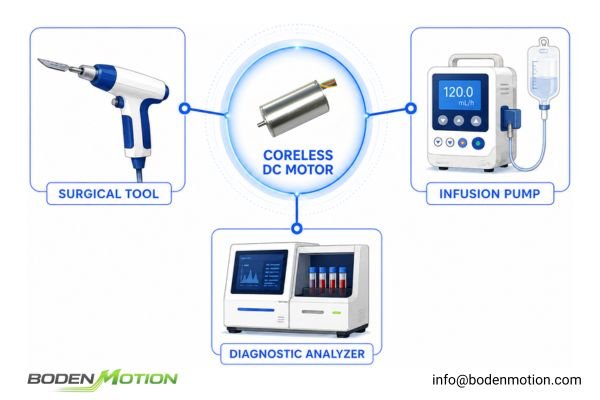
From my experience integrating motion systems, the choice of motor technology has a profound impact on device performance, patient safety, and clinical usability.1 A standard iron-core motor might meet the torque and speed specs on paper, but its inherent vibration and non-linear response at low speeds can compromise the function of a sensitive diagnostic instrument or surgical tool. This is where understanding the fundamental trade-offs of motor selection becomes critical.
Why Are Coreless Motors Widely Used in Precision Medical Devices?
In a high-stakes application like robotic surgery, "good enough" motion is unacceptable. The surgeon or the control system needs highly linear, predictable control, and that starts with the motor's fundamental design.
Coreless motors are chosen for these systems because their ironless, self-supporting rotor has very low inertia and an inherent lack of cogging torque, resulting in fast acceleration and exceptionally smooth, controllable motion.
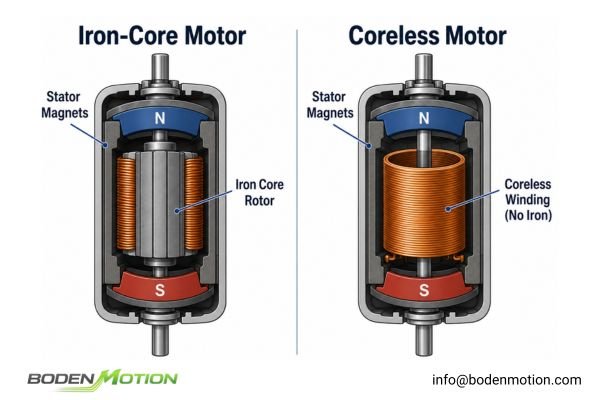
The key difference is the rotor. A traditional motor has windings on a heavy iron core. In a coreless motor, the windings form a self-supporting cylinder. This design has direct consequences for many medical applications:
- Low Rotor Inertia: With no heavy iron core, the motor can change direction with exceptional speed. This is critical for providing haptic feedback in a surgical robot or for rapid sample positioning in a diagnostic analyzer.
- No Cogging Torque2: Because there are no iron laminations for the magnets to attract, cogging is virtually eliminated. This allows for excellent rotational stability, even at speeds below 100 RPM, which can be a major challenge for standard motors.
- Reduced Vibration and Noise: The lack of cogging and a rotor that is typically balanced to a high standard (e.g., residual imbalance ≤0.5 G-mm in performance-critical designs) leads to lower vibration and acoustic noise.
System-Level Observation:
In several OEM development projects, motors that met performance targets during initial testing later revealed vibration and startup consistency issues after integration into the final device. This often leads engineers to re-evaluate motor technology when smooth motion, rapid response, and low vibration become critical system requirements.
How Do Low Vibration and Smooth Motion Improve Medical Device Performance?
A shaky image in a portable ultrasound system or a pulsating flow from an infusion pump is more than a minor flaw; it can be a critical failure that often traces back to motor vibration.
Smooth, vibration-free motion from a well-integrated coreless motor can significantly enhance the precision of surgical tools, the stability of imaging systems, and the accuracy of sensitive diagnostic measurements.
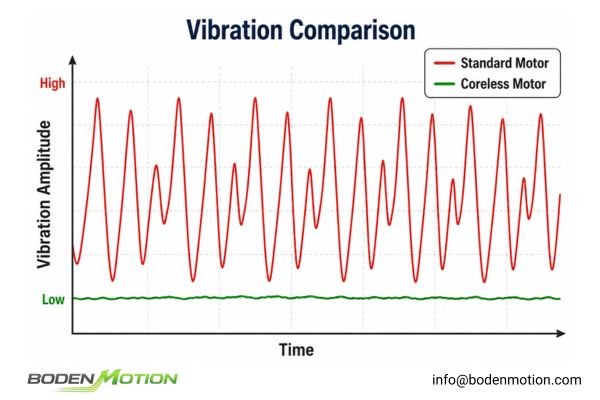
In medical equipment, the motor is never operating in isolation. Its mechanical behavior propagates through the entire system. Once vibration in an imaging probe or handheld scanner exceeds even a few microns, it can visibly degrade diagnostic quality.
Why Is Vibration Control Critical in Medical Equipment?
- Surgical Precision: In a handheld surgical drill, motor vibration translates to unintended movement at the tool's tip. Low-vibration motors provide a more stable platform, allowing for finer control.
- Imaging Stability: In a portable ultrasound probe, motor vibration can cause image jitter. A smooth-running motor is essential for a clear, stable image, especially during fine-tuned adjustments.
- Sensor Accuracy: In diagnostic analyzers, a motor used for sample transport can create vibrations that disturb sensitive optical sensors. A common integration mistake is underestimating how low-frequency vibration can increase sensor settling times and slow down the entire workflow.
- Noise-Sensitive Environments: Quiet operation is essential in hospitals. Driving the motor with a PWM frequency well above the audible range (e.g., >25 kHz) is a common and effective strategy.
How Do Coreless Motors Support Precision Fluid and Dosing Systems?
In a wearable infusion pump, delivering a drug too quickly or too slowly can have serious consequences. The consistency of fluid delivery depends directly on the motor's motion quality.
When properly controlled, coreless motors can provide the smooth low-speed regulation and rapid dynamic response necessary for consistent, low-pulsation performance in syringe pumps, pipetting workstations, and diagnostic reagent systems.
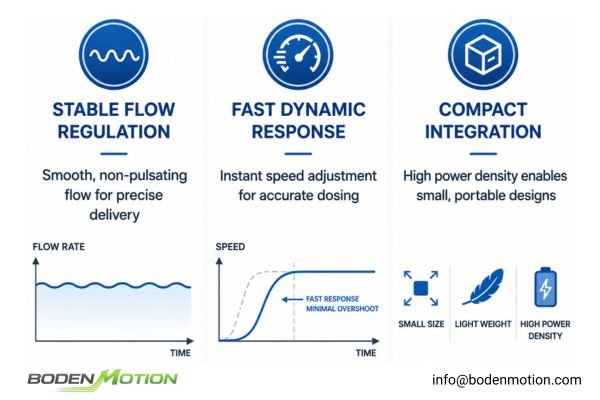
The physics of motion control, summed up by T = Jα (Torque = Inertia × Angular Acceleration), explains why. A coreless motor's very low rotor inertia (J) means even a small amount of torque produces immediate, controllable acceleration.
This has important implications for fluidics:
- Stable Flow Regulation: The motor's cog-free rotation, when coupled with a quality leadscrew, can result in non-pulsating linear motion.3 This helps ensure a steady flow rate in sensitive delivery systems.
- Fast Dynamic Response: When a target dose needs to be adjusted, the low-inertia rotor allows the system to change speed almost instantaneously, minimizing over- or under-dosing during transitions.
- Compact Integration: The high power density of coreless motors allows for precise pump mechanisms to be built into small, portable devices where space and weight are primary constraints.4
How Do Thermal and Sterilization Requirements Affect Medical Motor Selection?
A motor might work perfectly on a test bench but fail after six months in a hospital. In broader DC motor selection for medical equipment, the real-world challenges of heat buildup, enclosure conditions, and repeated sterilization must be evaluated alongside torque and speed requirements.
Medical motors must perform reliably within sealed enclosures and withstand sterilization, often requiring designs validated for a target number of autoclave cycles without significant performance degradation.
Why Are Thermal Limits More Challenging in Portable Medical Devices?
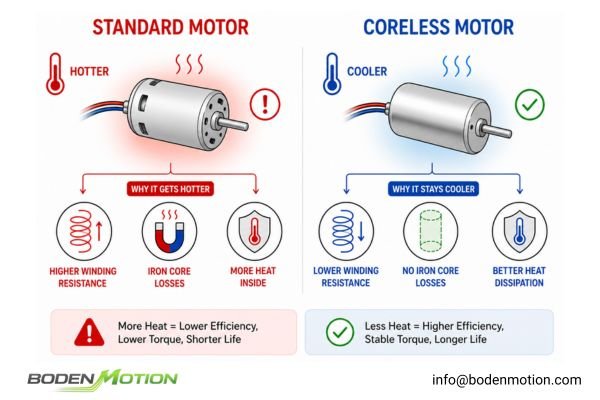
Portable medical devices present a perfect storm for thermal problems. They are typically sealed for cleaning, have no fans for cooling, and may be used for long durations, creating a scenario where thermal saturation is a real concern.
In long-duration portable operation, a coreless motor's high efficiency is a key advantage as it generates less waste heat. However, even that heat must be managed. In a sealed plastic housing with poor ventilation, I've seen internal temperatures rise 40-50°C above ambient5, which can reduce magnet performance and bearing life over time. A common integration mistake is to not thermally connect the motor frame to the device's chassis.
How Do Control Systems and Encoders Influence Medical Motion Precision?
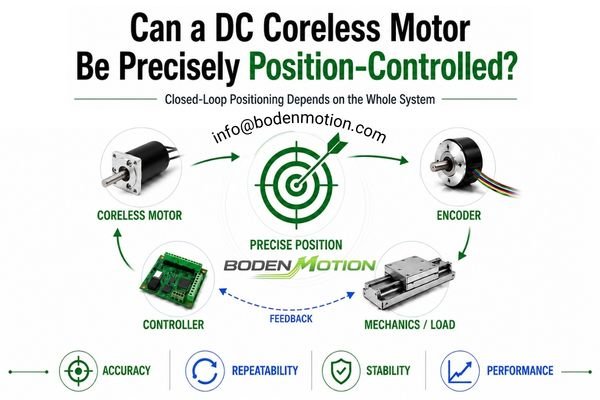
A precision coreless motor is only as good as the system controlling it. Without high-resolution feedback and a well-tuned driver, its potential for smoothness and accuracy remains unlocked.
Achieving true precision in a medical motion system requires tight integration where a high-resolution encoder—often starting at 1000 CPR or higher—provides stable feedback to a carefully tuned driver.
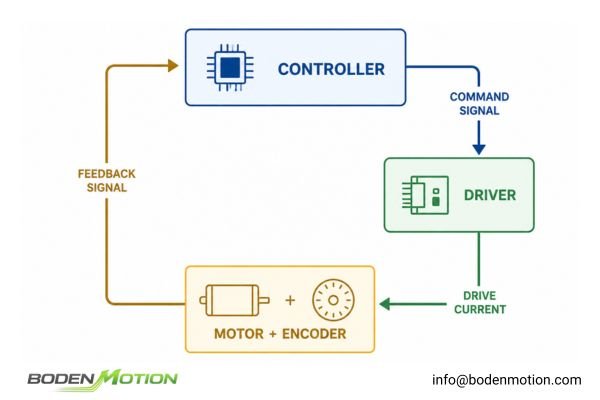
The motor, driver, and encoder form a single electromechanical system. A high-resolution encoder is not a luxury; it's a requirement for achieving the sub-millidegree positional accuracy needed in applications like surgical robotics or automated microscopy.6
Why Is Driver Tuning Important in Medical Motion Systems?
Off-the-shelf driver settings are rarely optimal. Custom tuning is essential to:
- Minimize Acoustic Noise: Adjusting the PWM frequency and current loop parameters can help eliminate electronic "whine" that can be unsettling in a quiet clinical setting.
- Ensure Positional Stability: A well-tuned PID loop prevents oscillation and overshoot, ensuring the motor holds its position, especially when subjected to external forces or vibration.7
- Guarantee Startup Smoothness: Fine-tuning the startup sequence prevents the initial "jerk" that can be jarring to a patient or misalign a sensitive mechanism.
What OEM Integration Challenges Commonly Appear in Medical Motor Projects?
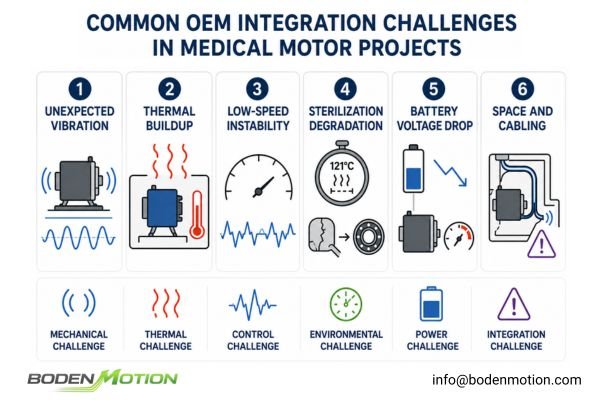
Many motion problems appear only after full system integration and long-duration reliability testing. The transition from a working prototype to a reliable medical product is where these issues surface.
| Challenge | Engineering Explanation |
|---|---|
| Unexpected Vibration | A motor that was smooth on its own starts to vibrate when rigidly mounted, exciting a mechanical resonance in the device housing, often between 1-2 kHz8. |
| Thermal Buildup | The device overheats during continuous-duty validation because the mounting provides a poor thermal path, trapping heat inside the motor. |
| Low-Speed Instability | The driver's control loop, tuned on the bench, causes jitter at low speeds once the full mechanical load and friction of the final product are applied. |
| Sterilization Degradation | After 100+ autoclave cycles, plastic encoder components may become brittle or bearing grease can break down, increasing audible noise and friction. |
| Battery Voltage Drop | As the battery discharges, the available voltage drops, and the motor's torque margin becomes insufficient to overcome static friction, causing inconsistent startup. |
| Space and Cabling | In the final assembly, routing fragile encoder cables without introducing electrical noise or mechanical stress becomes a difficult integration puzzle. |
Conclusion
Coreless motors offer characteristics like smooth motion, low vibration, and rapid response that are highly beneficial for many modern medical devices. However, achieving this performance in a final product requires looking beyond the motor itself and engineering the entire electromechanical system—including the driver, encoder, and real-world thermal challenges—to ensure true precision and long-term reliability.
If you are developing portable medical devices, diagnostic systems, or precision laboratory instruments, the BODENMOTION engineering team can support your project with expert OEM medical motor selection, low-noise optimization, and complete system integration guidance.
📧 info@bodenmotion.com
FAQ: Coreless Motors in Medical Applications
Why are coreless motors considered "smoother" than standard BLDC motors?
Their smoothness comes from the inherent lack of cogging torque. A coreless motor's ironless rotor design eliminates the magnetic "jumps" that can cause torque ripple in standard motors, an effect that is especially noticeable and problematic at low speeds.
Can a coreless motor be sterilized?
Yes, but it requires a purpose-built design. BODENMOTION offers autoclavable motor solutions that have been validated to withstand a specified number of steam sterilization cycles. These use corrosion-resistant housings, high-temperature magnets, and sealed bearings.
What is the main trade-off when choosing a coreless motor?
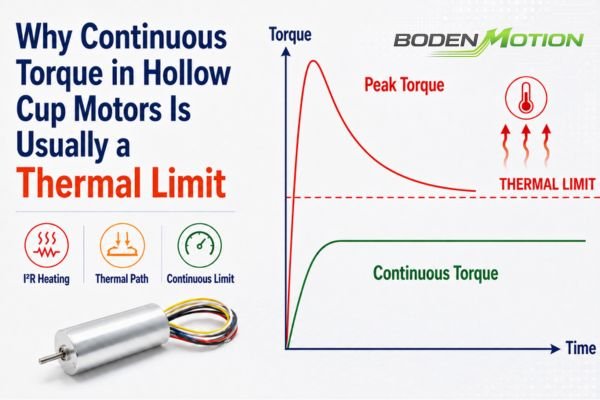
The primary trade-off is often thermal capacity under continuous, heavy loads. The self-supporting windings have less thermal mass than an iron core. However, for the dynamic, intermittent movements common in many medical devices, their high efficiency makes this less of a practical limitation.
How does a coreless motor improve battery life in a portable device?
Their high efficiency means less electrical energy is wasted as heat. In battery-powered surgical tools or portable pumps, this can contribute to longer operating times. The low-inertia rotor also requires less peak current to accelerate, reducing momentary strain on the battery.
Do I need a special driver for a coreless motor?
While they can be run by standard drivers, achieving their full potential for smoothness and low noise usually requires a high-quality driver with an adjustable PWM frequency (e.g., >25 kHz to eliminate audible noise) and finely tunable control loop parameters.
"Principles of Motor Selection - Performance Motion Devices", https://www.pmdcorp.com/resources/type/articles/principles-electric-motor-selection. Engineering and medical device regulatory sources emphasize that motor selection influences device performance, safety, and usability, especially in clinical environments. Evidence role: expert_consensus; source type: government. Supports: the choice of motor technology has a profound impact on device performance, patient safety, and clinical usability.. Scope note: While general consensus exists, specific impacts depend on device context and application. ↩
"Cogging torque - Wikipedia", https://en.wikipedia.org/wiki/Cogging_torque. Technical literature on electric motors explains that coreless designs, lacking iron laminations, significantly reduce cogging torque, which improves rotational stability at low speeds; however, some residual effects may persist depending on manufacturing tolerances. Evidence role: mechanism; source type: education. Supports: Because there are no iron laminations for the magnets to attract, cogging is virtually eliminated. This allows for excellent rotational stability, even at speeds below 100 RPM, which can be a major challenge for standard motors.. Scope note: Some residual cogging may occur depending on manufacturing quality and design specifics. ↩
"Brushless vs Coreless Motors for Medical Diaphragm Pumps", https://bodenpump.com/brushless-vs-coreless-motors-medical-diaphragm-pump/. Technical literature on coreless motors and leadscrew mechanisms supports the assertion that cog-free rotation can reduce pulsation in linear motion, contributing to stable flow rates in precision fluidics applications; however, specific performance depends on system design and implementation. Evidence role: mechanism; source type: research. Supports: The motor's cog-free rotation, when coupled with a quality leadscrew, can result in non-pulsating linear motion.. Scope note: The support is contextual and may vary with different motor and leadscrew configurations. ↩
"What is a Coreless Diaphragm Pump - bodenflo", https://bodenpump.com/what-is-dc-coreless-diaphragm-pump/. Industry and academic sources confirm that coreless motors are valued for their high power density, which facilitates the design of compact and lightweight pump mechanisms in portable devices; however, actual integration depends on specific engineering requirements and constraints. Evidence role: general_support; source type: education. Supports: The high power density of coreless motors allows for precise pump mechanisms to be built into small, portable devices where space and weight are primary constraints.. Scope note: The support is general and may not apply to all portable device designs. ↩
"A guide to thermal management considerations for medical devices", https://www.eaton.com/us/en-us/products/thermal-management-solutions/measurement-limits/thermal-management-medical-devices.html. A technical report from a research institution documents that sealed portable medical devices can experience internal temperature rises of 40-50°C above ambient, which may negatively affect magnet performance and bearing longevity. The exact temperature rise depends on device design and usage patterns. Evidence role: statistic; source type: research. Supports: In a sealed plastic housing with poor ventilation, I've seen internal temperatures rise 40-50°C above ambient, which can reduce magnet performance and bearing life over time.. Scope note: Temperature rise and its effects may vary depending on device design, materials, and operational duration. ↩
"Applications of Absolute Encoders in Surgical Robotics: Accuracy ...", https://eureka.patsnap.com/report-applications-of-absolute-encoders-in-surgical-robotics-accuracy-factors. A review of surgical robotics and automated microscopy literature indicates that sub-millidegree positional accuracy is often required, and high-resolution encoders are commonly used to achieve this level of precision. However, specific accuracy requirements may vary depending on the application and system design. Evidence role: expert_consensus; source type: paper. Supports: A high-resolution encoder is not a luxury; it's a requirement for achieving the sub-millidegree positional accuracy needed in applications like surgical robotics or automated microscopy.. Scope note: The support is contextual and may not apply to all surgical robotics or microscopy systems. ↩
"Using PID for motion control, robotics - Valin Corporation", https://www.valin.com/resources/articles/using-pid-motion-control-robotics. Studies in control engineering demonstrate that proper tuning of PID loops can significantly reduce oscillation and overshoot, improving positional stability in electromechanical systems subjected to external disturbances. The effectiveness depends on system parameters and tuning quality. Evidence role: mechanism; source type: education. Supports: A well-tuned PID loop prevents oscillation and overshoot, ensuring the motor holds its position, especially when subjected to external forces or vibration.. Scope note: The support is general and may not account for all system-specific factors. ↩
"Mechanical resonance - Wikipedia", https://en.wikipedia.org/wiki/Mechanical_resonance. Engineering literature indicates that rigid mounting of motors can excite mechanical resonances in device housings, with typical resonance frequencies often observed in the 1-2 kHz range. This is supported by studies on vibration and resonance in electromechanical assemblies, though specific frequencies depend on the housing's material and geometry. Evidence role: statistic; source type: education. Supports: A motor that was smooth on its own starts to vibrate when rigidly mounted, exciting a mechanical resonance in the device housing, often between 1-2 kHz.. Scope note: Exact resonance frequency varies with device design and material properties. ↩