In miniature brushless DC motors, manufacturing tolerance is much narrower than in larger motors. Small winding deviations can become measurable factors affecting efficiency, stability, vibration, and long-term reliability.
Tiny BLDC motors operate with limited stator space, fine copper wires, and often high rotational speeds. From my perspective as an integration engineer, winding precision is not just a manufacturing detail; it directly influences how the motor performs in real OEM applications.
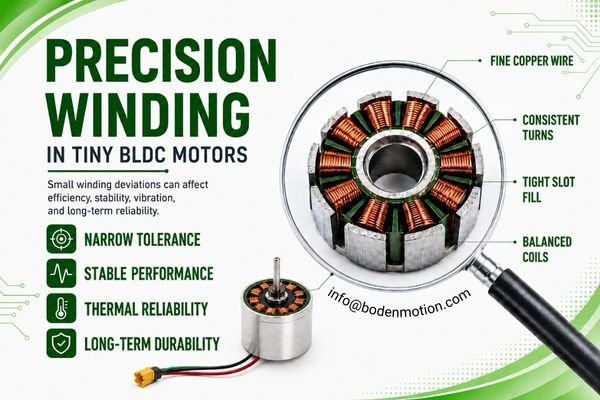
Over my years in OEM integration, I've seen projects struggle with performance issues that were eventually traced back to inconsistent motor windings. This article explains why this precision is so crucial, connecting the manufacturing process to key performance metrics like magnetic field stability, thermal behavior, and the subtle vibrations that can impact a high-performance device.
What Winding Precision Means in a Tiny Brushless Motor
Many engineers see winding as a simple step, but in tiny motors, inconsistent windings create hidden reliability risks that are difficult to diagnose later.
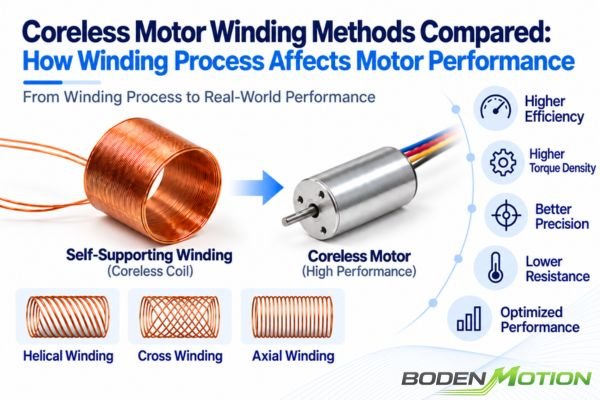
True winding precision is not just about neatly arranged wires; it's a set of controlled manufacturing parameters—from tension to turn count—that ensures electromagnetic balance and repeatable performance.
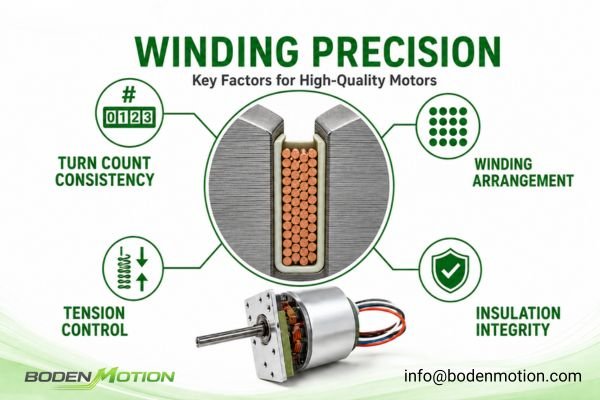
In a tiny brushless motor, effective winding precision includes multiple factors working together:
- Turn Count Consistency: Ensuring each coil has the same number of turns.
- Winding Arrangement: Layering wires neatly and uniformly within the stator slot.
- Winding Tension Control: Applying constant, correct tension to the copper wire.
- Insulation Integrity: Preserving the wire's thin enamel coating without damage.
- Phase-to-Phase Uniformity: Achieving nearly identical resistance and inductance across all phases.
- End-Winding Height Control: Keeping the end loops compact and consistent.
These factors together influence the balance of the stator's magnetic field. An inconsistently wound motor might still operate, but its performance in demanding applications is often compromised.1 Understanding this link is the first step to diagnosing many elusive system-level problems.
System-Level Observation:
A motor with poor winding can be seen as an imbalanced system from the start. This imbalance may force the driver to work harder to maintain stable control, sometimes leading to higher current draw and reduced system efficiency, even if the motor's basic specs look fine on paper.
How Winding Deviation Affects Magnetic Field Stability
The smooth operation of a BLDC motor relies on the stator windings generating a stable and symmetrical rotating magnetic field. Winding deviations can disrupt this symmetry.
When there are significant differences between the three-phase windings—such as an unequal number of turns or uneven wire distribution—an imbalanced magnetic field can be created. This imbalance may exert uneven electromagnetic forces on the rotor as it spins.
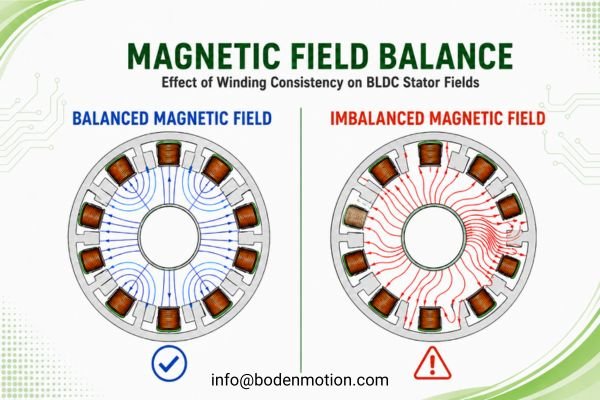
In some cases, the consequences of this imbalance can include:
- Torque Ripple2: Fluctuations in torque output that can cause jerky motion.
- Uneven Current Draw: One phase may draw more current, leading to inefficient power use.
- Rough Commutation: The transition between phases can become less smooth, creating electrical noise.
- Low-Speed Jitter: The motor may struggle to maintain a stable position at low RPMs.
- High-Frequency Vibration: A "buzz" or vibration that can resonate through the device.
In tiny motors, the stator dimensions are so small that the magnetic field is already highly concentrated. This can make it more sensitive to winding deviations, where a small physical imperfection may create a measurable disturbance in the magnetic field. This is why a stable winding process is a prerequisite for achieving a stable magnetic field.
Why Copper Fill Ratio Must Be Carefully Controlled
The copper fill ratio specifies the percentage of the stator slot area occupied by copper wire. While a higher ratio can help lower resistance and improve efficiency, it's not a simple case of "more is better," especially in miniature motors.
The goal is not to achieve the absolute maximum fill ratio, but to achieve a repeatable, thermally safe, and manufacturable winding structure. Pushing the fill ratio too aggressively introduces risks.
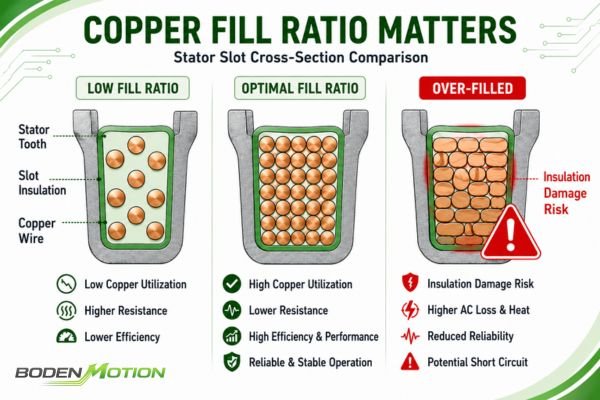
If the copper fill is too high or wires are arranged unevenly, it can lead to several problems:
- Insulation Damage: Wires pressed too tightly can stress the thin enamel insulation, increasing the long-term risk of a short circuit.3
- Impeded Heat Dissipation: Overly compacted windings can eliminate small air gaps that help with thermal transfer, potentially creating localized hotspots.
- End-Winding Deformation: Forcing too much wire into the slots can cause the end windings to bulge, which may interfere with assembly.
- Reduced Manufacturing Consistency: An ambitious fill ratio that is difficult to control can lead to greater batch-to-batch variation.
Design Trade-Off:
In many OEM applications, a slightly lower but highly consistent copper fill ratio is preferable to a theoretically higher but variable one. A 5% increase in manufacturing reliability and thermal safety often outweighs a 1% theoretical gain in efficiency.
Why Winding Tension Matters More in Miniature Motors
Winding tension—the force applied to the copper wire as it's wound—is a subtle but critical process parameter. It directly affects the wire's final position, density, and mechanical stability within the stator slot.
In miniature motors, where the copper wire can be extremely fine, tension control is even more vital. The wire is far more sensitive to force variations, which can affect its physical and electrical properties.
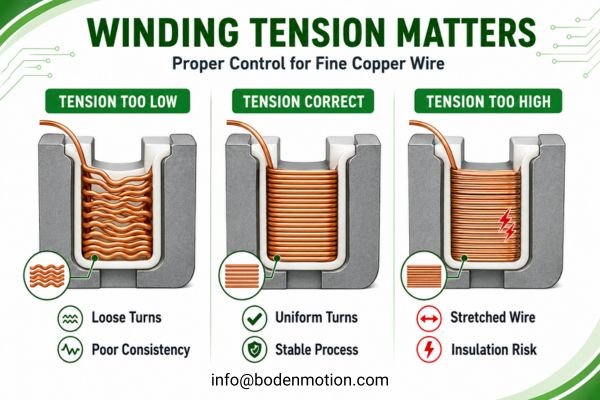
The tension must be carefully controlled:
- If tension is too low: Coils may be loose. At high speeds, these wires can shift or vibrate, leading to inconsistent performance and potential chafing over time.
- If tension is too high: The wire can be stretched, which alters its diameter and, consequently, its resistance.4 In severe cases, the insulation can be thinned or damaged, creating a latent defect.
Maintaining precise, stable winding tension is key to achieving consistent phase resistance and better mechanical stability, which in turn reduces the risk of electromagnetically induced vibration.5 This level of process control is a key indicator of a high-quality motor supplier.
How Poor Winding Consistency Can Increase Heat and Efficiency Loss
If a tiny motor is overheating despite operating within its load limits, inconsistent windings can be a contributing factor. Any significant imbalance in the windings can force the motor to work inefficiently, converting more energy into waste heat.
The causal chain is straightforward: inconsistent windings lead to an imbalance in phase resistance and inductance. During operation, this electrical imbalance can cause uneven current distribution among the three phases. In this scenario, one phase may draw more current than the others to produce the required torque.
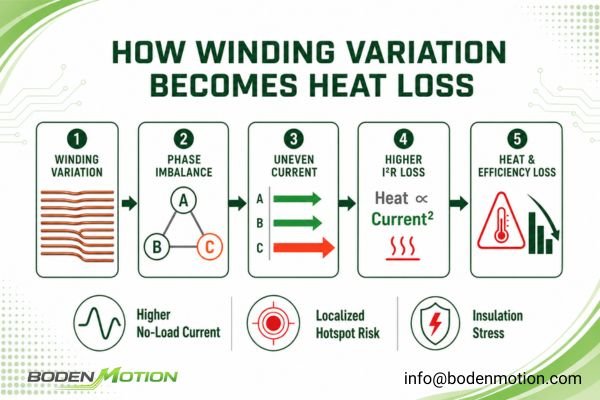
This can lead to a cascade of negative effects:
- Increased I²R Losses: The phase drawing higher current generates significantly more heat (Heat ∝ Current²).
- Reduced Motor Efficiency: More electrical energy is converted to waste heat instead of mechanical work.
- Higher No-Load Current: The motor may consume more power just to overcome its own internal imbalances.
- Localized Hotspots: The overworked phase can degrade its insulation faster, potentially shortening the motor's lifespan6.
This is why comparing phase resistance values and no-load current across a batch of motors is a fundamental quality check for any OEM project7.
How Winding Precision Affects Vibration, Noise, and High-Speed Stability
When an engineer encounters unexpected vibration, the first instinct is often to check rotor balance. However, when mechanical causes have been ruled out, the issue may be electromagnetic in origin, with winding consistency being a possible source.
As discussed, inconsistent windings can create an uneven magnetic field. This may subject the rotor to fluctuating, non-uniform electromagnetic forces as it rotates.
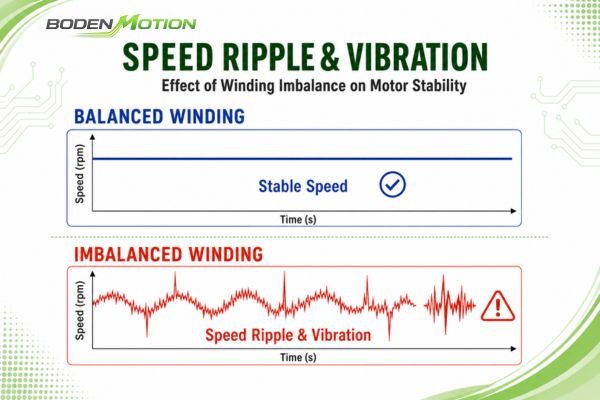
This phenomenon can manifest in several ways:
- Speed Ripple8: Minor fluctuations in the motor's speed with each rotation.
- Electromagnetic Noise: A high-pitched "whine" that changes frequency with RPM.
- High-Frequency Vibration: A "buzzing" sensation that can be felt through the device structure.
- Increased Bearing Load9: Uneven forces may contribute to premature bearing wear over time.
Real Integration Challenge:
I've seen this in applications like medical handheld tools and robotics. The device feels "unstable," and teams spend weeks trying to fix it with mechanical dampers or software filters. In some of these cases, the root cause was an inconsistently wound motor. Performing a simple vibration test or a no-load current comparison on a few samples early on could have highlighted the issue much sooner.
Key Information to Confirm Before Requesting Tiny BLDC Motor Samples
When sourcing tiny brushless motors, you should evaluate more than just the datasheet and price. For serious OEM projects, it's essential to confirm that a potential supplier has robust winding process controls.
Having a technical discussion about your application and the supplier's manufacturing capabilities before sampling can save significant time and resources.

| Information to Provide to Your Supplier | Questions to Ask Your Supplier |
|---|---|
| Target voltage and speed range | What is your typical winding method (e.g., needle, flyer)? |
| Load profile (torque, inertia) | What are your typical copper fill ratio and tension control parameters? |
| Duty cycle and expected run time | What is your standard tolerance for phase resistance consistency? |
| Maximum allowed temperature rise | What is the expected range for no-load current? |
| Noise and vibration requirements | How do you test for temperature rise and high-speed noise? |
| Space and mounting constraints | What batch consistency data can you provide from past production? |
This level of due diligence helps you identify potential risks early.10 A supplier who can confidently discuss these process controls is more likely to provide motors with the batch-to-batch consistency your product requires.
Conclusion
In tiny motors, winding precision is a cornerstone of performance, efficiency, and reliability. While not the only factor, it provides a stable electromechanical foundation for your entire motion system.
A motor with precise, consistent windings is easier to drive, runs cooler, and operates more smoothly. If you're designing a compact OEM device, our engineering team can help review your requirements for motor parameters, application conditions, and batch consistency to help you select a suitable motion solution.
info@bodenmotion.com
FAQ
Why is winding precision important in a tiny brushless motor?
Winding precision affects magnetic field balance, phase resistance consistency, and thermal properties. In tiny motors, where physical tolerances are tight, small winding deviations can have a more pronounced effect on performance metrics like efficiency, vibration, and high-speed stability.
Does higher copper fill ratio always mean better motor performance?
Not necessarily. While a higher copper fill ratio can improve electrical performance, an excessively high or poorly controlled fill can compromise insulation reliability, impede heat dissipation, and make manufacturing consistency more difficult. The goal is an optimal, repeatable fill ratio.
How does winding tension affect motor quality?
Winding tension influences coil shape, wire position, insulation integrity, and resistance consistency. Too little tension can lead to loose windings that may vibrate, while too much tension can stretch the wire or damage its insulation.
Can poor winding cause motor noise?
Yes, it can be a contributing factor. Poor winding consistency may create magnetic imbalance, leading to torque ripple and electromagnetic vibration. This can manifest as motor noise, particularly at certain speeds.
What should OEM buyers ask before choosing a tiny brushless motor supplier?
OEM buyers should discuss the supplier's process controls for winding, including their winding method, tension control, phase resistance tolerance, and batch consistency data. It's also wise to inquire about their testing for temperature rise, no-load current, and vibration.
"What do brushless motor's winding parameters mean and ...", https://www.haydonkerkpittman.com/learningzone/whitepapers/brushless-motors-winding-parameters-what-they-mean-and-how-to-choose. Research on brushless motor winding precision indicates that inconsistent winding can lead to reduced efficiency, increased vibration, and lower performance, especially in high-demand applications. Evidence role: mechanism; source type: paper. Supports: An inconsistently wound motor might still operate, but its performance in demanding applications is often compromised.. Scope note: Most studies focus on industrial or RC motors; results may vary for other motor types. ↩
"What is torque ripple and how does it affect linear motion ...", https://www.linearmotiontips.com/what-is-torque-ripple-how-does-it-affect-linear-motion-applications/. Torque ripple is a well-documented phenomenon in electric motors, characterized by periodic variations in torque output due to factors such as winding imbalances and magnetic field irregularities. Evidence role: definition; source type: encyclopedia. Supports: Fluctuations in torque output that can cause jerky motion.. Scope note: The source may discuss torque ripple in general motor contexts, not exclusively in relation to winding imbalance. ↩
"How Insulation Affects Enameled Wire Performance in ...", https://www.jingdawire.com/blogs/how-enameled-wire-insulation-dictates-performance/. A technical review of winding insulation in electric machines confirms that excessive mechanical stress on enamel-coated wires can degrade insulation and increase the risk of electrical faults over time. Evidence role: mechanism; source type: education. Supports: Wires pressed too tightly can stress the thin enamel insulation, increasing the long-term risk of a short circuit.. Scope note: The review discusses general principles and may not address all specific winding geometries. ↩
"Single-Step Shear-Based Deformation Processing of ...", https://asmedigitalcollection.asme.org/manufacturingscience/article/143/5/051010/1089722/Single-Step-Shear-Based-Deformation-Processing-of. A materials science source confirms that excessive mechanical tension during wire winding can cause elongation, reducing diameter and increasing resistance, though the degree of change depends on wire composition and tension magnitude. Evidence role: mechanism; source type: education. Supports: The wire can be stretched, which alters its diameter and, consequently, its resistance.. Scope note: The effect is most pronounced in soft copper wires and may be less significant in harder alloys or with moderate tension. ↩
"Influence of Concentric and Unequal-Turn Windings on ...", https://ieeexplore.ieee.org/iel7/6287639/10380310/10477996.pdf. Engineering research indicates that precise winding tension improves phase resistance uniformity and mechanical stability, thereby reducing susceptibility to electromagnetically induced vibration in electric motors. Evidence role: mechanism; source type: research. Supports: Maintaining precise, stable winding tension is key to achieving consistent phase resistance and better mechanical stability, which in turn reduces the risk of electromagnetically induced vibration.. Scope note: The reduction in vibration depends on other factors such as winding geometry and motor design; tension control is one of several contributing variables. ↩
"Electrical Insulation Failure", https://www.cbmconnect.com/electrical-insulation-failure-2/. Research and technical standards indicate that excessive current in a motor phase can accelerate insulation degradation, which may reduce the operational lifespan of the motor. This relationship is well-established, though the exact rate of degradation depends on operating conditions and insulation materials. Evidence role: mechanism; source type: research. Supports: The overworked phase can degrade its insulation faster, potentially shortening the motor's lifespan. Scope note: The rate of insulation degradation varies with motor design and environmental factors. ↩
"IEEE Standard Test Procedure for Polyphase Induction ...", https://engineering.purdue.edu/~dionysis/EE452/Lab12/IEEEstd_112.pdf. Industry standards and engineering literature recognize phase resistance and no-load current measurements as essential quality control procedures for electric motor manufacturing, supporting their use in OEM projects. This is generally accepted practice, though specific protocols may vary by manufacturer. Evidence role: expert_consensus; source type: education. Supports: comparing phase resistance values and no-load current across a batch of motors is a fundamental quality check for any OEM project. Scope note: Protocols may differ between manufacturers and motor types. ↩
"Cogging Torque and Torque Ripple: What You Need to Know", https://www.kollmorgen.com/en-us/blogs/everywhere-cogging-torque-and-torque-ripple-what-you-need-to-know. Speed ripple is a recognized phenomenon in electric motors, characterized by periodic variations in rotational speed, often attributed to factors such as winding irregularities or magnetic field harmonics. This is supported by technical literature on motor dynamics. Evidence role: definition; source type: education. Supports: Speed Ripple: Minor fluctuations in the motor's speed with each rotation.. Scope note: The specific causes and magnitude of speed ripple may vary depending on motor design and application. ↩
"13 Common Causes of Motor Failure", https://www.fluke.com/en-us/learn/blog/motors-drives-pumps-compressors/13-causes-of-motor-failure?srsltid=AfmBOopu05_L4Hq6u1LY5hGKmaVxLVxIZ-YuWcVPuuQbzmzJCOzwNYCc. Uneven forces resulting from motor irregularities, such as inconsistent winding, can increase bearing loads and contribute to premature wear, as documented in engineering studies on motor reliability. Evidence role: mechanism; source type: paper. Supports: Increased Bearing Load: Uneven forces may contribute to premature bearing wear over time.. Scope note: The degree of bearing load increase depends on the severity of the motor irregularity and operating conditions. ↩
"3 supplier due diligence tips for risk management", https://www.moodys.com/web/en/us/kyc/resources/insights/three-things-to-know-performing-supplier-due-diligence.html. Risk management literature and supplier evaluation frameworks recommend thorough due diligence as a key step in identifying potential risks early in the supply chain process. Evidence role: expert_consensus; source type: education. Supports: This level of due diligence helps you identify potential risks early.. Scope note: General risk management principles apply broadly but may not address specific risks in motor supply. ↩