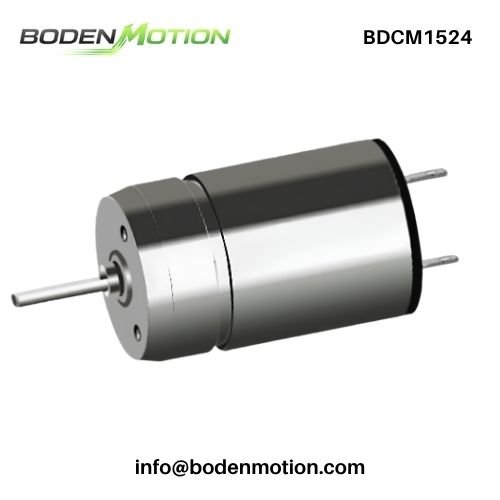
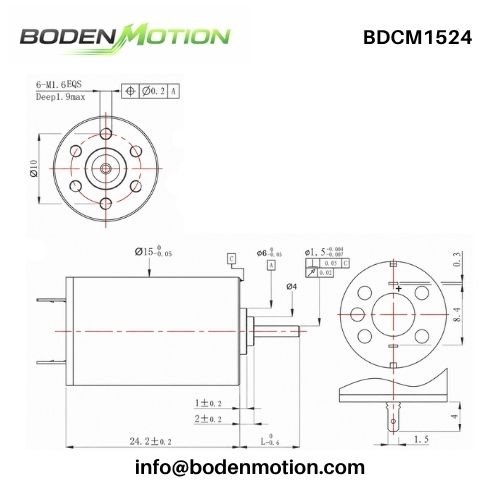
The BDCM1524 ironless DC motor is built around a compact Ø15 × 24 mm platform for applications where installation space, electrical efficiency, and predictable brushed-motor control must be balanced. Its precious-metal brush construction and low-inertia coreless rotor make it well suited to compact mechanisms that require responsive acceleration and smooth speed adjustment without a complex electronic commutation system.
Four winding versions cover 3V, 6V, 12V, and 24V systems, with rated speeds from 7,600 to 9,840 rpm and rated torque from 1.4 to 1.8 mN·m. The 6V configuration reaches a maximum measured efficiency of 81.0%, giving OEM engineers several ways to match the motor to battery-powered or regulated DC systems without changing the external motor envelope.
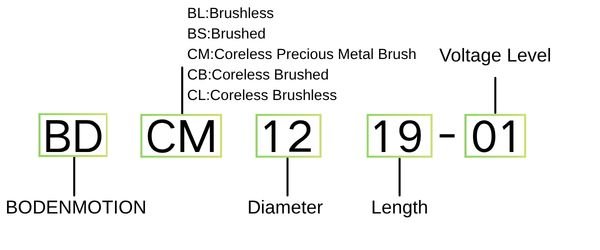
The four suffixes represent different winding configurations. Their resistance, current demand, speed constant, and torque constant differ, so the motor should be selected around the required electrical platform rather than treated as one winding operated across multiple voltages.
| Motor Model | Unit | BDCM1524-01 | BDCM1524-02 | BDCM1524-03 | BDCM1524-04 |
|---|---|---|---|---|---|
| At Nominal | |||||
| Nominal Voltage | V/DC | 3 | 6 | 12 | 24 |
| Nominal Speed | rpm | 8,560 | 9,840 | 9,440 | 7,600 |
| Nominal Current | A | 0.6 | 0.4 | 0.2 | 0.1 |
| Nominal Torque | mN·m | 1.6 | 1.8 | 1.7 | 1.4 |
| Free Load | |||||
| No-load Speed | rpm | 10,700 | 12,300 | 11,800 | 9,500 |
| No-load Current | mA | 40 | 20 | 11 | 4 |
| At Max. Efficiency | |||||
| Maximum Efficiency | % | 78.2 | 81.0 | 79.3 | 78.2 |
| Speed | rpm | 9,577 | 11,193 | 10,561 | 8,503 |
| Current | A | 0.30 | 0.20 | 0.10 | 0.03 |
| Torque | mN·m | 0.8 | 0.8 | 0.9 | 0.7 |
| At Max. Output Power | |||||
| Maximum Output Power | W | 2.2 | 2.9 | 2.7 | 1.8 |
| Speed | rpm | 5,350 | 6,150 | 5,900 | 4,750 |
| Current | A | 1.5 | 1.0 | 0.5 | 0.2 |
| Torque | mN·m | 3.9 | 4.6 | 4.4 | 3.5 |
| At Stall | |||||
| Stall Current | A | 3.0 | 2.0 | 0.9 | 0.3 |
| Stall Torque | mN·m | 7.8 | 9.1 | 8.7 | 7.0 |
| Motor Constants | |||||
| Terminal Resistance | Ω | 1.00 | 3.00 | 13.04 | 80.00 |
| Terminal Inductance | mH | 0.02 | 0.05 | 0.23 | 1.05 |
| Torque Constant | mN·m/A | 2.64 | 4.61 | 9.60 | 23.80 |
| Speed Constant | rpm/V | 3,566.7 | 2,050.0 | 983.3 | 395.8 |
| Speed/Torque Constant | rpm/mN·m | 1,368.4 | 1,347.1 | 1,352.9 | 1,348.3 |
| Mechanical Time Constant | ms | 11.0 | 10.1 | 11.9 | 11.9 |
| Rotor Inertia | g·cm² | 0.77 | 0.72 | 0.84 | 0.84 |
| Number of Pole Pairs | — | 1 | 1 | 1 | 1 |
| Number of Phases | — | 5 | 5 | 5 | 5 |
| Weight | g | 22 | 22 | 22 | 22 |
| Typical Noise Level | dB | ≤40 | ≤40 | ≤40 | ≤40 |
Not sure how to interpret model differences? See the model code breakdown below ↓
Because the BDCM1524 uses a relatively short motor body, careful shaft alignment and load control help preserve smooth running and prevent the driven mechanism from adding unnecessary bearing or brush stress.
Shaft Load Management
The sintered metal bearing supports a maximum dynamic axial load of 0.3 N and a maximum radial load of 1.2 N, measured 5 mm from the flange. Pulley, belt, or offset-load arrangements should avoid placing excessive side force directly on the motor shaft.
Mechanical Clearance
Axial play is specified at 0.05–0.15 mm, while radial play is limited to 0.012 mm. Coupling concentricity and shaft alignment should be checked during assembly.
Press-Fit Protection
Maximum static press-fit force is 20 N. Assembly force should be applied through the correct structural surface rather than transmitted through the output shaft.
Operating Environment
The specified ambient temperature range is −20°C to +80°C, relative humidity should remain below 90% RH at 25°C, and the highest rotor temperature is 85°C.
Duty-Cycle Consideration
The maximum-output and stall regions require substantially higher current than nominal operation. Continuous use should therefore be based on the actual load, enclosure temperature, and required brush life rather than on maximum-output figures alone.
The standard motor already provides several winding choices, while additional mechanical or electrical adaptations can be reviewed according to the OEM assembly and production requirements.
| Customization Item | Available Options / Description |
|---|---|
| Winding Version | Standard 3V, 6V, 12V, or 24V configuration |
| Operating Point | Select the winding according to required speed, torque, current, and duty cycle |
| Shaft Configuration | Shaft geometry or length can be reviewed according to the driven mechanism |
| Lead / Terminal Format | Electrical connection arrangement subject to project confirmation |
| Mounting Interface | Mechanical adaptation can be evaluated for the equipment structure |
| Gearbox Option | Planetary gearbox available for lower-speed, higher-torque output |
| Prototype Configuration | Samples can be selected for real-load and thermal validation before production |
A planetary gearbox is available for applications requiring lower output speed and higher transmitted torque, while additional customization requests can be reviewed according to project requirements.
The BDCM1524 is most relevant to compact mechanisms that benefit from simple brushed control, moderate power demand, and a relatively short motor package.
Final suitability should be confirmed using the actual load torque, operating time, power supply, transmission ratio, and temperature environment.
For a small precious-metal brushed motor, efficiency should be considered together with winding voltage, load point, current demand, and service cycle. A version showing the highest efficiency value is not automatically the best choice for every mechanism.
Germany | Precision Instrument Manufacturer
Application: compact adjustment mechanism
Feedback: The short Ø15 × 24 mm motor body simplified integration into the available space while providing the required speed for the internal drive.
Japan | Portable Equipment OEM
Application: battery-powered motion module
Feedback: The low-voltage winding options allowed the motor to be matched more closely to the existing power architecture during prototype development.
United States | Automation Device Developer
Application: miniature geared actuator
Feedback: Pairing the motor with a planetary gearbox provided the lower output speed required by the mechanism without moving to a larger motor platform.
[BDCM1524 Ironless Precious-Metal Brushed DC Motor Specification PDF]
A1: Each version uses a different winding design, so efficiency is determined by its resistance, current, torque constant, speed constant, and operating point rather than voltage alone. The 6V version reaches a maximum measured efficiency of 81.0% under the specified test condition.
A2: Not automatically. Maximum-output operation involves higher current and lower speed than nominal operation, so continuous use should be confirmed through rotor-temperature, brush-life, and duty-cycle testing in the final equipment.
A3: Selection depends on battery voltage, allowable current, target speed, and load. Lower-voltage windings may fit low-cell-count battery systems, while higher-voltage versions operate at lower current for comparable motor size; the complete power architecture should be evaluated before selection.
A4: Standard samples are typically prepared within 3–5 days, while bulk production normally requires approximately 20–30 days, subject to customization requirements and the actual production schedule.
A5: Yes. The BDCM1331 is another precious-metal brushed coreless motor with a Ø13 × 31 mm body and a 2.5–4.5W product class. It offers a longer axial structure and higher rated torque on selected windings, making it worth evaluating when the BDCM1524 does not provide enough performance margin.
For compact OEM equipment using brushed coreless motors, BODENMOTION supports selection based on the actual voltage platform, load profile, efficiency target, mechanical envelope, and operating cycle.
📧 Email: info@bodenmotion.com
🌐 Website: https://bodenmotion.com