Many OEM projects encounter serious issues not during prototyping, but when a chosen supplier cannot maintain manufacturing consistency during series production. For miniature BLDC motors, application engineering support often becomes more critical than the initial unit price.
A reliable miniature BLDC motor supplier is defined by their manufacturing process control, deep application engineering support, transparent quality systems, and a stable supply chain—ensuring your product's performance is repeatable from the first unit to the last one in a large production run.
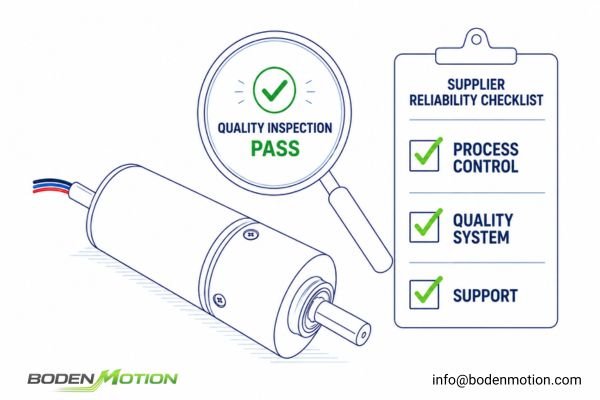
From my experience, the initial success with a perfect prototype can quickly turn into a project bogged down by field failures, production line issues, and costly redesigns. A motor isn't a simple commodity, especially in compact devices. Its performance is deeply coupled with the entire system—the driver, the mechanical structure, and the thermal path. Choosing a supplier is less a procurement decision and more a long-term engineering partnership to manage project risk.
Why Is Supplier Reliability So Important in Mini BLDC Motor Projects?
Small parameter variations in a motor can appear trivial on a datasheet. Inside a compact OEM device, however, that small shift can trigger significant system-level failures in noise, vibration, and long-term reliability.
In long-lifecycle products like medical devices, supplier reliability is paramount. Inconsistent motor batches can lead to performance degradation that may require field service, warranty claims, or even force a costly product recertification.
Miniature BLDC motors operate in tightly integrated systems where small physical changes have outsized effects. A slight drift in a supplier’s manufacturing process can create a domino effect:
- Vibration & Noise: A small increase in rotor residual imbalance might be insignificant in a larger industrial motor. But in a handheld diagnostic tool operating at several thousand RPM, it can create a noticeable resonance with the plastic housing, generating an unnerving audible noise that undermines user confidence.
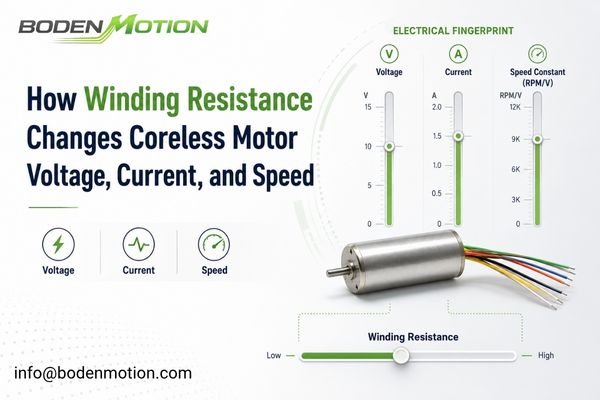
- Thermal Behavior: A supplier substitutes a batch of magnet wire with one of slightly higher resistance. The modest increase in I²R losses generates a little extra heat. In a compact, sealed enclosure with a constrained thermal path, that extra half-watt can be enough to cause thermal throttling, reducing device performance under continuous load.1
- Startup & Lifespan: A supplier quietly changes their bearing grease to a lower-cost alternative. The new grease may have a different viscosity profile at low temperatures, causing the device to fail its startup sequence in colder climates—a field failure scenario that is very difficult to diagnose remotely.
Beyond Torque and Speed: Defining the Full Motor Specification
I've seen projects get into trouble because the initial motor specification was incomplete. An engineer picks a motor from a catalog based on a peak torque and no-load speed requirement, only to find it overheats or creates unacceptable noise in the final product.
A robust motor specification must capture the full operating envelope, including thermal, acoustic, and dynamic load profiles, not just two or three numbers from a datasheet.
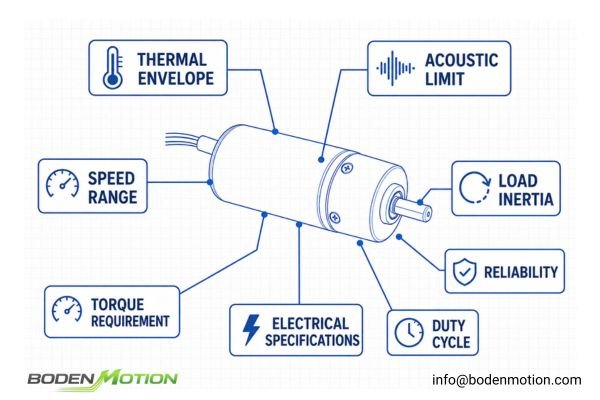
Before you even approach a supplier, you need to define what the motor must do within your system. A good supplier partner will ask for these details, but having them ready accelerates the entire process and reduces risk. Your specification should go beyond the basics.
| Parameter | Why It's a Critical System-Level Spec |
|---|---|
| Duty Cycle | A motor that runs for 1 second every minute has vastly different thermal behavior than one running continuously. This defines the thermal management strategy. |
| Thermal Environment | Will the motor be in a sealed plastic case or an aluminum chassis with airflow? The thermal path is as important as the motor's power rating. |
| Acoustic Noise | Simply saying "quiet" is not enough. Specify an acceptable dB level at a certain distance, and if possible, identify sensitive frequency ranges. |
| Load Inertia | A significant mismatch between motor rotor inertia and load inertia can cause control loop instability, overshoot, and poor settling times.2 |
| Vibration Sensitivity | If the motor is mounted near an optical sensor or in a handheld device, the acceptable level of residual imbalance becomes a critical design parameter. |
System-Level Observation: The datasheet rarely tells the full story. A motor's performance in your device is a function of its interaction with your enclosure, your driver, and your load. Providing a comprehensive specification is the first step in ensuring a successful integration.
What Manufacturing Capabilities Should OEM Engineers Evaluate?
Your prototype samples perform perfectly. But can the supplier produce 10,000 more with low parameter variation? This is where you separate a component reseller from a true manufacturing partner.
Key capabilities to scrutinize are automated winding consistency, high-speed balancing processes, precision control over shaft and bearing assembly, and strict inspection protocols for incoming magnetic materials.
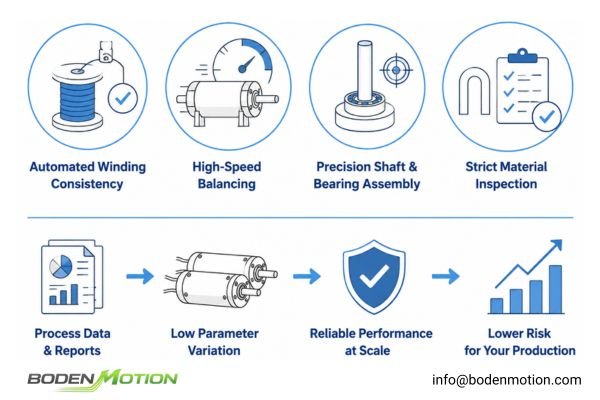
When I visit a potential supplier, I focus on their process control. For miniature motors, this is what determines batch-to-batch consistency and ultimately reduces your production risks. The goal is to see evidence of repeatable, automated processes that remove human variability. Look for things like automated winding machines that guarantee consistent resistance and inductance, which directly impacts the motor's torque constant (Kt)3. Ask to see their rotor balancing equipment and the residual imbalance reports it generates. This data is far more valuable than a simple "pass/fail" stamp on a final inspection sheet. These details are what prevent system-level vibration issues down the line.
How Important Are Quality Control and Reliability Testing?
A supplier shipping a product is one thing; a supplier that can provide objective evidence of how they prevent problems is another. A robust quality system is your best insurance against future field failures.
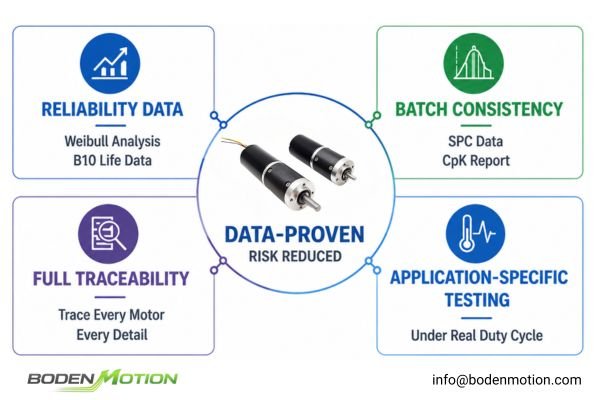
A reliable supplier should provide concrete data from their dynamic balancing, acoustic noise testing, and application-specific life testing to prove consistency and validate long-term performance.
Don't just ask "Do you do QC?". Ask to see how they use data to manage risk. A serious engineering partner will be able to:
- Share Reliability Data: They won't just claim a 10,000-hour life. They should be able to show you the Weibull analysis or B10 life data4 from their test racks, run under a load profile that simulates your application's actual duty cycle.
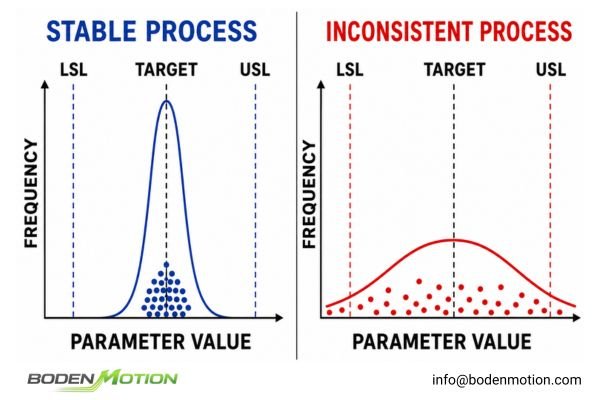
- Provide Batch Consistency Reports: Ask for SPC (Statistical Process Control) data or a CpK report5 for a critical parameter like winding resistance from recent production runs. This is hard proof of their process control.
- Demonstrate Full Traceability: If you have a field failure, can they trace the motor back to its exact production date, operator, and raw material lots? This capability is essential for effective root cause analysis.
- Perform Application-Specific Testing: Can they test the motor's temperature rise and current draw while simulating your device's actual duty cycle, not just run a simple no-load test?
Why Does Engineering Support Matter More Than Price Alone?
You've integrated a low-cost motor, but now it overheats, exhibits audible noise at a certain speed, or shows startup instability. Who do you call? If the answer is "nobody," you chose the wrong supplier.
Expert engineering support for driver matching, thermal management, and system-level troubleshooting is where a true partner helps you solve complex integration problems and avoid costly launch delays.
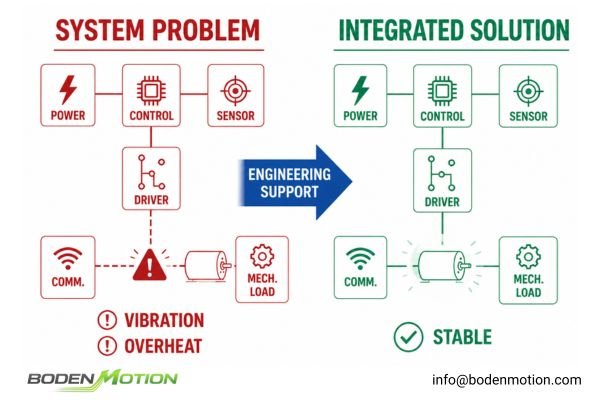
The datasheet shows motor performance under ideal lab conditions. An engineering partner helps bridge the gap between that data and real-world system behavior. This means hands-on, collaborative problem-solving. For instance, if your motor stalls against the mechanism's initial stiction, a good partner will analyze the startup current profile and help tune the driver's control algorithm or even suggest a winding modification to increase stall torque without compromising efficiency at the nominal operating point. This is the difference between a component vendor and an application engineering partner—they help you solve the problem at the system level.
How Can OEM Engineers Evaluate Supply Chain Stability?
Your product is a success, but your supplier just informed you of a 16-week lead time due to a material shortage. Your production line is about to go down.
Evaluating a supplier's supply chain—including material sourcing, scalability, and their formal change management process—is a critical engineering risk management function.
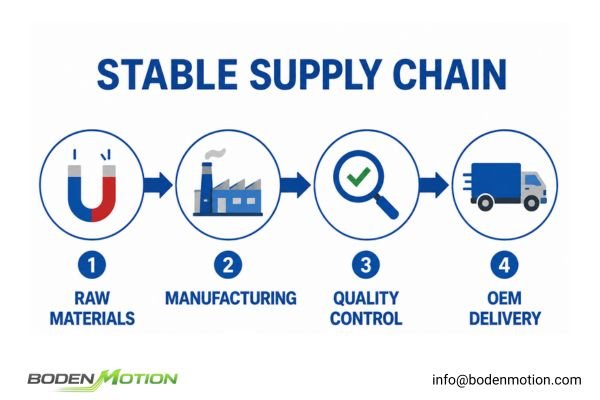
A supplier's inability to deliver consistently can halt your production just as effectively as a technical failure. When evaluating a potential partner, I focus on their process for managing these key risks:
- Lead Time Predictability: Can they provide stable and predictable lead times, or are they constantly fluctuating? Unpredictability forces you to carry more inventory (cost) or risk production shutdowns.
- Material Sourcing Strategy: Do they have a dual-sourcing strategy for critical raw materials like rare-earth magnets or key semiconductor components? A supplier who is single-sourced on a key material presents a significant supply chain risk.
- Formal Change Management: This is the most important factor. Do they have a rigid, well-documented Product Change Notification (PCN) process? For a device with a 5–10 year product lifecycle, this is non-negotiable.
What Common Mistakes Do OEM Buyers Make When Selecting Mini BLDC Suppliers?
Over the years, I've seen many well-meaning teams make predictable and costly mistakes when choosing a motor partner. It usually starts with an overemphasis on one factor while ignoring the total system risk.
The single biggest mistake is focusing on unit price while underestimating the total cost of ownership, which includes the engineering time needed for troubleshooting, production delays, and potential field failures.
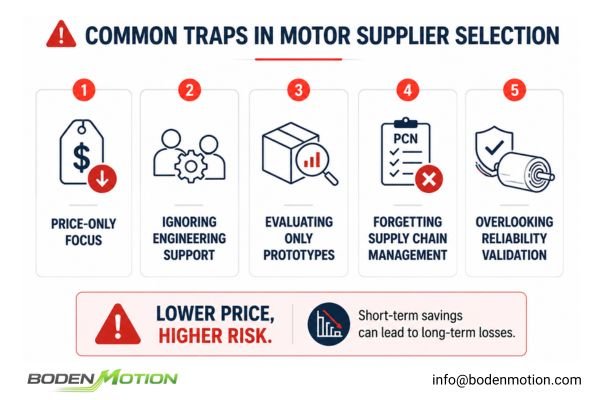
Here are the most common traps that I've seen teams fall into:
- Price-Only Selection: Focusing on saving a small amount on the component while ignoring the massive potential cost of a product recall or launch delay6.
- Ignoring Engineering Support: Assuming your internal team can solve every complex electromechanical, thermal, or driver-related integration issue alone.
- Evaluating Only Prototypes: Approving a "golden sample" without seeing batch data that proves the supplier can maintain that quality at scale.
- Forgetting Supply Chain Management: Not asking about the PCN process, then having your production line stop because the supplier changed a bearing without telling you.
- Overlooking Reliability Validation: Launching a product with a multi-year warranty based on a motor with no long-term, application-specific life test data.
Conclusion
A truly reliable mini BLDC supplier is an engineering partner who actively helps you reduce project risk. They provide manufacturing consistency you can verify with data, deep engineering support to solve real integration problems, and a stable, transparent supply chain.
Your project's success depends on this partnership. Choosing a motor supplier is about ensuring consistency, clear communication, and technical collaboration—not just sourcing a part.
The BODENMOTION team is structured to be that engineering partner. We support OEMs by providing deep system integration analysis, verifiable manufacturing quality, and stable long-term supply for demanding miniature BLDC motor projects.
📧 info@bodenmotion.com
FAQ: How to Choose a Reliable Mini BLDC Supplier
Why is manufacturing consistency so important for miniature BLDC motors?
Because small motor parameter variations can create large system-level problems. A slight batch-to-batch variation in a motor's torque constant (Kt) could cause a precision pump to deliver an incorrect dosage or a positioning system to overshoot its target. Consistency in the motor removes a major variable, ensuring your end product behaves predictably.
Should OEM buyers focus mainly on motor pricing?
It's more effective to focus on the total cost of ownership. A cheap motor that causes field failures, requires weeks of engineering troubleshooting, or delays your launch becomes incredibly expensive. A motor from a reliable partner with deep engineering support almost always reduces overall project risk and cost.
What testing capability should a reliable supplier provide?
Look for a partner who can provide reliability data relevant to your application. This includes accelerated life-testing reports under your specific load profile, thermal performance data inside a simulated enclosure, and acoustic noise analysis. They should use testing to validate reliability, not just to pass a basic final inspection.
Why do some motors pass prototype testing but have issues in production?
Prototypes are often carefully built "golden samples." Mass production introduces statistical process variations. A supplier without rigorous process controls (like SPC) for critical steps like winding, balancing, and magnetizing will experience quality drift. Their 100th batch may not perform identically to the first batch you qualified.
How important is driver matching support?
It is critical because the driver and motor function as one electromechanical system. A good partner can help you tune the driver's control loop to mitigate audible PWM noise, ensure reliable startup under load, or optimize efficiency to extend battery life. This specialized support is something a simple component reseller cannot provide.
Can BODENMOTION support customized OEM mini BLDC projects?
Yes, this is our core focus. We work with OEM teams to develop solutions for their specific application requirements, not just sell off-the-shelf parts. This includes custom windings for a specific operating point, integrated gearboxes and encoders, unique mounting solutions, and providing the collaborative engineering support needed to solve complex system-level challenges.
"Heat generation of a motor and a driver | Engineering", https://www.pulsemotor.com/global/Engineering/Special-features/stepping-motor-drive-IC_07.html. Engineering studies on thermal management in compact electric motors show that small increases in resistive losses can significantly impact internal temperatures, potentially leading to thermal throttling in sealed enclosures with limited heat dissipation. Evidence role: mechanism; source type: education. Supports: A modest increase in I²R losses in a compact, sealed BLDC motor can cause enough heat buildup to trigger thermal throttling and reduce performance.. Scope note: The precise threshold for thermal throttling varies by device design and is not universally quantified in the literature. ↩
"Industry Insights: Understanding the Mysteries of Inertia Mismatch", https://www.automate.org/motion-control/industry-insights/understanding-the-mysteries-of-inertia-mismatch. Research in control systems engineering indicates that mismatched rotor and load inertia can lead to instability, overshoot, and degraded transient response in servo and motion control applications. Evidence role: mechanism; source type: education. Supports: A significant mismatch between motor rotor inertia and load inertia can cause control loop instability, overshoot, and poor settling times.. Scope note: The degree of impact depends on the specific control algorithm and system configuration. ↩
"Effects of Improper Coil Winding on Motor Performance - ALLPCB", https://www.allpcb.com/allelectrohub/effects-of-improper-coil-winding-on-motor-performance. Technical literature explains that automated winding processes can improve the consistency of resistance and inductance in motor coils, which are key factors influencing the torque constant (Kt) of miniature motors; however, the degree of improvement may depend on the specific automation technology and quality controls used. Evidence role: mechanism; source type: paper. Supports: Automated winding machines guarantee consistent resistance and inductance, which directly impacts the motor's torque constant (Kt).. Scope note: The support may be contextual, as the impact can vary with different automation systems and manufacturing environments. ↩
"Use of Weibull analysis to model reliability data - Anzen engineering", https://www.anzenengineering.com/anzen-wiki/newsletter/2025-07-weibull-analysis/. A Weibull analysis is a statistical method commonly used in engineering to estimate product reliability and predict failure rates, while B10 life data refers to the time by which 10% of a population of products are expected to fail under specified conditions. Evidence role: definition; source type: encyclopedia. Supports: They should be able to show you the Weibull analysis or B10 life data from their test racks, run under a load profile that simulates your application's actual duty cycle.. ↩
"Statistical process control - Wikipedia", https://en.wikipedia.org/wiki/Statistical_process_control. Statistical Process Control (SPC) and CpK (Process Capability Index) are standard quality control tools used in manufacturing to monitor process stability and capability, providing quantitative evidence of batch consistency. Evidence role: definition; source type: education. Supports: Ask for SPC (Statistical Process Control) data or a CpK report for a critical parameter like winding resistance from recent production runs. This is hard proof of their process control.. ↩
"The Hidden Cost of a Product Recall | Working Knowledge", https://www.library.hbs.edu/working-knowledge/the-hidden-cost-of-a-product-recall. Industry analyses and case studies indicate that cost-driven component selection can increase the risk of product recalls and launch delays due to quality or compatibility issues. Evidence role: general_support; source type: research. Supports: Focusing on saving a small amount on the component while ignoring the massive potential cost of a product recall or launch delay.. Scope note: The support is based on industry trends and case studies, not on a specific quantified risk for all products. ↩