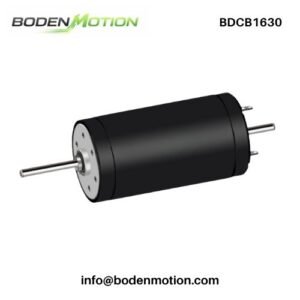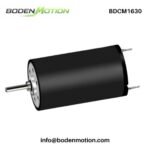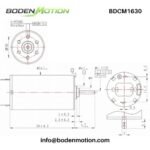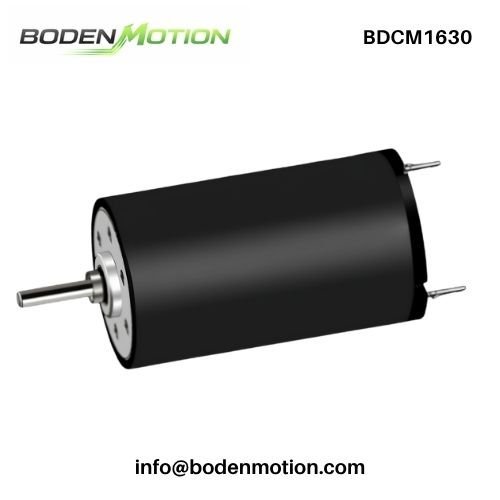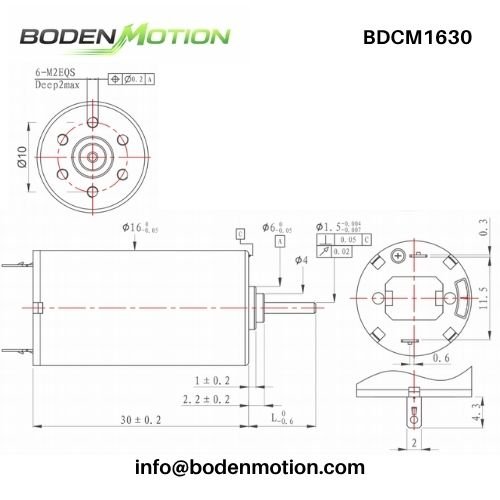
The BDCM1630 micro brushed DC motor uses a Ø16 × 30 mm coreless structure to provide more torque capacity than shorter 16 mm platforms while retaining a compact radial footprint. Rated torque reaches 4.4 mN·m, and the 30 g motor body makes it suitable for OEM mechanisms where moderate load capability, simple two-wire control, and compact packaging need to work together.
Four winding versions cover 3V, 6V, 12V, and 24V systems. Rated speed ranges from 6,240 to 9,600 rpm, while typical motor noise is specified at 38 dB or lower. For projects requiring a different output speed or feedback capability, planetary gearbox and photoelectric or magnetoelectric encoder configurations are available as options.
The four suffixes identify different winding configurations. Their current demand, speed, torque constant, and resistance differ, so voltage selection should be made together with the target operating point and available power supply.
| Motor Model | Unit | BDCM1630-01 | BDCM1630-02 | BDCM1630-03 | BDCM1630-04 |
|---|---|---|---|---|---|
| At Nominal | |||||
| Nominal Voltage | V/DC | 3 | 6 | 12 | 24 |
| Nominal Speed | rpm | 9,600 | 7,760 | 6,240 | 6,240 |
| Nominal Current | A | 1.9 | 0.8 | 0.3 | 0.1 |
| Nominal Torque | mN·m | 4.2 | 4.4 | 4.2 | 3.6 |
| Free Load | |||||
| No-load Speed | rpm | 12,000 | 9,700 | 7,800 | 7,800 |
| No-load Current | mA | 95 | 50 | 15 | 10 |
| At Max. Efficiency | |||||
| Maximum Efficiency | % | 80.5 | 78.5 | 80.7 | 76.6 |
| Speed | rpm | 10,920 | 8,730 | 7,098 | 6,942 |
| Current | A | 0.9 | 0.4 | 0.1 | 0.1 |
| Torque | mN·m | 1.9 | 2.2 | 1.9 | 2.0 |
| At Max. Output Power | |||||
| Maximum Output Power | W | 6.6 | 5.6 | 4.3 | 3.7 |
| Speed | rpm | 6,000 | 4,850 | 3,900 | 3,900 |
| Current | A | 4.5 | 2.0 | 0.7 | 0.3 |
| Torque | mN·m | 10.5 | 11.1 | 10.4 | 9.1 |
| At Stall | |||||
| Stall Current | A | 9.0 | 3.9 | 1.5 | 0.6 |
| Stall Torque | mN·m | 21.0 | 22.2 | 20.9 | 18.2 |
| Motor Constants | |||||
| Terminal Resistance | Ω | 0.33 | 1.56 | 8.28 | 37.50 |
| Terminal Inductance | mH | 0.02 | 0.08 | 0.39 | 1.05 |
| Torque Constant | mN·m/A | 2.36 | 5.83 | 14.54 | 28.92 |
| Speed Constant | rpm/V | 4,000.0 | 1,616.7 | 650.0 | 325.0 |
| Speed/Torque Constant | rpm/mN·m | 570.5 | 437.8 | 373.9 | 428.1 |
| Mechanical Time Constant | ms | 8.1 | 6.2 | 4.7 | 5.4 |
| Rotor Inertia | g·cm² | 1.36 | 1.36 | 0.90 | 0.90 |
| Number of Pole Pairs | — | 1 | 1 | 1 | 1 |
| Number of Phases | — | 5 | 5 | 5 | 5 |
| Weight | g | 30 | 30 | 30 | 30 |
| Typical Noise Level | dB | ≤38 | ≤38 | ≤38 | ≤38 |
Not sure how to interpret model differences? See the model code breakdown below ↓
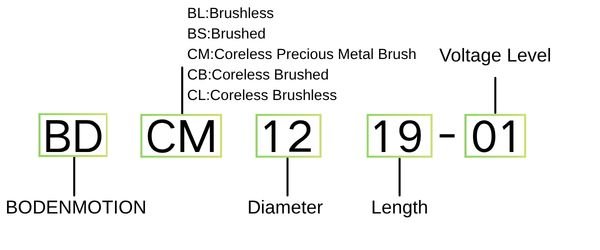
Maintaining low motor noise after installation depends on more than the motor itself. Shaft loading, coupling alignment, mounting stiffness, and the transmission can all add vibration or acoustic output to the finished assembly.
Shaft Load Control
The sintered metal bearing supports a maximum dynamic axial load of 0.5 N and a maximum radial load of 5 N, measured 5 mm from the flange. Overhung gears or pulleys should be evaluated carefully before placing their full load directly on the motor shaft.
Mechanical Clearance
Axial play is specified at 0.05–0.15 mm, while radial play is limited to 0.012 mm. Accurate coupling alignment helps reduce additional friction, vibration, and bearing stress.
Press-Fit Installation
Maximum static press-fit force is 15 N. Assembly force should be applied through the appropriate structural surface rather than transferred unnecessarily through the output shaft.
Noise-Sensitive Mounting
Rigid brackets can transmit motor vibration into the equipment housing, while thin panels may amplify it. The specified motor noise should therefore be checked again after installation into the final mechanism.
Thermal Environment
The motor is specified for ambient temperatures from −20°C to +80°C, relative humidity below 90% RH at 25°C, and rotor temperatures up to 125°C.
High-Current Operating Conditions
The 3V and 6V windings require substantially more current than the higher-voltage versions. Driver contacts, wiring, battery impedance, and connector resistance should be considered when these configurations are used under heavier loads.
The BDCM1630 can be adapted according to the target voltage platform, transmission design, feedback requirement, and final equipment layout.
| Customization Item | Available Options / Description |
|---|---|
| Winding Version | Standard 3V, 6V, 12V, or 24V configuration |
| Planetary Gearbox | Optional for reduced output speed and increased transmitted torque |
| Encoder Option | Optional photoelectric or magnetoelectric encoder |
| Operating Point | Winding selection based on speed, torque, current, and load requirements |
| Shaft Configuration | Shaft dimensions and geometry can be reviewed for the driven mechanism |
| Wiring / Lead Length | Connection arrangement can be adapted to the equipment layout |
| Connector Type | Connector requirements can be reviewed for the OEM harness |
| Mounting Interface | Mechanical adaptation can be evaluated for the final assembly |
| Prototype Combination | Motor, gearbox, and optional encoder can be tested together before production |
The gearbox and encoder are optional configurations rather than standard components of the base motor.
The BDCM1630 is relevant to compact equipment that requires more torque than smaller precious-metal brushed motors while still benefiting from simple DC control and relatively low acoustic output.
The main selection tradeoff in this motor platform is not simply voltage versus speed. Higher-current low-voltage windings, brush duty cycle, system noise, transmission losses, and mechanical loading all influence how the BDCM1630 behaves in the final product.
Germany | Precision Equipment Manufacturer
Application: compact optical adjustment mechanism
Feedback: The Ø16 mm motor diameter fit the existing mechanical envelope while providing enough torque to eliminate the need for a larger motor platform.
Japan | Laboratory Automation OEM
Application: sample-handling actuator
Feedback: The low motor noise helped reduce additional acoustic contribution inside the enclosed instrument during repeated movement cycles.
United States | Industrial Device Developer
Application: miniature geared drive
Feedback: The gearbox option allowed the team to reduce output speed while retaining the compact Ø16 mm motor structure used in the prototype.
[BDCM1630 Micro Precious Metal Brushed Coreless DC Motor Specification PDF]
A1: The models use different winding configurations. The 3V version has much lower terminal resistance and is rated at 1.9 A, while the 24V version is rated at 0.1 A. Power-supply and wiring requirements should therefore be selected for the specific winding rather than based on motor size alone.
A2: Motor-level acoustic performance does not include vibration from brackets, housings, gears, bearings, or driven components. Coupling alignment and mounting resonance should be checked at the complete system level.
A3: Not automatically. Maximum-output points involve higher current and lower speed than nominal operation. Continuous suitability should be confirmed using the actual load cycle, temperature rise, and required service interval.
A4: Yes. Samples can normally be shipped by FedEx or DHL, while bulk orders can be arranged by air or sea according to order quantity and destination.
A5: Yes. The BDCM1625 uses a shorter Ø16 × 25 mm body and belongs to the 4–8W product class. It is more suitable when axial installation space is tighter, while the BDCM1630 provides a longer Ø16 × 30 mm platform and rated torque up to 4.4 mN·m.
For compact OEM systems requiring a precious-metal brushed coreless motor, BODENMOTION supports selection around the actual power supply, mechanical load, acoustic target, and transmission requirements.
📧 Email: info@bodenmotion.com
🌐 Website: https://bodenmotion.com