A low-priced motor may look acceptable on a datasheet and in initial samples. However, the real test comes during mass production and long-term field operation, where early failures can manifest as rising noise, vibration, speed instability, or overheating.
Cheap mini BLDC motors can fail early when the cost reduction is achieved by compromising critical quality areas. These often include bearing selection, rotor balancing tolerance, electromagnetic consistency, and the depth of the supplier's testing process. The result can be a higher total cost of ownership due to warranty claims, field replacements, and reputational damage.
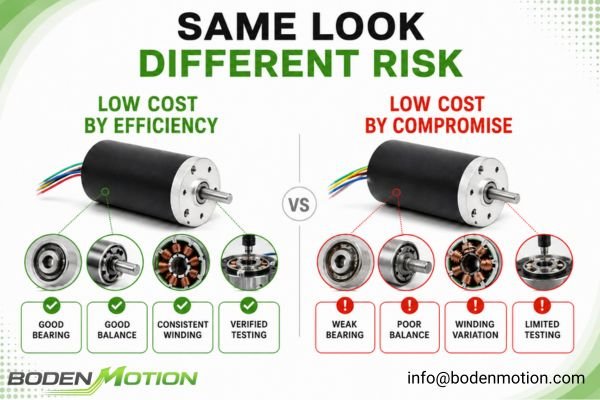
For OEM engineers and technical buyers, the key is not to reject all low-cost motors, but to understand how the supplier achieved their price. A low price from manufacturing efficiency is an advantage1; a low price from using substandard components is a hidden liability2. This article explains the common failure points and what to verify before a lower-priced motor increases your project risk.
What “Cheap Mini BLDC Motor” Really Means in OEM Purchasing
In OEM procurement, a "cheap" motor quote refers to one with a significantly lower unit price compared to alternatives with similar ratings. This can create confusion about whether the price reflects value or risk.
The challenge for engineers and buyers is to distinguish between a genuinely efficient product and one with hidden quality compromises, as the price difference can originate from very different sources.
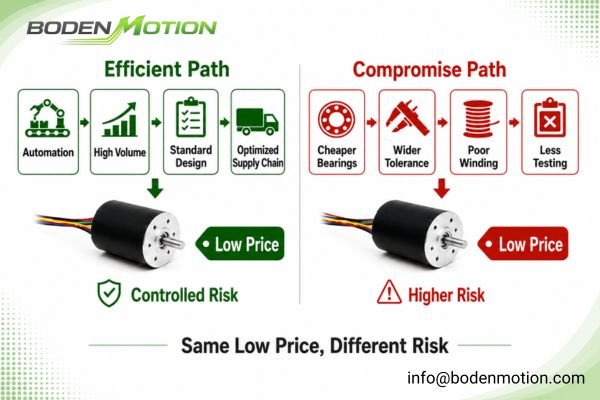
Reasonable Cost Reduction Sources (Lower Risk)
- Mature & Automated Production: Reduces labor costs and improves process consistency.
- High Production Volume: Creates economies of scale in material purchasing and amortization of overhead3.
- Standardized Design: Leverages a proven, off-the-shelf design with minimal non-recurring engineering costs.
- Optimized Supply Chain: Involves efficient sourcing and logistics for standard components.
Risky Cost Reduction Sources (Higher Risk)
- Lower-Cost Bearing Selection: Using bearings with wider quality variation, less stable lubrication, unsuitable internal clearance, or weaker material and process control.
- Wider Rotor Balancing Tolerance: Simplifying the balancing process or using wider acceptance limits to increase throughput.
- Inconsistent Winding Process: Sacrificing precision in winding tension, layering, and copper fill.
- Unstable Magnetic Material Grade: Using magnets with lower energy product or poor temperature stability.
- Limited Final Testing: Performing only a basic functional check instead of comprehensive performance verification.
A low price is not automatically a quality problem. The real risk depends on how the cost reduction was achieved and whether the motor has been validated under the actual application conditions.
Why Bearing Quality Strongly Affects Motor Lifetime
A common field pattern is a motor that is quiet when new but develops unacceptable acoustic noise after several months of operation. This often points to a problem that was not obvious during initial testing.
In many cases, the root cause is the bearing system, as its performance directly impacts motor lifetime by managing all mechanical loads and high-speed rotational forces.
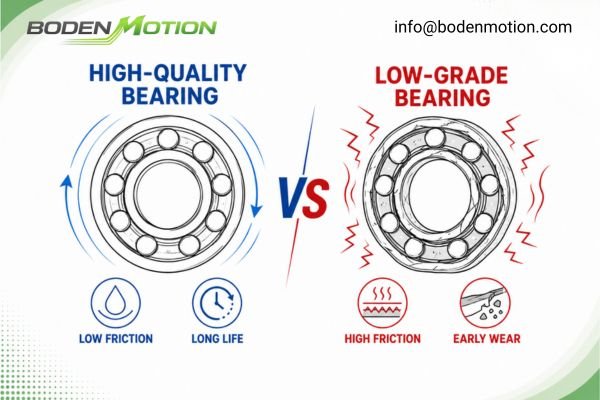
Loose dimensional control, unsuitable internal clearance, poor raceway finish, unstable lubrication, or inconsistent assembly can increase friction, vibration, and acoustic noise. While bearing precision ratings (like ABEC grades) define some dimensional and rotational accuracies, a higher rating alone does not guarantee lower noise or longer life. The entire system matters. Poor clearance, lubrication, or assembly control first increases friction, then raises temperature and vibration, and eventually accelerates bearing, insulation, and system-level wear.
For applications with defined lifetime, acoustic, high-speed, continuous-duty, or side-load requirements, bearing type, clearance, lubrication, mounting, and actual load conditions should be discussed explicitly with the supplier. However, even a well-selected bearing cannot reach its expected life if the rotor continuously applies an unbalanced cyclic load4.
How Poor Rotor Balancing Causes Noise, Vibration, and Early Wear
Rotor balancing determines how smoothly the motor operates, especially at high speeds, where even tiny imperfections can create major problems.
In compact motors that can spin at 10,000 or 20,000 RPM, a minuscule mass imbalance can generate significant disruptive forces that lead to premature wear.
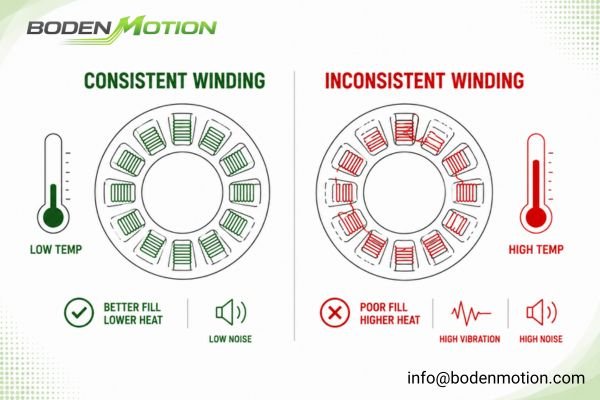
Because imbalance force rises with the square of rotational speed5, doubling the speed increases the force generated by the same imbalance by approximately four times. This force creates vibration, which is transmitted through the bearings to the motor housing and the final device structure. The balancing process may be applied with wider tolerances, simplified verification, or limited sampling when production cost is prioritized over vibration consistency.
Poor balancing has direct system-level consequences:
- Audible Noise and Vibration: Makes the end product feel low-quality.
- Accelerated Bearing Wear: The constant cyclic load fatigues the bearings, causing premature failure.
- Housing Resonance: The vibration can excite a resonant frequency in the equipment enclosure, amplifying noise.
Real Integration Challenge: It's important to distinguish between motor imbalance and load imbalance. This can be separated by measuring vibration with the motor running alone and then repeating the test after the fan, impeller, coupling, or other rotating load is installed.
For high-speed or vibration-sensitive applications, the balancing requirement should be defined using a measurable acceptance criterion. Mechanical balance determines how smoothly the rotor turns, but batch consistency also depends on how evenly the motor produces electromagnetic torque.
Why Winding Consistency and Magnetic Materials Matter
Electromagnetic consistency determines whether every motor in a production batch produces similar behavior under the same operating conditions.
Inconsistent winding, insulation, or magnetic materials create unit-to-unit variation in current, torque, efficiency, and temperature rise, leading to unreliable performance.
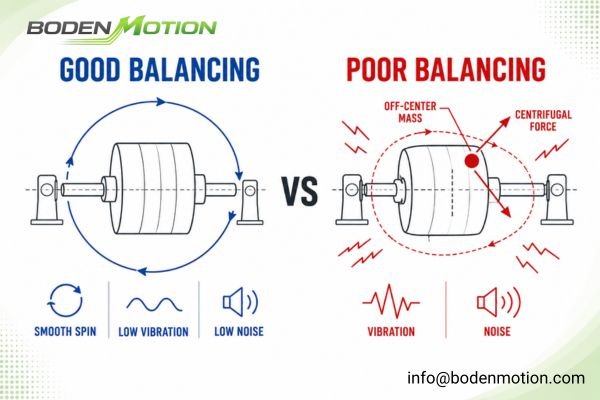
Several factors contribute to electromagnetic inconsistency in lower-cost production:
- Winding Variation: Uneven phase resistance or inductance can create current imbalance and uneven torque production, particularly when the driver parameters are not matched to the actual motor characteristics.
- Copper Fill and Thermal Path: If the winding design remains unchanged, lower effective copper fill or inconsistent conductor placement can increase resistance and reduce thermal efficiency, leading to a noticeably higher temperature rise under the same load conditions.
- Magnet & Insulation Stability: Using a magnet grade with insufficient temperature capability for the actual operating point—for example, selecting a standard N-grade where a higher-coercivity grade is required—can increase the risk of irreversible demagnetization during overheating. Similarly, thinner or lower-grade wire insulation can break down under thermal stress, causing a short circuit6.
These internal differences are not always visible during incoming inspection, which is why supplier testing must detect them before the motor enters OEM production.
How Weak Testing Standards Increase Batch Risk
A motor that only passes a basic functional check allows hidden long-term defects to enter the supply chain. This approach minimizes supplier cost but transfers risk directly to the OEM.
The cost of these failures is then shifted from the supplier to the OEM's warranty budget and brand reputation, often negating any initial price savings.
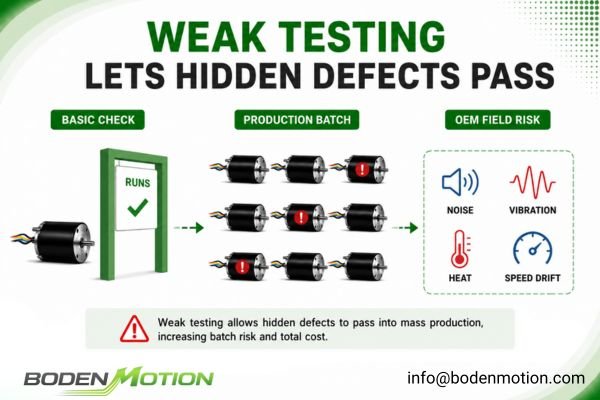
A practical quality plan must align testing depth with application risk. Not every test needs to be performed on every motor. A mature plan normally combines 100% end-of-line checks, such as basic function, direction, speed, current, and Hall signal verification where applicable, with sampling-based performance validation.
For OEM applications, sampling-based or qualification testing should verify:
- No-Load Current & Speed: A powerful indicator of friction, balancing, or winding issues.
- Noise & Vibration: Quantifies mechanical quality against an agreed acceptance limit.
- Temperature Rise: Ensures the motor has sufficient thermal margin under real-world load.
- Load Performance: Confirms the motor delivers the required torque and speed without stalling.
- Batch Consistency: Checks that critical parameters fall within a stable statistical distribution.
Consider a hypothetical production case: an initial sample lot performs normally, while a later production batch shows a higher rejection rate. This often indicates weak process control or insufficient testing at the supplier. Testing is only meaningful when the acceptance criteria reflect the actual load, speed, duty cycle, lifetime, and temperature requirements.
How Application Requirements Determine Whether a Low-Cost Motor Is Acceptable
Selecting a motor on price alone creates risk, but how do you know if a lower-cost option is truly acceptable for your specific device?
The answer lies in matching the motor's capabilities and the supplier's quality level to the application's actual load, lifetime, and environmental requirements.
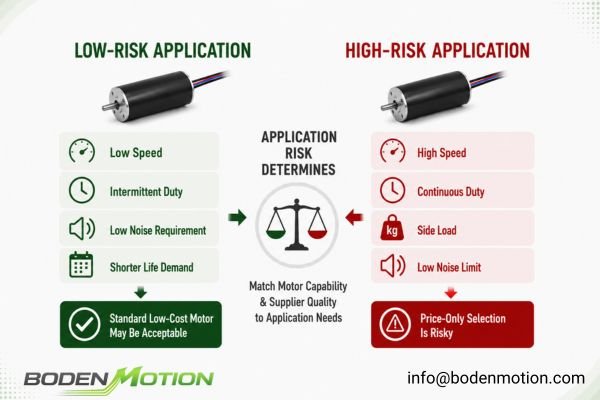
The selection process should start with the application risk, as not all applications have the same reliability demands7. For a low-speed, intermittent-duty application with minimal noise or lifetime requirements, a standard low-cost motor may be perfectly acceptable. For a high-speed, continuous-duty application with a side load, strict noise limits, or a long lifetime target, selecting purely on price is a significant risk8.
At BODENMOTION, application evaluation begins with the loaded speed, torque profile, duty cycle, thermal limits, driver conditions, noise target, and expected production volume. These inputs are used to compare motor options, define customization requirements, and establish sample-validation criteria before mass production.
Once the application risk level is clear, the next step is to verify whether the supplier can control the corresponding materials, processes, and test limits.
OEM Cost-Risk Checklist for Cheap Mini BLDC Motors
Once your application requirements are defined, you need a structured way to evaluate a potential supplier's ability to meet them consistently.
This checklist helps OEM buyers and engineers systematically verify a supplier's capabilities, framing the discussion around managing risk rather than just negotiating price.
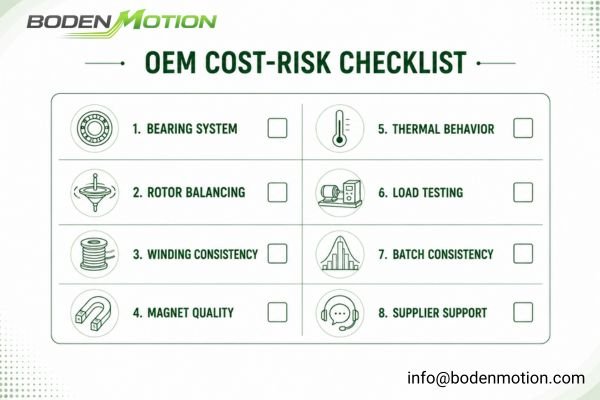
Use this checklist to structure your technical qualification of a potential supplier. Their ability to provide clear data and articulate their control processes for these areas is a strong indicator of their quality maturity.
| Risk Area | What to Check | Why It Matters |
|---|---|---|
| Bearing System | Bearing specs, lubrication, clearance, mounting, and lifetime data. | Affects noise, friction, heat, and long-term reliability. |
| Rotor Balancing | Balancing method, acceptance criteria, and vibration test data. | Affects vibration, bearing wear, and equipment noise, especially at high RPM.9 |
| Winding Consistency | Allowable range for phase resistance, inductance, and no-load current. | Affects heat, efficiency, torque ripple, and batch-to-batch performance. |
| Magnet Quality | Magnet grade, temperature rating, and supplier consistency. | Affects torque stability and prevents permanent demagnetization from overheating. |
| Thermal Behavior | Temperature rise test data under your specific load conditions. | Validates thermal margin, preventing insulation aging and performance drift. |
| Load Testing | Supplier's capability to perform loaded tests that simulate your application. | Reveals real-world torque margin and thermal stability problems. |
| Batch Consistency | Ask for batch distribution data, tolerance records, or Cpk values for critical characteristics when appropriate. | Validates that mass production units will perform like the approved samples. |
| Supplier Support | Technical capability for failure analysis, customization, and application support. | Reduces project risk and troubleshooting time after sample approval. |
Conclusion
Cheap mini BLDC motors can introduce significant project risk when cost savings are achieved by weakening materials, widening process tolerances, or limiting verification testing. These compromises often lead to early field failures that increase the total cost of ownership.
The lowest unit price does not guarantee the lowest project cost. A more robust selection process starts by defining the application's true requirements for lifetime, load, duty cycle, and noise. By matching the motor's specification and the supplier's quality system to these requirements, OEM teams can choose a solution that is genuinely cost-effective—one that delivers reliable performance for the entire life of the product.
At BODENMOTION, we help OEM engineers evaluate motor reliability, manufacturing quality, and application requirements to select the most suitable mini BLDC motor for long-term performance. If you're developing a new project or comparing motor suppliers, contact us at info@bodenmotion.com for technical discussion and OEM support.
FAQ
Q1: Why do some low-cost mini BLDC motors fail early?
Early failures often stem from compromises in critical areas like lower-grade bearings, wider rotor balancing tolerances, inconsistent winding, unstable magnet materials, or insufficient quality testing by the supplier.
Q2: Are all low-cost mini BLDC motors unreliable?
No. A low price can be the result of high production efficiency and a standardized design. The risk increases when the cost reduction sacrifices essential materials, process controls, or testing that are necessary to meet the application's lifetime and performance requirements.
Q3: Can a motor pass sample testing but still fail during mass production?
Yes. Initial samples may be produced under closely controlled conditions that are not fully representative of later mass production. Failures can occur due to process drift, material variation, or insufficient batch consistency control at the supplier. This is why verifying a supplier's quality system is as important as testing samples.
Q4: What tests should be completed before approving a mini BLDC motor for mass production?
A comprehensive qualification should include no-load current and speed checks, loaded performance and temperature rise tests under application conditions, noise and vibration measurements, and an endurance or reliability validation. The results are used to establish agreed-upon batch acceptance limits.
Q5: What information should an OEM provide when requesting a mini BLDC motor recommendation?
Provide the operating voltage, loaded speed, continuous and peak torque, load type (including any radial/axial forces), duty cycle, target lifetime, operating temperature, driver type, noise/vibration limits, and expected annual volume.
"How to Reduce Manufacturing Costs Without Sacrificing Quality - Cin7", https://www.cin7.com/blog/how-to-reduce-manufacturing-costs/. Industry sources and engineering literature note that manufacturing efficiency, such as process optimization and automation, can reduce production costs without compromising product quality. Evidence role: general_support; source type: education. Supports: A low price from manufacturing efficiency is an advantage.. Scope note: This support is general and may not apply to all manufacturing contexts or motor types. ↩
"Impact of Substandard Parts on Tractors - Kalapi Auto", https://kalapiauto.com/impact-of-substandard-parts-on-tractors/. Engineering standards and reliability studies indicate that the use of substandard components in electric motors can lead to increased failure rates and hidden long-term costs. Evidence role: general_support; source type: research. Supports: A low price from using substandard components is a hidden liability.. Scope note: The evidence generally applies to electric motors and may not address every possible scenario or component type. ↩
"How Production Volume Can Affect a Product's Design —> Part 1", https://www.sigmadzn.com/blog/how-production-volume-can-affect-a-products-design-part-1-defining-volumes-process-and-dfx. A standard economics reference explains that economies of scale occur when increased production volume leads to lower per-unit costs due to factors such as bulk purchasing and spreading fixed costs over more units. Evidence role: definition; source type: encyclopedia. Supports: High production volume creates economies of scale in material purchasing and amortization of overhead. ↩
"[PDF] BEARING DAMAGE AND FAILURE ANALYSIS - SKF", https://cdn.skfmediahub.skf.com/api/public/093168a92d25cc46/pdf_preview_medium/093168a92d25cc46_pdf_preview_medium.pdf. Engineering research and reliability standards indicate that unbalanced cyclic loads can significantly reduce bearing life by increasing dynamic stresses and accelerating fatigue failure. Evidence role: mechanism; source type: research. Supports: even a well-selected bearing cannot reach its expected life if the rotor continuously applies an unbalanced cyclic load.. Scope note: The degree of life reduction depends on the magnitude and frequency of the unbalanced load as well as bearing design. ↩
"[PDF] Rotating Unbalance", https://community.wvu.edu/~bpbettig/MAE340/Lecture_2_5_Rotating_unbalance.pdf. Standard texts in rotor dynamics state that the force due to mass imbalance in a rotating system is proportional to the square of the rotational speed, supporting the claim that doubling the speed increases the imbalance force by a factor of four. This relationship is widely accepted in mechanical engineering literature. Evidence role: mechanism; source type: education. Supports: imbalance force rises with the square of rotational speed, doubling the speed increases the force generated by the same imbalance by approximately four times. ↩
"Troubleshooting the most typical winding problems of three phase ...", https://electrical-engineering-portal.com/troubleshooting-winding-problems-three-phase-electric-motors. Engineering standards and educational resources describe how inadequate wire insulation in electric motors can fail under thermal stress, potentially leading to short circuits. Evidence role: mechanism; source type: education. Supports: Thinner or lower-grade wire insulation can break down under thermal stress, causing a short circuit.. Scope note: The precise failure temperature and risk depend on insulation class and motor design. ↩
"E-Motors in Industrial Applications: Performance, Efficiency & Long ...", https://berlin.cwiemeevents.com/articles/emotors-in-industrial-applications. Engineering literature and standards recognize that different applications impose varying reliability requirements on components such as electric motors, depending on factors like speed, duty cycle, and operational environment. Evidence role: expert_consensus; source type: encyclopedia. Supports: not all applications have the same reliability demands. Scope note: The support is general and may not address every specific application scenario. ↩
"Motor Selection - Monolithic Power Systems", https://www.monolithicpower.com/en/learning/mpscholar/electric-motors/motor-and-drive-selection/motor-selection?srsltid=AfmBOopYwg6g96EJglPHrV7lopLkxEGzZyLwigf_Zss6IJuirVCbX1dI. Engineering best practices caution that selecting electric motors solely based on price, without considering application-specific requirements, can lead to performance failures and increased lifecycle costs, especially in demanding use cases. Evidence role: expert_consensus; source type: education. Supports: For a high-speed, continuous-duty application with a side load, strict noise limits, or a long lifetime target, selecting purely on price is a significant risk.. Scope note: The evidence is based on general engineering consensus and may not reflect every individual case. ↩
"A New Deep Learning Framework for Imbalance Detection of ... - PMC", https://pmc.ncbi.nlm.nih.gov/articles/PMC10457798/. Technical literature confirms that improper rotor balancing increases vibration, accelerates bearing wear, and raises equipment noise, with these effects becoming more pronounced at higher rotational speeds. Evidence role: mechanism; source type: education. Supports: Affects vibration, bearing wear, and equipment noise, especially at high RPM. ↩