When designing a compact robotic actuator, engineers often face a critical trade-off between installation space, available output, dynamic response, and integration complexity. While many motor sizes exist, the 12mm diameter coreless motor is often worth evaluating as a practical starting point. This is not because 12mm is a magic number, but because it can represent a useful engineering compromise for mechanisms like miniature grippers, positioning modules, and robotic end-effectors.
The value of a 12mm coreless motor is not its diameter alone, but how well that diameter supports the complete robotic motion system, including the necessary gearing, feedback, and mechanical interfaces, without consuming excessive space or mass.

The suitability of a 12mm motor is ultimately determined by the specific application's requirements for torque, speed, control, and thermal performance. Simply choosing the smallest possible motor can lead to thermal overload, while oversizing adds unnecessary weight and bulk. Understanding where and why a 12mm platform fits can streamline the selection process.
What Makes the 12mm Diameter Practical for Compact Robotics?
From a mechanical design perspective, the 12mm diameter provides a useful spatial constraint for a variety of robotic mechanisms, such as gripper fingers, sampling equipment, and miniature linear actuators. It is small enough to be integrated into narrow assemblies where larger motors would be impractical.
A 12mm motor platform can provide sufficient internal space for an effective electromagnetic and mechanical design while remaining compact enough for space-constrained robotic systems. It is also a commercially available size category with multiple motor configurations and integration options.

Three factors contribute to its practicality:
- Mechanical Envelope: The 12mm body provides a starting point, but the complete actuator size also includes motor length, shaft extensions, wiring, and any attached gearbox or encoder1. This form factor can be incorporated into compact mechanisms when the surrounding structural components and transmission layout are designed accordingly.
- Component Design Space: Compared to sub-10mm motors, a 12mm diameter offers more internal volume2. Depending on the motor architecture, this can accommodate a larger magnetic circuit, additional winding volume, or more substantial bearings, creating potential advantages in torque capability and mechanical durability.
- Available Motor Platforms: OEM engineers can evaluate different winding configurations, operating voltages, motor lengths, and compatible gearbox or encoder arrangements within the 12mm size category.
How 12mm Coreless Motors Balance Torque, Speed, and Power
A motor's diameter influences its potential performance, but it does not define it. The actual output of a 12mm coreless motor depends on its active length, winding design, magnetic circuit strength, and thermal limits. A motor must be selected based on its ability to deliver the required torque and speed at the application's working point, not at a theoretical maximum.
Different windings affect a motor's speed constant (Kv) and torque constant (Kt), allowing its performance to be tailored for specific voltage and speed requirements. However, changing the winding does not automatically increase the motor's continuous torque capability, which also depends on allowable current, electromagnetic design, and heat dissipation.

For example, comparing two BODENMOTION 12mm brushless coreless motors at the same nominal voltage illustrates how significantly their operating characteristics can differ.
| Model | Nominal Voltage | Body Length | Rated Speed | Rated Torque | Weight |
|---|---|---|---|---|---|
| BDCL1220-03 | 12 V | 20 mm | 21,420 rpm | 0.34 mN·m | 9.5 g |
| BDCL1230-01 | 12 V | 30 mm | 13,685 rpm | 2.40 mN·m | 14 g |
Values are based on the published nominal specifications of the corresponding 12V motor variants. Actual operating performance depends on load, controller settings, and installation conditions.
Despite sharing the same 12mm diameter and nominal voltage, these motors offer substantially different rated torque, speed, and weight characteristics. The BDCL1230-01 provides higher rated torque but operates at a lower rated speed and has a longer, heavier body. These differences reflect their overall motor designs, not motor length alone.
For robotic actuator selection, this means that diameter should be treated as an initial installation constraint rather than a complete performance specification3. Engineers must evaluate whether the motor can deliver the required output within the available length, mass, and thermal limits.
Why Low-Inertia Coreless Designs Are Useful for Robotic Motion
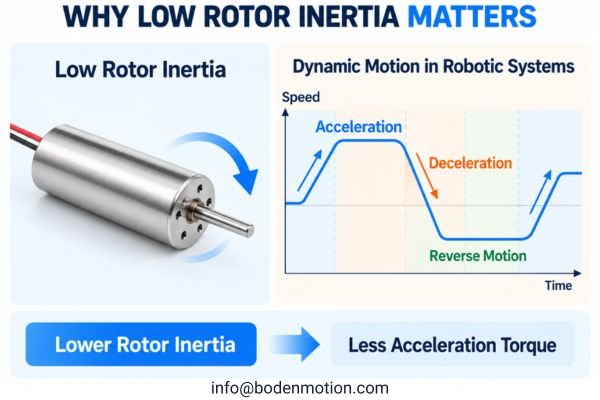
Compact robotic systems frequently perform tasks that require rapid changes in motion: repeated accelerations, short positioning movements, and frequent direction reversals. Low rotor inertia can be particularly valuable in these dynamic applications.
The lower the rotor inertia, the less torque is required to accelerate the motor itself at a given angular acceleration. This can improve dynamic response, although the final positioning performance must still be evaluated at the complete actuator level, accounting for load inertia, friction, transmission characteristics, and drive limitations.
The rotor construction differs between brushed and brushless coreless designs:
- Brushed Coreless Motors: In a typical brushed coreless design, the lightweight, ironless copper winding forms the rotor, which rotates around a stationary internal magnet4. Eliminating a conventional iron rotor core helps reduce rotating inertia.
- Brushless Coreless Motors: These designs typically feature a stationary coreless winding and a rotating permanent-magnet assembly. They can also offer favorable rotor inertia characteristics, although the actual inertia depends on the rotating magnet structure and must be verified for the specific motor.
Low rotor inertia is one reason coreless designs are considered for applications such as robotic dexterous hands, where rapid finger actuation and frequent motion changes are important.
However, a low-inertia motor does not automatically produce a fast actuator. The effective acceleration also depends on available motor torque, reflected load inertia, gearbox characteristics, and the driver's current limits.
Where Are 12mm Coreless Motors Used in Robotic Systems?
The combination of compact dimensions, available motor configurations, and integration options makes 12mm coreless motors suitable for evaluation in a range of robotic applications. The specific reason for selecting this diameter varies with the mechanism's primary function.
For a gripper, the available installation envelope and output force may be the main constraints. For a positioning module, feedback integration, mechanical stiffness, and transmission accuracy may be more important.

| Robotic Application | Main Motion Requirement | Why a 12mm Motor May Fit |
|---|---|---|
| Miniature Robotic Grippers | Compact gripping motion, controlled force | Small installation envelope, responsive motion, gearbox options |
| Robotic Pipetting Systems | Repeatable, precise, small-volume motion | Feedback integration and controllable movement |
| Precision Positioning Modules | Controlled speed and displacement | Encoder options and compatible precision transmissions |
| Compact Robotic End-Effectors | Low weight, limited installation space | Lightweight cylindrical motor package and useful output capability |
| Miniature Linear Actuators | Controlled thrust and linear travel | Can be paired with gearing and lead screws |
| Small Inspection Probes | Smooth scanning motion | Compact dimensions and potential for low-cogging operation |
For a miniature robotic gripper, the primary challenge is fitting the drive mechanism within the gripper finger or base while delivering sufficient gripping force. A 12mm motor combined with a suitable transmission can be a practical option, but the required motor torque depends on the gripping mechanism, mechanical advantage, and transmission efficiency5.
For a compact positioning actuator, the focus shifts toward resolution, repeatability, and mechanical stiffness6. The combination of an encoder and a low-backlash transmission may be important, particularly when the application requires accurate bidirectional positioning.
In either case, choosing the motor diameter is only one step. The actual actuator must be evaluated against the mechanism's required force, speed, positioning performance, and available installation space.
How Gearboxes and Encoders Turn a 12mm Motor Into a Robotic Actuator
In robotics, a bare motor is rarely the final solution. The motor's output must be adapted to the load's requirements through transmission components and, where closed-loop control is required, monitored with suitable feedback devices.
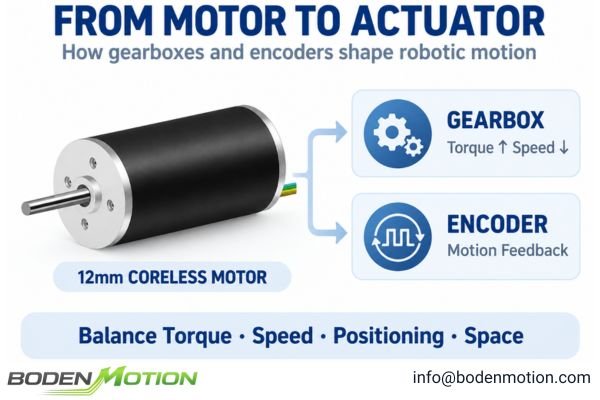
A 12mm coreless motor becomes part of a complete robotic actuator when its speed and torque are matched to the load through a transmission and its motion is controlled using the appropriate feedback system. Selecting these integrated components is just as important as selecting the motor itself.
-
Gearbox Integration: A gearbox, often a planetary gearhead in compact designs, increases output torque while reducing output speed.7 The approximate output torque is
T_output ≈ T_motor × N × η, whereNis the gear ratio andηis the gearbox efficiency under the operating conditions. Engineers must also consider the gearbox's rated torque, backlash, mechanical efficiency, and lifetime under the expected load. -
Encoder Integration: An encoder provides feedback for closed-loop position and speed control. However, high encoder resolution does not automatically guarantee high output positioning accuracy. If the encoder is mounted on the motor shaft, backlash and torsional deformation in the gearbox or couplings can introduce errors between the measured motor position and the final actuator output.
-
Linear Actuator Integration: For applications requiring linear motion, a 12mm motor can be integrated with a lead screw and nut, with or without additional gearing. The screw lead and gear ratio influence linear speed, while available motor torque and transmission efficiency determine the achievable thrust.8 The screw's load capacity and mechanical characteristics must also be considered.
For a miniature robotic gripper, these relationships create a practical engineering trade-off. Increasing the gear ratio can provide greater output torque, but it also reduces output speed.9 The final gripping force depends on how the output torque is converted into linear or angular gripping motion through the mechanism.
A higher reduction ratio may therefore help achieve the required gripping force but can make the gripper slower during opening and closing. Additional transmission stages may also increase overall length, mechanical losses, backlash, or cost.
The objective is not simply to maximize gear reduction, but to find a motor-transmission combination that satisfies gripping force, motion speed, positioning requirements, and available space simultaneously.
What Limits the Performance of a 12mm Coreless Motor in Robotics?
While a 12mm coreless motor offers a useful balance of compactness and performance potential, it is not without limitations. Operating beyond its design limits can lead to overheating, premature wear, or mechanical failure.
A compact motor may have sufficient peak performance but still be unsuitable for a robotic application if the required continuous torque, thermal margin, mechanical loading, or lifetime exceeds its design limits. These constraints must be evaluated based on the complete motion cycle.
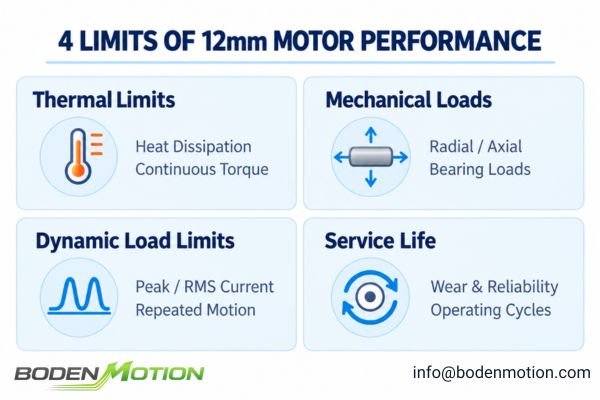
Engineers must consider four key constraints:
-
Thermal Constraints: Continuous torque is limited by the motor's ability to dissipate heat, with winding losses related to I²R heating10. In a compact, enclosed robotic actuator, heat dissipation may be worse than under the datasheet's reference conditions. The allowable continuous operating point must therefore be evaluated against the actual mounting and ambient conditions, with derating applied where necessary.
-
Mechanical Load Limits: The motor's bearings can only handle specified radial (sideways) and axial (push/pull) loads. Exceeding these limits can accelerate bearing wear or cause premature failure. The gearbox and actuator output bearings may have separate load limits that must also be checked.
-
Dynamic Load Limits: Repetitive acceleration and deceleration can produce substantial current peaks. RMS (root mean square) current is a useful indicator for evaluating winding heating over a motion cycle, but it must be considered alongside the motor's thermal characteristics, peak current duration, cooling conditions, and driver limits.
-
Lifetime Considerations: For brushed coreless motors, the brush-commutator system is an important wear mechanism. For brushless motors, bearing wear is often a major lifetime consideration. The expected operating hours, number of motion cycles, mechanical loading, and temperature conditions must be compared with the motor's specified lifetime and validation conditions.
When Should Engineers Choose a Motor Smaller or Larger Than 12mm?
The decision to move away from a 12mm platform is driven by engineering constraints that make it less suitable for a particular application. The objective is to identify the most compact motor configuration that can reliably satisfy the required operating conditions.
A 12mm motor is not the ideal size for every robotic mechanism. Its usefulness depends on whether it provides sufficient performance without the constraints of excessive miniaturization or the additional size and mass of an unnecessarily large motor.

As discussed in our comparison of 6mm, 12mm, and 16mm coreless motors, choosing a motor diameter involves balancing installation dimensions, output capability, dynamic requirements, and thermal performance.
| Engineering Constraint | Potential Direction | Main Trade-Off |
|---|---|---|
| Extremely limited space | Consider smaller motors (e.g., 8mm, 10mm) | Less available space for torque production, heat dissipation, and mechanical components |
| Moderate torque in a compact design | Evaluate 12mm platforms | Balance of performance, integration options, and thermal margin |
| Higher continuous torque demand | Consider larger motors (e.g., 16mm, 17mm) | Greater size and mass, potentially higher system cost |
| High torque at very low speed | Evaluate suitable motor and gearbox combinations | Gear reduction increases torque but adds length, losses, backlash, and cost |
| Very strict positioning accuracy | Focus on feedback and transmission | Motor diameter alone is insufficient; may require high-resolution feedback and low-backlash transmission |
A smaller motor may be necessary when installation space is the dominant constraint. Conversely, a larger motor may be appropriate when a 12mm platform cannot provide the required continuous torque or sufficient thermal margin for the duty cycle.
However, larger diameter does not automatically mean higher electrical power consumption at the same mechanical output11. Actual efficiency and energy requirements depend on the motor design and operating point.
How to Select a 12mm Coreless Motor for a Robotic Application
Selecting the right 12mm motor is a systematic process that starts with the load and works back to the motor. It requires defining the complete mechanical, electrical, and control requirements of the robotic actuator.
A successful selection process begins with a clear definition of the actuator's required output and installation constraints. This allows engineers to evaluate motor, gearbox, and feedback options to find a suitable combination without unnecessary oversizing.
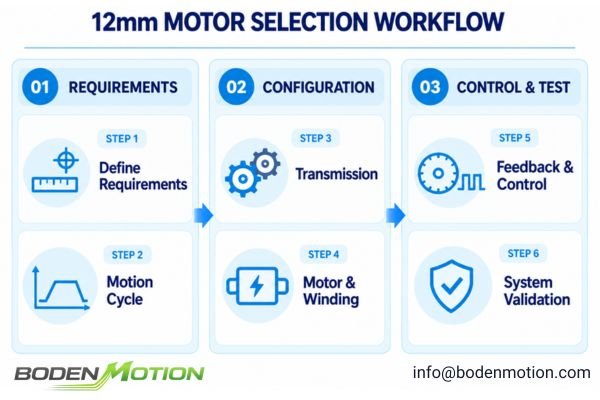
Follow these steps for a robust selection:
- Define Mechanical Requirements: Determine the maximum allowable diameter and length, supply voltage, and the required output speed, continuous torque, and peak torque for the application.
- Characterize the Motion Cycle: Define the duty cycle, including running times, rest times, acceleration profiles, and frequent direction changes.
- Determine Transmission Needs: Decide whether a gearbox or linear transmission is required to match the motor's operating characteristics to the load. Calculate the required ratio and account for transmission efficiency.
- Select Motor Architecture: Choose between brushed and brushless designs based on lifetime, cost, operating requirements, and control complexity12. Select a winding suitable for the supply voltage and required operating point.
- Evaluate Feedback and Control: Specify the required position or speed feedback, encoder resolution, and compatibility with the motor driver. Consider whether feedback should be measured at the motor shaft or actuator output.
- Validate the System: Prototype and test the complete actuator under realistic load conditions to verify output performance, temperature rise, dynamic response, and positioning accuracy.
Conclusion
12mm coreless motors represent a practical option for many compact robotic systems, offering a useful balance between installation size, dynamic performance, and available output capability. Their suitability for applications such as miniature grippers and positioning mechanisms depends on how effectively they are integrated with the appropriate transmission and feedback components. For OEM engineers evaluating different motor configurations, BODENMOTION offers a range of coreless motors for compact motion applications.
However, motor diameter alone does not guarantee performance. Reliable integration requires evaluating the complete actuator, including continuous torque, thermal management, load characteristics, motion cycles, and lifetime expectations. If you are developing a compact robotic actuator, BODENMOTION can help evaluate suitable motor configurations and integration options. Share your installation dimensions, supply voltage, target output torque and speed, motion cycle, and gearbox or encoder requirements with our engineering team at info@bodenmotion.com to discuss your application.
FAQ
Q1: Why are 12mm coreless motors used in compact robotic systems?
They offer a practical balance between a small installation footprint, useful mechanical output, and the dynamic response potential of coreless designs, making them a viable option for space-constrained actuators.
Q2: Are 12mm coreless motors suitable for robotic grippers?
Yes, they can be suitable for compact robotic grippers, particularly when paired with a transmission that provides the required gripping force and motion speed. The final suitability depends on the gripping mechanism, duty cycle, and available installation space.
Q3: Can a 12mm coreless motor provide precise positioning?
Yes, a 12mm motor can be used in precise positioning systems when integrated with appropriate feedback and mechanical transmission components. However, final output accuracy depends on encoder placement and resolution, gearbox backlash, mechanical stiffness, and control strategy.
Q4: Do 12mm coreless motors always need a gearbox?
No. For applications where the required speed and torque fall within the motor's direct-drive capabilities, a gearbox may not be necessary. Gearboxes are primarily used to increase output torque while reducing speed.
Q5: Is a 12mm motor better than a 16mm motor for robotics?
Neither size is universally better. A 12mm motor may offer advantages in size and weight, while a 16mm motor generally provides more design space for higher torque and thermal capacity. The choice depends on the application's actual operating requirements.
Q6: What information should OEM engineers provide when selecting a 12mm coreless motor?
Provide the maximum installation dimensions (diameter and length), supply voltage, required output torque and speed at the load, a detailed motion cycle (including acceleration, run times, and rest times), ambient temperature, and any requirements for a gearbox or encoder.
FIRGELLI Automations, "Linear Actuator Selection and Sizing Engineering Guide," discusses installation dimensions, mechanical packaging, and the need to evaluate the full actuator configuration against the available space. It provides general actuator-sizing guidance rather than a component-by-component dimensional specification for miniature motor, gearbox, encoder, and wiring assemblies. ↩
Alva Industries, "The Scaling Rule for Frameless Motors – Diameter, Length, & Torque: A Practical Design Guide" (May 21, 2026), explains how motor diameter and length influence geometric design space and electromagnetic performance. Although the article addresses frameless motors, its geometric principle helps explain why a larger diameter allows greater cross-sectional space in otherwise comparable constructions. ↩
Bryan Sisler, "Three Steps to Size Motors," Plant Engineering (August 6, 2019), explains that selecting a motor requires assessing load characteristics, torque, speed, duty requirements, operating environment, and available electrical power. Its industrial-motor guidance supports treating physical fit as one constraint rather than a complete performance specification. ↩
Mir A. Hossain, "Coreless DC Motors: A Guide to Choosing the Right One," Assun Motor (November 29, 2023), describes brushed coreless motors with lightweight ironless rotor windings rotating around stationary permanent magnets. This construction reduces rotating mass and differs from typical brushless coreless motor architectures. ↩
ZAYTRAN, "Robotic Gripper Sizing: The Science, Technology and Lore," explains how gripping method, finger geometry, applied gripping force, and moment arms affect mechanical force and torque requirements. The guide addresses gripper-side loads; motor-shaft torque must additionally account for the particular drive mechanism and its losses. ↩
Xeryon, "Mini & Micro Linear Actuators: A Complete Guide to Compact Precision Motion," discusses resolution, repeatability, feedback integration, and mechanical play as selection considerations for miniature precision actuators. Mechanical stiffness is a related design consideration but is not directly analyzed in this guide. ↩
Wikipedia, "Epicyclic Gearing," describes planetary gear-train configurations and the relationships among gear ratio, output speed, and torque. In a reduction configuration, output speed decreases while ideal torque increases; actual performance depends on mechanical efficiency and load ratings. ↩
MOONS', "Thrust Generation Principle of a Linear Lead Screw Motor," explains the relationship between screw lead, rotational speed, input torque, transmission efficiency, and theoretical axial thrust. The article addresses lead-screw behavior; the effect of an additional gearbox ratio follows from the separate gear-speed and gear-torque relationships. ↩
University of California San Diego, MAE 3, "Gear Ratios," explains through rotational speed ratios and conservation of power why higher gear reduction produces lower output speed and higher ideal output torque, subject to real-world mechanical losses. ↩
Northwestern University, "Mystery Motor Data Sheet," ME 333 Introduction to Mechatronics, pp. 2–3, identifies resistive winding heating as I²R loss and explains that maximum continuous motor current and torque are limited by allowable heat dissipation. Its illustrative thermal power limit is an educational assumption, not a universal motor rating. ↩
U.S. Department of Energy, "Determining Electric Motor Load and Efficiency," Motor Challenge fact sheet, pp. 1, 7–8, defines motor efficiency as useful mechanical output divided by electrical input and discusses how efficiency varies with operating load. These principles show why input power at a given mechanical output cannot be inferred from motor size alone; the document does not directly compare miniature motor diameters. ↩
Groschopp, Inc., "The Basics of Motor Selection: A Designer's Guide to Motor Types and Customizations" (2016), pp. 3, 5–6, 8–9, and 12–15, compares brushed permanent-magnet DC and brushless DC motors in terms of lifetime, brush wear, cost, operating requirements, and control needs. The guide emphasizes selecting a motor architecture based on the complete application requirements. ↩