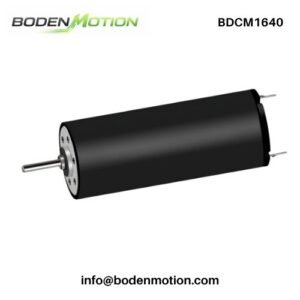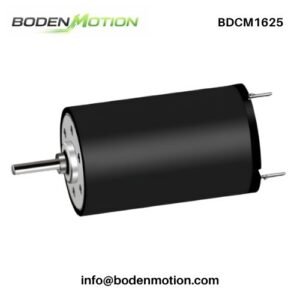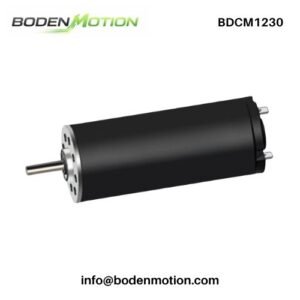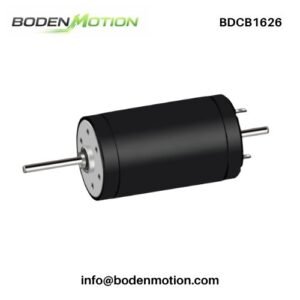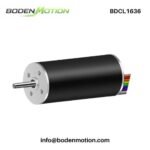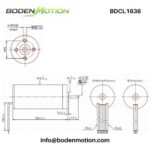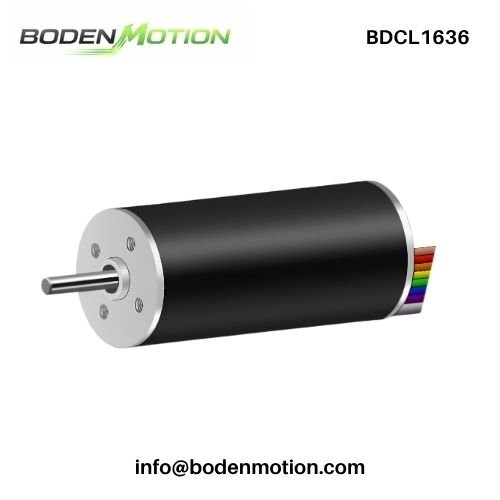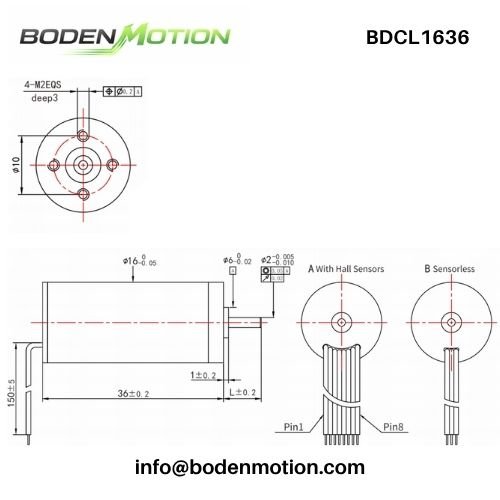
The BDCL1636 coreless brushless DC motor is built for applications that need more torque and power from a compact 16 mm motor platform. Its Ø16 × 36 mm body combines a 29 g structure with rated torque up to 6.57 mN·m, giving OEM designers additional performance margin for compact actuators, robotic mechanisms, and higher-load embedded motion systems.
Four winding versions cover 9V, 12V, 18V, and 24V, with rated speeds remaining between 14,276 and 15,355 rpm. The platform can be configured with Hall-sensor or sensorless wiring, while planetary gearbox and magnetoelectric encoder options extend the motor into applications requiring lower output speed, additional torque, or feedback capability.
The four models share the same Ø16 × 36 mm mechanical platform but use different winding configurations. Voltage, current, torque constant, target speed, and driver capability should therefore be evaluated together when selecting the final version.
| Motor Model | Unit | BDCL1636-01 | BDCL1636-02 | BDCL1636-03 | BDCL1636-04 |
|---|---|---|---|---|---|
| At Nominal | |||||
| Nominal Voltage | V/DC | 9 | 12 | 18 | 24 |
| Nominal Speed | rpm | 15,355 | 14,760 | 15,258 | 14,276 |
| Nominal Current | A | 1.51 | 1.19 | 0.71 | 0.56 |
| Nominal Torque | mN·m | 6.39 | 6.57 | 5.38 | 5.90 |
| Free Load | |||||
| No-load Speed | rpm | 18,500 | 18,000 | 17,950 | 17,200 |
| No-load Current | mA | 180 | 135 | 130 | 100 |
| At Max. Efficiency | |||||
| Maximum Efficiency | % | 72.2 | 72.2 | 67.2 | 65.8 |
| Speed | rpm | 16,095 | 15,660 | 15,168 | 14,448 |
| Current | A | 1.197 | 0.897 | 0.730 | 0.532 |
| Torque | mN·m | 4.60 | 4.74 | 5.56 | 5.55 |
| At Max. Output Power | |||||
| Maximum Output Power | W | 17.2 | 17.2 | 16.8 | 15.6 |
| Speed | rpm | 9,250 | 9,000 | 8,975 | 8,600 |
| Current | A | 4.1 | 3.1 | 2.1 | 1.5 |
| Torque | mN·m | 17.80 | 18.25 | 17.93 | 17.35 |
| At Stall | |||||
| Stall Current | A | 8.00 | 6.00 | 4.00 | 2.80 |
| Stall Torque | mN·m | 35.50 | 36.50 | 35.85 | 34.69 |
| Motor Constants | |||||
| Terminal Resistance | Ω | 1.13 | 2.00 | 4.50 | 8.57 |
| Terminal Inductance | mH | 0.070 | 0.125 | 0.282 | 0.265 |
| Torque Constant | mN·m/A | 4.54 | 6.22 | 9.26 | 12.85 |
| Speed Constant | rpm/V | 2,056 | 1,500 | 997 | 717 |
| Speed/Torque Constant | rpm/mN·m | 521.0 | 493.2 | 500.6 | 495.8 |
| Mechanical Time Constant | ms | 2.73 | 2.58 | 2.62 | 2.60 |
| Rotor Inertia | g·cm² | 0.50 | 0.50 | 0.50 | 0.50 |
| Number of Pole Pairs | — | 1 | 1 | 1 | 1 |
| Number of Phases | — | 3 | 3 | 3 | 3 |
| Weight | g | 29 | 29 | 29 | 29 |
| Typical Noise Level | dB | ≤50 | ≤50 | ≤50 | ≤50 |
Not sure how to interpret model differences? See the model code breakdown below ↓
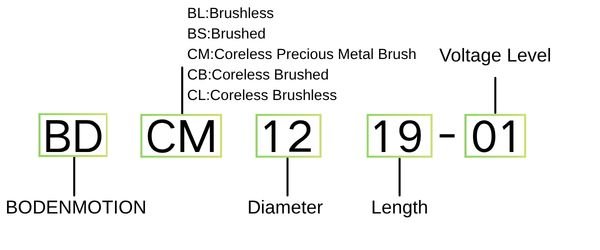
The combination of higher torque and relatively low rotor inertia makes the BDCL1636 suitable for dynamic mechanisms, but mechanical alignment, driver sizing, and bearing loading remain important during integration.
Shaft Load Limits
The sintered metal bearing system supports a maximum dynamic axial load of 0.8 N and a maximum radial load of 8 N, measured 5 mm from the flange.
Bearing Configuration
Ball-bearing and sleeve-bearing options are available. The preferred arrangement depends on radial loading, rotational stability, acoustic requirements, and expected operating cycle.
Mechanical Clearance
Axial play is specified at 0.05–0.15 mm, while radial play is limited to 0.015 mm. Coupling and gearbox alignment should be controlled to avoid unnecessary bearing stress.
Press-Fit Protection
Maximum static press-fit force is 10 N. Installation force should be applied through the correct motor structure rather than transferred through the output shaft.
Driver Current Margin
Nominal current ranges from 0.56 to 1.51 A, while stall current reaches 2.8–8.0 A depending on the winding. The BLDC driver should therefore provide suitable acceleration current, current limiting, and protection.
Thermal Environment
Ambient temperature is specified from −20°C to +80°C, relative humidity below 90% RH at 25°C, and maximum rotor temperature at 85°C.
The BDCL1636 can be configured according to the power platform, controller architecture, transmission requirements, and feedback needs of the OEM system.
| Customization Item | Available Options / Description |
|---|---|
| Winding Version | 9V, 12V, 18V, or 24V configuration |
| Feedback Configuration | Hall-sensored or sensorless motor arrangement |
| Bearing Type | Ball bearing or sleeve bearing |
| Planetary Gearbox | Optional for lower output speed and increased transmitted torque |
| Encoder Option | Optional magnetoelectric encoder for additional motion feedback |
| Cable Length | Can be adapted to controller position and equipment layout |
| Connector Type | Connector format can be reviewed according to the OEM harness |
| Wire Sequence | Cable, connector, and wire sequence can be customized |
| Shaft Interface | Shaft requirements can be reviewed according to the driven mechanism |
| Prototype Configuration | Motor, feedback, bearing, gearbox, and encoder combination can be evaluated before production |
Hall-sensored versions use Hall Sensor A, B, and C together with a 3.5–25 VDC VHall supply, while sensorless versions use the three motor phase connections.
The BDCL1636 is suited to compact systems where a 16 mm motor must deliver more torque and power while retaining fast brushless response.
Final selection should consider the real load inertia, acceleration target, gearbox ratio, current limit, thermal environment, and operating cycle.
The BDCL1636 sits in a performance range where motor size alone no longer determines whether the application will work. Driver current, load inertia, transmission ratio, feedback method, and thermal conditions all influence how much of the available torque can be used reliably.
Germany | Robotics Equipment Manufacturer
Application: compact auxiliary joint
Feedback: The Ø16 mm motor platform provided the required torque while keeping the joint housing smaller than the previous drive assembly.
Japan | Automation System OEM
Application: high-speed positioning mechanism
Feedback: The low rotor inertia helped the actuator respond quickly during repeated acceleration and deceleration cycles.
United States | Industrial Device Developer
Application: Hall-sensored geared actuator
Feedback: The configurable feedback and gearbox options allowed the motor platform to be adapted to the existing controller and mechanical transmission.
[BDCL1636 Coreless Brushless DC Motor Specification PDF]
A1: Nominal current describes operation at the rated point, while acceleration or heavy transient loads can require significantly more current. For example, the 24V version is rated at 0.56 A but reaches 2.8 A at stall, so the driver should provide appropriate transient-current margin and protection.
A2: Hall feedback can be useful when startup under load or defined rotor-position information is important. Sensorless control reduces wiring and may be suitable when the controller and application can provide reliable startup without additional position sensors.
A3: Not automatically. The 18.25 mN·m value applies to the 12V winding at its maximum-output test point, where speed falls to 9,000 rpm and current rises to 3.1 A. Continuous suitability should be checked against thermal limits and the actual duty cycle.
A4: Yes. Volume pricing is available for OEM orders, with the final quotation depending on quantity, customization requirements, and production configuration.
A5: Yes. The BDCL1624 uses a shorter Ø16 × 24 mm body and belongs to the 1–3W power class. It is more suitable when axial space and lower power consumption matter more than the BDCL1636’s higher torque and 7–18W output range.
For robotics, automation, and compact industrial motion systems requiring more torque from a 16 mm coreless brushless platform, BODENMOTION supports selection around the complete motor, driver, feedback, and mechanical system.
📧 Email: info@bodenmotion.com
🌐 Website: https://bodenmotion.com