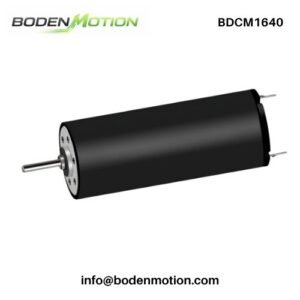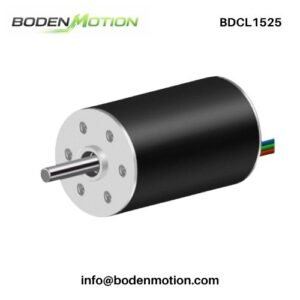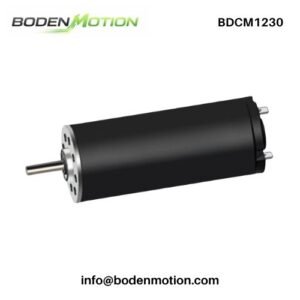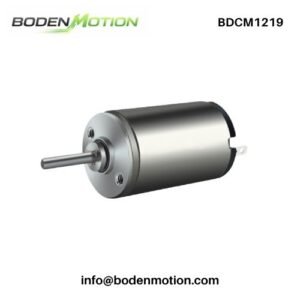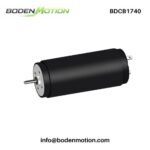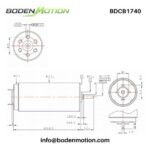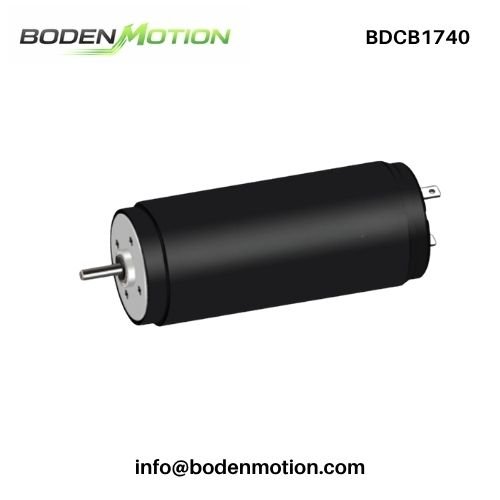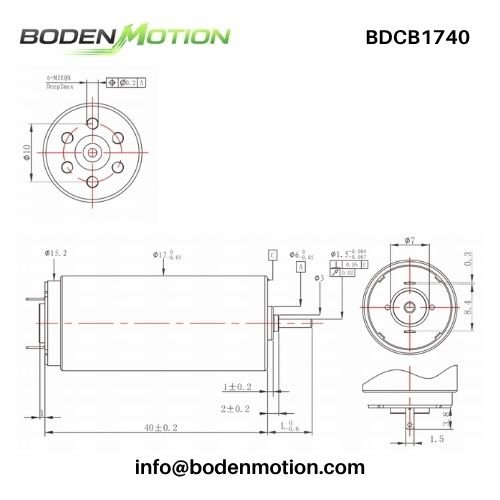
The BDCB1740 17mm hollow cup motor is built for robotic mechanisms that need stronger torque and power without moving to a substantially larger motor diameter. Its Ø17 × 40 mm graphite brushed platform provides a 10–30W power class, rated torque up to 9.8 mN·m, and a 48 g structure suitable for compact actuators, joints, and transmission assemblies.
The three winding versions support 6V, 12V, and 24V systems, allowing OEM engineers to balance supply voltage, operating current, speed, and torque according to the robot architecture. The 12V version reaches the highest rated speed at 18,590 rpm, while the 24V version provides the highest rated torque at 9.8 mN·m with a lower nominal current of 0.74 A.
The suffixes identify separate winding configurations. Voltage, driver current capacity, target speed, torque demand, and duty cycle should be evaluated together before selecting the final motor version.
| Motor Model | Unit | BDCB1740-01 | BDCB1740-02 | BDCB1740-03 |
|---|---|---|---|---|
| At Nominal | ||||
| Nominal Voltage | V/DC | 6 | 12 | 24 |
| Nominal Speed | rpm | 11,408 | 18,590 | 13,520 |
| Nominal Current | A | 1.54 | 1.97 | 0.74 |
| Nominal Torque | mN·m | 6.0 | 9.5 | 9.8 |
| Free Load | ||||
| No-load Speed | rpm | 13,500 | 22,000 | 16,000 |
| No-load Current | mA | 120 | 130 | 48 |
| At Max. Efficiency | ||||
| Maximum Efficiency | % | 78.6 | 80.3 | 80.4 |
| Speed | rpm | 12,218 | 19,910 | 14,480 |
| Current | A | 0.99 | 1.26 | 0.47 |
| Torque | mN·m | 3.7 | 5.8 | 6.0 |
| At Max. Output Power | ||||
| Maximum Output Power | W | 13.59 | 35.22 | 26.43 |
| Speed | rpm | 6,750 | 11,000 | 8,000 |
| Current | A | 4.71 | 6.07 | 2.27 |
| Torque | mN·m | 19.2 | 30.6 | 31.5 |
| At Stall | ||||
| Stall Current | A | 9.30 | 12.00 | 4.50 |
| Stall Torque | mN·m | 38.5 | 61.2 | 63.1 |
| Motor Constants | ||||
| Terminal Resistance | Ω | 0.65 | 1.00 | 5.33 |
| Terminal Inductance | mH | 0.028 | 0.075 | 0.290 |
| Torque Constant | mN·m/A | 4.19 | 5.15 | 14.17 |
| Speed Constant | rpm/V | 2,250.0 | 1,833.3 | 666.7 |
| Speed/Torque Constant | rpm/mN·m | 351.0 | 359.7 | 253.6 |
| Mechanical Time Constant | ms | 6.2 | 6.4 | 4.5 |
| Rotor Inertia | g·cm² | 1.69 | 1.69 | 1.69 |
| Number of Pole Pairs | — | 1 | 1 | 1 |
| Number of Phases | — | 5 | 5 | 5 |
| Weight | g | 48 | 48 | 48 |
| Typical Noise Level | dB | ≤42 | ≤42 | ≤42 |
Not sure how to interpret model differences? See the model code breakdown below ↓
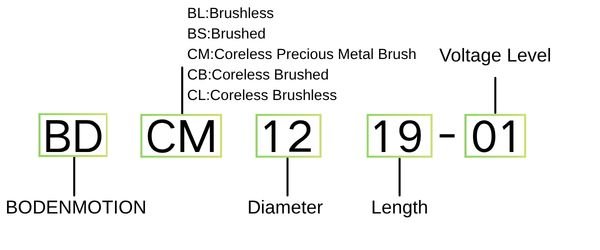
The BDCB1740 provides higher torque and power than shorter 17 mm motors, but the final actuator design must still manage shaft loading, coupling alignment, current demand, and heat generation.
Radial and Axial Load Control
The bearing system supports a maximum dynamic axial load of 0.8 N and a maximum radial load of 8 N, measured 5 mm from the flange. External bearings or additional support should be considered when gears, belts, or offset loads create higher shaft forces.
Shaft Alignment
Axial play is specified at 0–0.1 mm, while radial play is limited to 0.015 mm. Accurate alignment between the motor, coupling, and gearbox helps reduce vibration, bearing stress, and uneven brush loading.
Driver and Supply Sizing
Nominal current ranges from 0.74 to 1.97 A, but stall current reaches 4.5–12 A. The driver and power supply should provide suitable acceleration current while using current limiting to protect the winding and brush system.
Thermal Validation
The permitted ambient temperature range is −20°C to +80°C, and rotor temperature should remain below 125°C. Temperature testing should use the actual enclosure, gearbox, operating cycle, and mechanical load.
Gearbox Integration
A planetary gearbox can convert the motor’s rotational speed into higher actuator torque. Gear ratio selection should account for required joint speed, transmission efficiency, startup load, and reflected inertia.
Customization should focus on the elements that directly affect robotic integration and actuator performance. Options beyond the standard specification remain subject to engineering confirmation.
| Customization Item | Available Options / Description |
|---|---|
| Winding Version | Standard 6V, 12V, or 24V configuration |
| Operating Point | Selection based on target speed, torque, current, and duty cycle |
| Shaft Configuration | Shaft length and output geometry can be reviewed for the transmission |
| Gearbox Option | Planetary gearbox for reduced speed and increased output torque |
| Lead Wire Length | Cable length and routing reviewed according to actuator layout |
| Connector Type | Connector format matched to the controller and wiring harness |
| Mounting Interface | Mechanical adaptation reviewed for the robotic assembly |
| Terminal Arrangement | Electrical terminal configuration subject to project requirements |
| Prototype Configuration | Sample motor selected for load, temperature, and lifetime testing |
The planetary gearbox is the optional component explicitly identified in the specification; other modifications should be confirmed according to technical feasibility and order requirements.
The BDCB1740 is suited to systems where compact diameter, relatively high torque, and a durable brushed motor platform are more important than minimizing motor length or weight.
Final selection should be based on joint torque, gearbox ratio, movement cycle, holding requirements, available current, and expected maintenance interval.
A motor for robotics should not be selected from rated torque alone. Gear reduction, startup friction, reflected inertia, holding time, brush loading, and current limits all influence the usable output of the final actuator.
Germany | Robotics System Integrator
Application: compact rotary joint actuator
Feedback: The 24V winding provided the required torque with lower operating current, while the planetary gearbox helped meet the target joint speed.
Japan | End-Effector Manufacturer
Application: electric gripper mechanism
Feedback: The Ø17 mm motor frame provided useful torque within the available housing diameter and supported repeated gripping cycles during prototype testing.
United States | Automation Equipment Developer
Application: indexing actuator
Feedback: The 12V version supplied the required speed margin while maintaining a compact mechanical layout for the integrated transmission module.
[BDCB1740 17mm Hollow Cup Graphite Brushed DC Motor Specification PDF]
A1: Actual joint torque is reduced by gearbox efficiency, bearing friction, coupling losses, misalignment, and changes in supply voltage. The calculation should also include startup friction and the torque needed to accelerate the load inertia.
A2: Not automatically. The 35.22W value applies to the 12V winding at a specific maximum-output test point, where current reaches 6.07 A and speed falls to 11,000 rpm. Continuous use should be confirmed through temperature, brush-wear, and duty-cycle testing.
A3: The choice depends on the available voltage, current limit, target motor speed, and gearbox ratio. The 12V version provides the highest rated speed, while the 24V version provides the highest rated torque with lower nominal current.
A4: BODENMOTION is located in Shenzhen, China. Customer visits can be arranged by appointment so the relevant engineering, production, and project teams are available.
A5: Yes. The BDCB1725 uses a shorter Ø17 × 25 mm body, weighs 28 g, and provides rated torque of 3.28–3.81 mN·m. It is more suitable when axial space and weight are more important than the BDCB1740’s higher torque and power capability.
For robotic joints, grippers, and compact automation actuators, BODENMOTION supports motor selection based on the complete load, gearbox, controller, and duty-cycle requirements.
📧 Email: info@bodenmotion.com
🌐 Website: https://bodenmotion.com