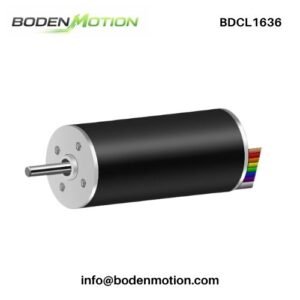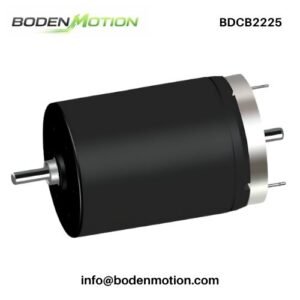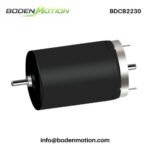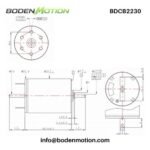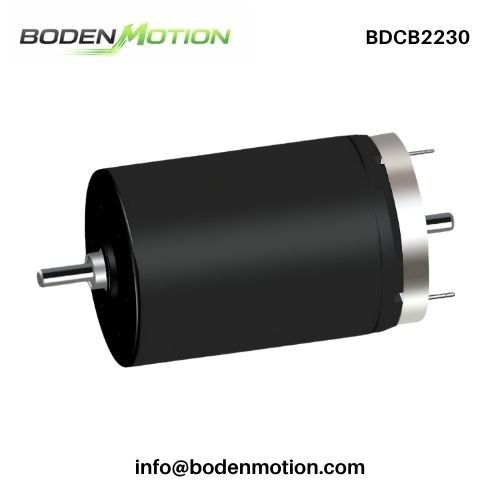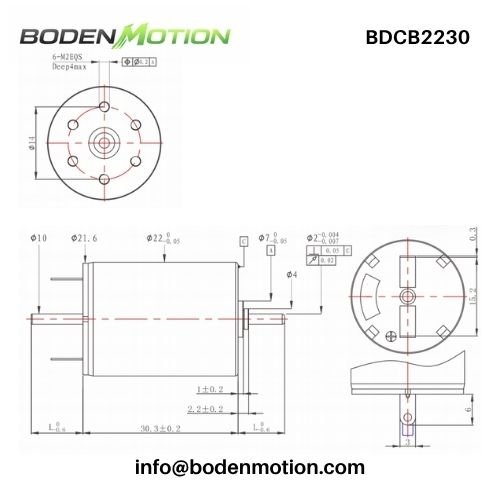
The BDCB2230 coreless electric motor features a Ø22 × 30 mm coreless design with graphite brush commutation, combining compact dimensions with durable brushed operation and straightforward DC control.
Its longer 30 mm body provides increased performance capacity for compact actuators, positioning mechanisms, and industrial drive systems. Available with multiple winding options, the motor can also be configured with an optional planetary gearbox and encoder for higher-torque or feedback-controlled applications.
The four versions use different windings, so voltage, rated current, speed, torque, and controller capacity should be considered together. Maximum-output and stall data describe higher-load test conditions and should not be treated as continuous ratings.
| Motor Model | Unit | BDCB2230-01 | BDCB2230-02 | BDCB2230-03 | BDCB2230-04 |
|---|---|---|---|---|---|
| At Nominal | |||||
| Nominal Voltage | V/DC | 6 | 12 | 18 | 24 |
| Nominal Speed | rpm | 9,492 | 10,248 | 9,234 | 9,405 |
| Nominal Current | A | 0.88 | 0.63 | 0.42 | 0.29 |
| Nominal Torque | mN·m | 3.91 | 5.22 | 5.79 | 5.26 |
| Free Load | |||||
| No-load Speed | rpm | 11,300 | 12,200 | 10,800 | 11,000 |
| No-load Current | mA | 90 | 65 | 45 | 30 |
| At Max. Efficiency | |||||
| Maximum Efficiency | % | 74.97 | 74.93 | 75.42 | 75.85 |
| Speed | rpm | 9,944 | 10,736 | 9,558 | 9,735 |
| Current | A | 0.679 | 0.489 | 0.339 | 0.234 |
| Torque | mN·m | 2.93 | 3.91 | 4.60 | 4.17 |
| At Max. Output Power | |||||
| Maximum Output Power | W | 7.23 | 10.41 | 11.30 | 10.44 |
| Speed | rpm | 5,650 | 6,100 | 5,400 | 5,500 |
| Current | A | 2.55 | 1.83 | 1.32 | 0.92 |
| Torque | mN·m | 12.22 | 16.30 | 19.98 | 18.13 |
| At Stall | |||||
| Stall Current | A | 5.00 | 3.60 | 2.60 | 1.80 |
| Stall Torque | mN·m | 24.45 | 32.60 | 39.96 | 36.26 |
| Motor Constants | |||||
| Terminal Resistance | Ω | 1.20 | 3.33 | 6.92 | 13.33 |
| Terminal Inductance | mH | 0.190 | 0.403 | 0.850 | 1.600 |
| Torque Constant | mN·m/A | 4.98 | 9.22 | 15.64 | 20.49 |
| Speed Constant | rpm/V | 1,883.3 | 1,016.7 | 600.0 | 458.3 |
| Speed/Torque Constant | rpm/mN·m | 462.2 | 374.2 | 270.3 | 303.3 |
| Mechanical Time Constant | ms | 13.05 | 11.08 | 7.90 | 9.09 |
| Rotor Inertia | g·cm² | 2.70 | 2.83 | 2.79 | 2.54 |
| Number of Pole Pairs | — | 1 | 1 | 1 | 1 |
| Number of Phases | — | 5 | 5 | 5 | 5 |
| Weight | g | 54 | 54 | 54 | 54 |
| Typical Noise Level | dB | ≤42 | ≤42 | ≤42 | ≤42 |
Not sure how to interpret model differences? See the model code breakdown below ↓
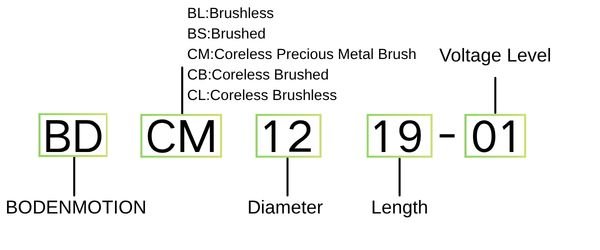
The BDCB2230 can tolerate greater mechanical loading than many smaller coreless motors, but bearing life and brush performance still depend strongly on shaft alignment, transmission design, and operating cycle.
Shaft Load Management
The sintered metal bearing supports a maximum dynamic axial load of 0.8 N and a maximum radial load of 8 N, measured 5 mm from the flange. Overhung gears, pulleys, and offset couplings should be designed so unnecessary side loads are not transferred directly to the motor.
Bearing Clearance
Axial play is specified at 0–0.1 mm. Sintered metal bearing radial play is limited to 0.03 mm, while ball-bearing radial play is limited to 0.015 mm.
Gearbox Alignment
When a planetary gearbox is added, shaft concentricity and coupling alignment should be checked carefully. Misalignment can increase friction, noise, bearing load, and current consumption.
Encoder Installation
Photoelectric and magnetoelectric encoders are optional accessories rather than standard motor components. Their installation length, wiring, resolution, and controller compatibility should be considered during actuator packaging.
Thermal Limits
The specified ambient range is −20°C to +80°C, relative humidity should remain below 90% RH at 25°C, and rotor temperature should not exceed 125°C.
Brush Duty Cycle
Frequent reversing, repeated high-current acceleration, or extended operation near the maximum-output region can increase graphite brush wear. Continuous-duty validation should use the actual load profile and enclosure conditions.
The BDCB2230 can be configured as a simple brushed motor or developed into a geared and feedback-enabled drive assembly according to the control and mechanical requirements of the OEM system.
| Customization Item | Available Options / Description |
|---|---|
| Winding Version | 6V, 12V, 18V, or 24V standard winding |
| Planetary Gearbox | Optional for lower speed and higher transmitted torque |
| Encoder Option | Optional photoelectric or magnetoelectric encoder |
| Shaft Configuration | Shaft length and geometry can be reviewed for the driven component |
| Bearing Configuration | Bearing arrangement can be evaluated according to load and precision requirements |
| Wiring / Lead Length | Electrical connection length and routing can be adapted to equipment layout |
| Connector Type | Connector selection can be reviewed according to the control system |
| Mounting Interface | Mechanical adaptation can be evaluated for the final actuator assembly |
| Prototype Combination | Motor, gearbox, and optional encoder can be tested as one integrated configuration |
The gearbox and encoder should be added according to application requirements rather than treated as standard components of the base motor.
The BDCB2230 is suitable for OEM mechanisms that need a durable brushed motor platform with enough torque and mechanical capacity to support either direct drive or a compact transmission.
Final selection should consider required output torque, gearbox efficiency, reversing frequency, feedback requirements, and expected service interval.
For a graphite brushed motor in the 22 mm class, the key question is not simply how much torque the motor can produce, but how that torque will be used over the complete duty cycle. Winding selection, transmission losses, brush wear, encoder requirements, and shaft loading all affect the final actuator.
Germany | Industrial Actuator Manufacturer
Application: compact valve drive
Feedback: The Ø22 × 30 mm motor provided sufficient torque margin for the transmission while keeping the actuator diameter within the existing housing design.
Japan | Precision Automation OEM
Application: encoder-assisted adjustment mechanism
Feedback: The optional encoder configuration allowed the development team to add motion feedback without changing the basic brushed motor platform used during prototype evaluation.
United States | Laboratory Equipment Developer
Application: automated sample-handling module
Feedback: The graphite brush motor maintained consistent operation across repeated movement cycles while the 24V winding matched the equipment’s existing DC supply architecture.
[BDCB2230 Coreless Graphite Brushed DC Motor Specification PDF]
A1: The 11.30 W value is measured at the maximum-output operating point of the 18V winding, where speed falls to 5,400 rpm and current rises to 1.32 A. It should not be treated automatically as a continuous operating rating.
A2: No. Photoelectric and magnetoelectric encoders are optional components. The standard motor can operate without encoder feedback, while an encoder can be added when the application requires speed or position monitoring.
A3: There is no single best winding. For example, the 18V version provides the highest rated torque at 5.79 mN·m, while the 24V version draws the lowest nominal current at 0.29 A and still provides 5.26 mN·m. The final choice should reflect the available supply, driver capacity, and required operating point.
A4: There is no strict MOQ for standard evaluation orders. Sample quantities, pilot runs, and volume production can be arranged according to project stage and customization requirements.
A5: Yes. The BDCB2225 uses a shorter Ø22 × 25 mm body and belongs to the 4–10W power class. It is more suitable when axial installation space is tighter, while the BDCB2230 provides a longer Ø22 × 30 mm platform for applications that can accommodate the additional length.
For OEM actuators requiring a durable graphite brushed motor, optional gearing, or feedback capability, BODENMOTION supports configuration selection around the complete mechanical and control system.
📧 Email: info@bodenmotion.com
🌐 Website: https://bodenmotion.com