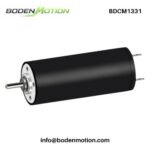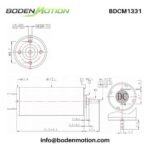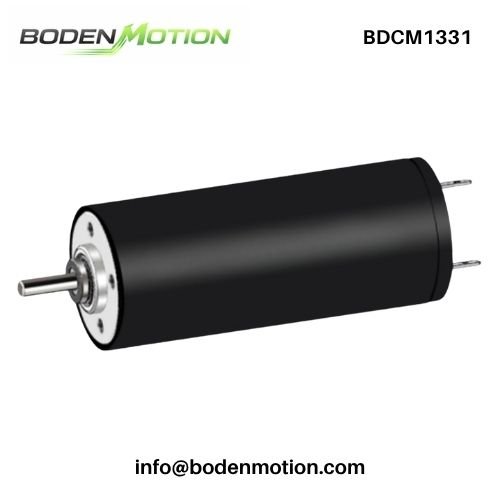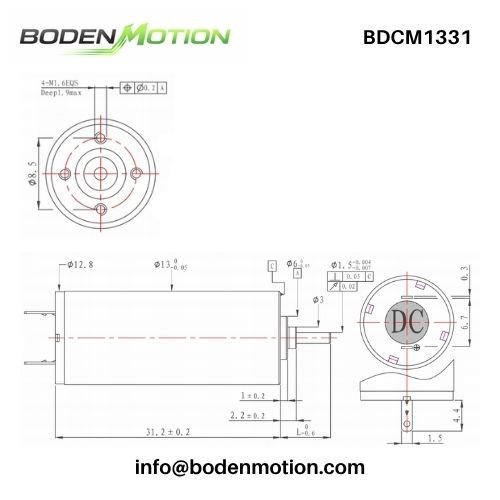
The BDCM1331 coreless brushed DC motor combines a Ø13 × 31 mm cylindrical body with a 20 g structure, providing more output capacity than shorter motors without moving to a substantially larger diameter. Its 2.5–4.5W product class is suited to compact industrial automation mechanisms that require responsive acceleration, controlled motion, and straightforward DC drive integration.
Four winding versions cover 3V, 6V, 12V, and 24V power platforms. Depending on the selected winding, rated speed ranges from 8,800 to 12,960 rpm and rated torque from 2.0 to 4.1 mN·m. The precious-metal brush system and coreless rotor structure support smooth rotation and a typical acoustic output of 38 dB for noise-sensitive automation assemblies.
The suffixes represent different winding configurations rather than interchangeable supply settings. The 2.5–4.5W designation identifies the product class, while the maximum-output figures below describe separate test operating points and should not be treated as recommended continuous power.
| Motor Model | Unit | BDCM1331-01 | BDCM1331-02 | BDCM1331-03 | BDCM1331-04 |
|---|---|---|---|---|---|
| At Nominal | |||||
| Nominal Voltage | V/DC | 3 | 6 | 12 | 24 |
| Nominal Speed | rpm | 9600 | 8800 | 9280 | 12960 |
| Nominal Current | A | 0.9 | 0.5 | 0.2 | 0.4 |
| Nominal Torque | mN·m | 2.1 | 2.4 | 2.0 | 4.1 |
| Free Load | |||||
| No-load Speed | rpm | 12000 | 11000 | 11600 | 16200 |
| No-load Current | mA | 45.0 | 30.0 | 18.0 | 12.0 |
| At Max. Efficiency | |||||
| Maximum Efficiency | % | 80.8 | 75.8 | 69.4 | 70.5 |
| Speed | rpm | 10920 | 9735 | 9918 | 13932 |
| Current | A | 0.4 | 0.3 | 0.2 | 0.3 |
| Torque | mN·m | 0.9 | 1.4 | 1.5 | 3.7 |
| At Max. Output Power | |||||
| Maximum Output Power | W | 3.2 | 3.5 | 3.1 | 11.1 |
| Speed | rpm | 6000 | 5500 | 5800 | 8100 |
| Current | A | 2.22 | 1.22 | 0.56 | 0.77 |
| Torque | mN·m | 5.1 | 6.0 | 5.0 | 10.5 |
| At Stall | |||||
| Stall Current | A | 4.40 | 2.40 | 1.08 | 1.57 |
| Stall Torque | mN·m | 10.3 | 12.1 | 10.1 | 21.0 |
| Motor Constants | |||||
| Terminal Resistance | Ω | 0.68 | 2.50 | 11.11 | 12.31 |
| Terminal Inductance | mH | 0.05 | 0.12 | 0.27 | 0.75 |
| Torque Constant | mN·m/A | 2.36 | 5.12 | 9.60 | 13.78 |
| Speed Constant | rpm/V | 4000.0 | 1833.3 | 966.7 | 675.0 |
| Speed/Torque Constant | rpm/mN·m | 1166.1 | 910.0 | 1150.3 | 618.5 |
| Mechanical Time Constant | ms | 8.0 | 6.2 | 7.9 | 4.2 |
| Rotor Inertia | g·cm² | 0.65 | 0.65 | 0.65 | 0.65 |
| Number of Pole Pairs | — | 1 | 1 | 1 | 1 |
| Number of Phases | — | 5 | 5 | 5 | 5 |
| Weight | g | 20 | 20 | 20 | 20 |
| Typical Noise Level | dB | ≤38 | ≤38 | ≤38 | ≤38 |
Not sure how to interpret model differences? See the model code breakdown below ↓
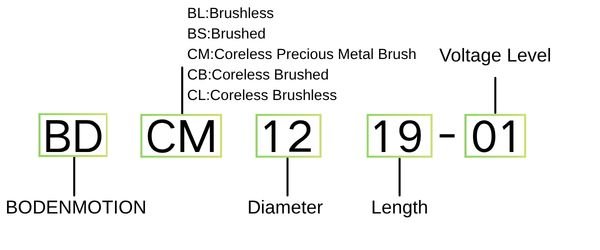
The BDCM1331 should be evaluated as part of the complete mechanism. Mounting rigidity, coupling alignment, shaft loading, supply stability, and operating cycle can all affect speed consistency, acoustic performance, and brush life.
Shaft Load Control
The sintered metal bearing supports a maximum dynamic axial load of 0.3 N and a maximum radial load of 1.2 N, measured 5 mm from the flange. Pulley, belt, cam, and offset-coupling designs should avoid transferring excessive side load to the motor shaft.
Coupling and Alignment
Axial play is specified at 0.05–0.15 mm, while radial play is limited to 0.012 mm. Accurate shaft alignment helps reduce vibration, uneven bearing loading, and additional system noise.
Press-Fit Protection
The maximum specified static press-fit force is 20 N. Assembly force should be applied through the correct structural surface rather than directly through the shaft or bearing system.
Acoustic Integration
The 38 dB figure represents typical motor-level noise. Thin brackets, hollow enclosures, gears, and poorly aligned couplings may amplify vibration after installation, so system-level acoustic testing remains necessary.
Temperature and Duty Cycle
The ambient operating range is −20°C to +80°C, relative humidity should remain below 90% RH at 25°C, and rotor temperature should not exceed 85°C. Long operating cycles should be validated under the actual load and enclosure conditions.
The selected configuration should reflect the available power supply, required operating point, installation envelope, and transmission design. Options beyond the standard datasheet should be confirmed through engineering review.
| Customization Item | Available Options / Description |
|---|---|
| Winding Version | Standard 3V, 6V, 12V, or 24V configuration |
| Operating Point | Model selection based on target speed, torque, current, and duty cycle |
| Shaft Design | Shaft length or end geometry can be reviewed for the driven mechanism |
| Lead and Terminal Format | Electrical connection arrangement subject to project confirmation |
| Mounting Interface | Mechanical adaptation reviewed according to the equipment structure |
| Gearbox Option | Planetary gearbox available for speed reduction and torque multiplication |
| Sample Configuration | Prototype version selected for real-load validation before production |
The planetary gearbox is the optional component specifically identified in the supplied specification. Other mechanical or electrical changes remain subject to feasibility review.
The BDCM1331 is best considered for compact automation mechanisms that need moderate brushed-motor power, responsive motion, and relatively low acoustic output.
Final suitability depends on the actual starting load, transmission ratio, operating time, current limit, and required service life.
For a precious-metal brushed motor, the lowest-noise or highest-speed version is not automatically the best choice. The winding, current requirement, mechanical load, operating cycle, and transmission structure must be evaluated together.
Germany | Industrial Automation Integrator
Application: compact valve adjustment module
Feedback: The 24V winding matched the existing control platform while the narrow motor diameter simplified installation inside the actuator housing.
Japan | Precision Instrument Manufacturer
Application: automated optical adjustment mechanism
Feedback: Smooth low-inertia response improved fine movement during repeated positioning cycles without requiring a larger motor frame.
United States | Laboratory Equipment OEM
Application: sample-handling drive assembly
Feedback: The motor provided the required speed range while keeping the completed mechanism quieter than the previous geared drive design.
[BDCM1331 Coreless Precious Metal Brushed DC Motor Specification PDF]
A1: Each suffix uses a different winding design, which changes resistance, torque constant, speed constant, current, and output characteristics. The 24V version should be treated as a distinct configuration rather than as the same motor operated at a higher voltage.
A2: The datasheet figure applies to the motor under specified test conditions. Mounting resonance, gear contact, coupling misalignment, enclosure vibration, and the driven load can increase system-level acoustic output.
A3: Not necessarily. Maximum-output data represents a specific test point with higher current and lower speed than nominal operation. Continuous suitability should be confirmed through temperature, brush-wear, and duty-cycle testing in the final equipment.
A4: There is no strict MOQ for standard evaluation orders. Sample quantities, pilot batches, and production orders can be arranged according to the project stage and customization requirements.
A5: Yes. The BDCM1320 uses a shorter Ø13 × 20 mm body, weighs 13 g, and belongs to the 1–2W power class. It is more suitable when axial space and system weight are more important than the BDCM1331’s higher output capability.
For automation projects requiring a compact precious-metal brushed motor, BODENMOTION supports configuration selection based on the complete electrical, mechanical, and operating requirements.
📧 Email: info@bodenmotion.com
🌐 Website: https://bodenmotion.com