When selecting a BLDC motor, many OEM engineers compare basic specifications like voltage, speed, torque, and size. However, the internal motor structure—specifically whether it is slotless or slotted—can profoundly affect motion quality, thermal performance, control complexity, and overall system cost.
In this article, "standard BLDC motor" refers to a conventional slotted BLDC motor. The choice between a slotless and a standard slotted BLDC motor represents a fundamental trade-off. Slotless motors prioritize motion smoothness and low motor-induced disturbance, while standard slotted motors often prioritize torque density, thermal capability, and cost-effectiveness.
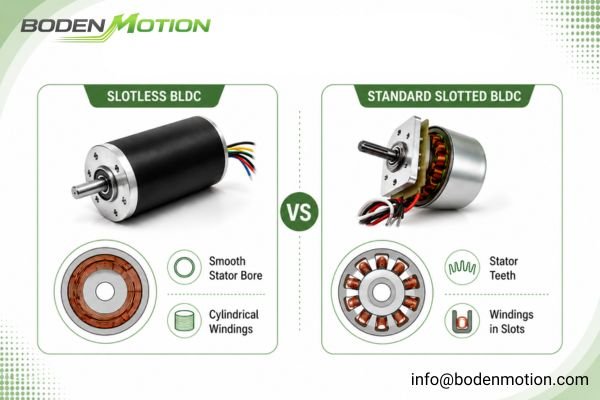
From our experience with OEM motor selection, teams that compare only rated torque and speed may overlook critical system-level factors like low-speed torque ripple, continuous-duty thermal limits, or driver compatibility. The best choice is not about which motor is more advanced, but which design philosophy better aligns with the dominant constraints of your application1.
How Stator Structure Changes BLDC Motor Performance
The key difference between these two motor types lies entirely in the stator's construction. This single design choice influences the motor's magnetic circuit, thermal pathways, winding style, and manufacturing method, leading to distinct performance characteristics.
A standard slotted BLDC motor uses a laminated iron core with slots, or "teeth," cut into its inner surface where copper windings are inserted. This approach brings the windings into close proximity with the rotor magnets and uses the iron teeth to concentrate and direct the magnetic flux.
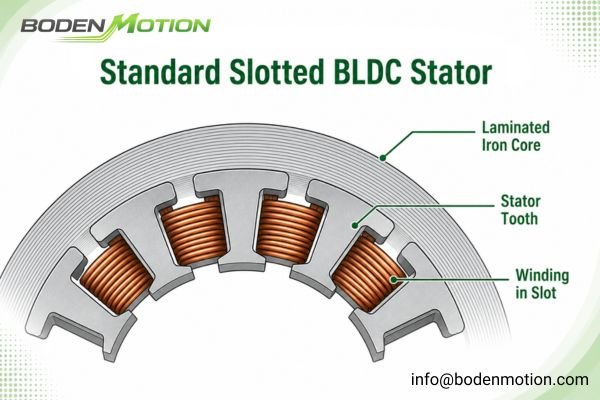
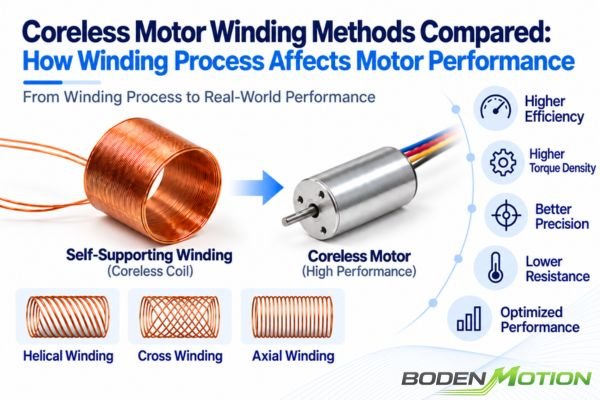
A slotless BLDC motor2, by contrast, features a stator with a smooth, cylindrical inner bore and has no teeth. The windings are created as a self-supporting cylinder (often secured with epoxy or other materials) that is then inserted into the stator. This design choice is fundamental to its smooth operating characteristics but also changes its relationship with torque and thermal performance.
Cogging Torque, Torque Ripple, and Motion Smoothness
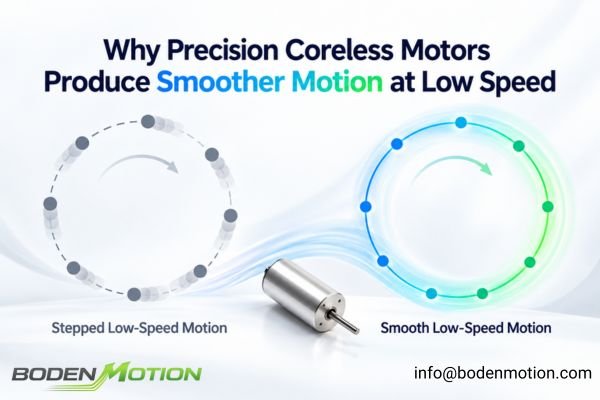
The most celebrated advantage of a slotless BLDC motor is its ability to provide exceptionally smooth motion. This originates from the elimination of a key source of torque disturbance: cogging torque.
Cogging torque is a magnetic detent torque that occurs in slotted motors as the permanent magnets on the rotor align with the stator teeth. It exists even when the motor is unpowered and can be felt as a series of slight "bumps" when turning the shaft by hand, leading to speed variations, positioning errors, and vibration.
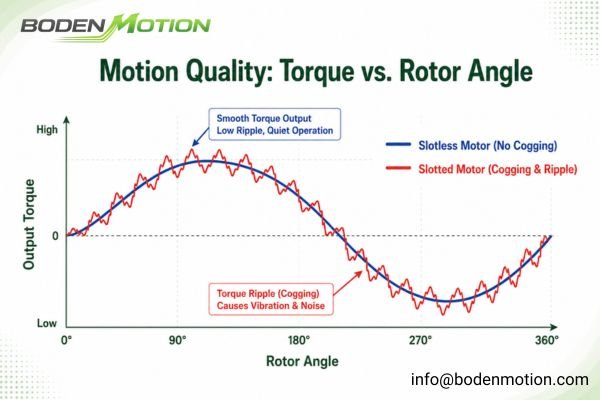
Because a slotless motor has no stator teeth, it eliminates this primary source of cogging torque, resulting in exceptionally smooth rotation3. However, it's important to distinguish between cogging torque and overall torque ripple. While slotless motors eliminate slot-induced cogging, some level of torque ripple may still arise from other sources, such as winding asymmetries, magnet variations, or commutation ripple from the motor driver4.
Torque Density, Motor Size, and Peak Output
For applications demanding high torque in a compact package, standard slotted motors often have a distinct advantage in torque density. This capability comes directly from the motor's internal magnetic circuit design.
The iron teeth in a slotted stator act as magnetic flux concentrators, creating a highly efficient path that allows the motor to generate more torque for a given physical volume and current. This is a primary reason why slotted motors are so prevalent in industrial automation and power-intensive applications.
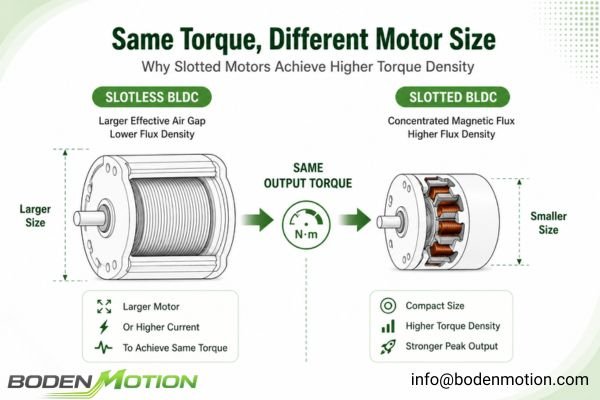
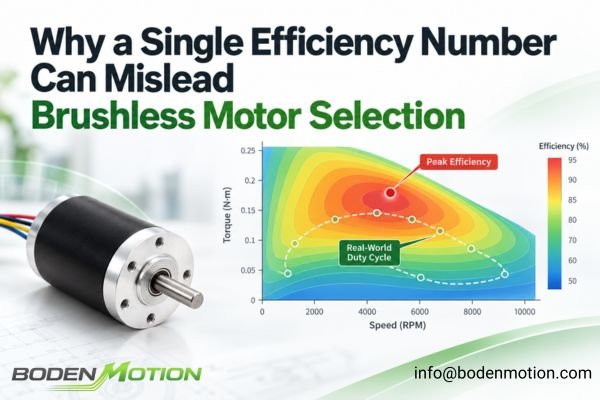
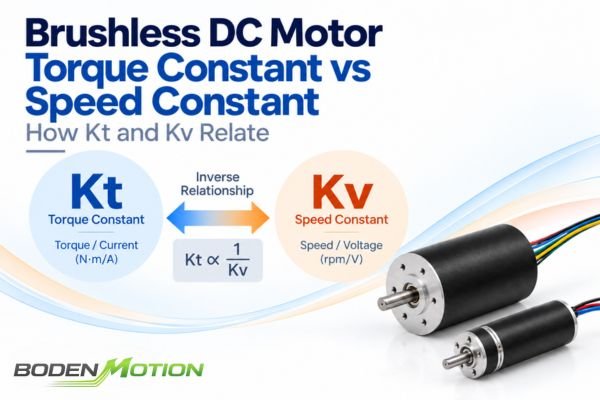
A higher torque constant (Kt) means that more torque is produced per ampere, but it is not a direct measure of motor efficiency. Overall efficiency also depends on factors like copper loss (I²R), iron loss, mechanical friction, speed, and temperature5. Slotless motors, with their larger effective air gap, generally have a lower magnetic flux density, which may require a larger motor or higher input current to achieve the same output torque as a slotted counterpart.
Thermal Behavior and Continuous-Duty Capability
A motor's ability to run continuously under load is limited by its ability to dissipate heat, as excessive winding temperatures can lead to insulation failure. Here, the structural differences again create a performance trade-off that is critical for OEM integration.
In many conventional slotted designs, the windings are embedded directly within the stator's iron core. This provides a direct, efficient thermal path for heat to conduct from the windings to the stator and then to the motor housing, which is advantageous in continuous high-torque applications.
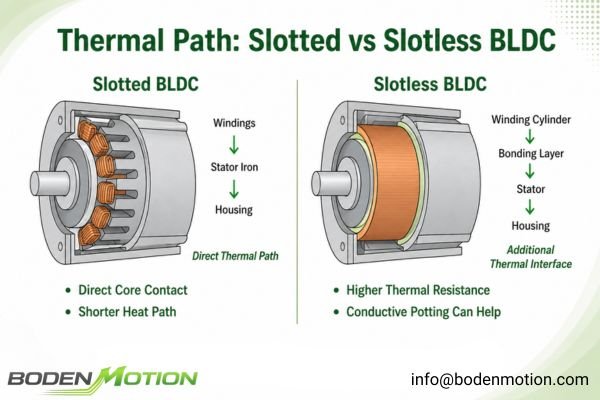
In a slotless motor, the winding cylinder is separated from the stator iron by a layer of bonding material, which can increase thermal resistance6. However, actual continuous-duty capability depends on the complete thermal design, and advanced slotless motors use thermally conductive potting compounds and optimized housing contact to improve heat dissipation. Ultimately, the continuous torque rating for any motor is determined by its total thermal resistance and the cooling conditions of the application.
Driver, Feedback, and Control Requirements
The choice between a slotless and slotted motor also has implications for the control system, though the relationship is more nuanced than many assume. A common misconception is that motor structure directly dictates the required control method.
In reality, the motor's Back-EMF waveform—whether it is more trapezoidal or sinusoidal—depends on the complete electromagnetic design, including winding distribution and magnet geometry, not just the presence or absence of slots. Motor topology alone does not determine the required control method.
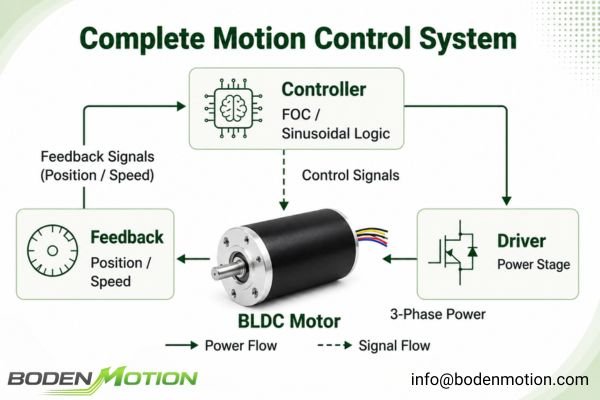
Both slotless and slotted BLDC motors may use various control strategies depending on the application's needs for smoothness, efficiency, and cost:
- Six-Step Commutation: A simpler method often used with Hall sensors, suitable for speed control.
- Sinusoidal Control: Requires higher-resolution feedback (like an encoder) and provides smoother motion.
- Field-Oriented Control (FOC)7: An advanced algorithm offering excellent torque control and efficiency.
While a slotless motor's inherent smoothness provides an excellent foundation for a precision motion system, achieving that potential still requires pairing it with a high-quality driver and an appropriate feedback device.
Application Selection Guide: When to Choose Each Type
The final decision should be driven by the application's most critical performance metric. We often find that the selection process becomes much clearer once engineers identify their system's dominant constraint.
Is the application more sensitive to motion disturbances like vibration and noise, or to limitations in torque, size, and cost? This guide helps map common system requirements to the most suitable motor technology.
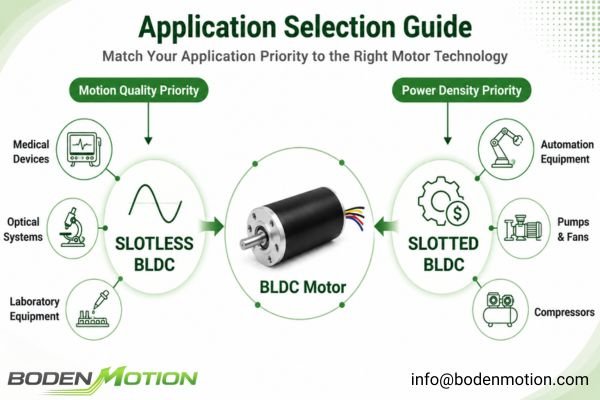
| Application Requirement | Recommended Motor Type | Engineering Reason |
|---|---|---|
| Smooth Low-Speed Motion | Slotless BLDC | Eliminates cogging, a primary cause of low-speed jerkiness.8 |
| Low Vibration & Noise | Slotless BLDC | Smoother magnetic field transitions reduce a key source of noise. |
| Medical & Lab Devices | Slotless BLDC | Motion quality and low noise are often critical for patient comfort and test results. |
| Optical Systems | Slotless BLDC | Reduces motor-induced jitter that can affect image stability or measurement. |
| High Torque in Limited Space | Standard Slotted BLDC | Higher torque density often allows for a more compact solution. |
| Continuous-Duty Thermal Load | Standard Slotted BLDC | The direct thermal path is often advantageous for dissipating continuous heat. |
| Cost-Sensitive Production | Standard Slotted BLDC | Mature manufacturing and material efficiency lead to lower unit costs. |
| Pumps, Fans, Compressors | Standard Slotted BLDC | Applications where output power and cost are prioritized over perfect smoothness. |
What OEM Buyers Should Specify Before Selection
To ensure a successful motor integration, the discussion must go beyond basic catalog specifications. A motor is not a standalone component but part of a complex electromechanical system.
Providing a motor supplier with comprehensive system-level parameters is the surest way to get a solution that performs reliably in the final product. This level of detail allows the supplier to act as an integration partner, identifying potential risks related to thermal limits, control stability, or mechanical resonance early in the design process.
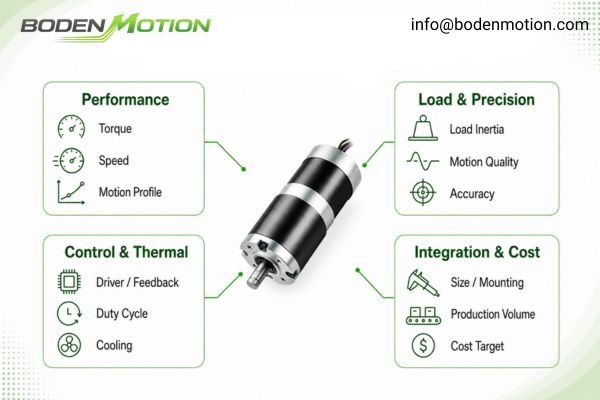
Before making a selection, be prepared to define:
- Torque: Continuous and peak torque requirements.
- Speed: The full operating speed range.
- Motion Profile: Acceleration, deceleration, and motion paths.
- Load: Load inertia and any frictional or external forces.
- Motion Quality: Acceptable limits for torque ripple, vibration, and noise.
- Positioning Accuracy: Required system-level accuracy and repeatability.
- Feedback & Control: The intended driver, control algorithm, and feedback device.
- Duty Cycle: How long the motor runs and rests.
- Thermal Environment: Ambient temperature and available cooling methods.
- Physical Constraints: Available space, mounting requirements, and weight limits.
- Production & Cost: Target production volume and unit cost.
Conclusion
Slotless and standard slotted BLDC motors reflect different engineering priorities rather than a simple difference in performance level. Slotless motors are better suited to applications sensitive to low-speed smoothness, vibration, and torque disturbance, while standard slotted motors are commonly selected where torque density, continuous output capability, manufacturing maturity, and cost are more important.
For OEM engineers, the appropriate choice depends on the system’s dominant constraints, including motion quality, output power, thermal load, installation space, control requirements, and target cost. If you are evaluating either motor structure for an OEM application, our engineering team can review your operating requirements and recommend a suitable motor platform. Contact us at info@bodenmotion.com.
FAQ
Q1: What is the main difference between slotless and standard slotted BLDC motors?
The main difference is the stator construction. Slotless motors use a smooth stator bore to minimize cogging torque and improve motion smoothness. Standard slotted motors use a toothed stator to concentrate magnetic flux, which generally results in higher torque density and lower cost.
Q2: Are slotless BLDC motors always better?
No. Slotless motors are better for applications requiring extreme smoothness and low vibration, such as medical devices or optical scanners. Standard slotted motors are often the better choice for high-torque, cost-sensitive, or continuous-duty applications like pumps and industrial automation.
Q3: Do slotless motors have zero cogging torque?
Slotless motors eliminate the primary source of cogging torque that arises from stator teeth, resulting in theoretically zero slot-induced cogging. However, very low levels of torque ripple can still exist due to other factors like magnet tolerances or commutation effects.
Q4: Why are standard slotted BLDC motors usually more cost-effective?
Their cost-effectiveness comes from highly mature and automated manufacturing processes, more efficient use of magnetic materials, and the economies of scale from being used in a vast range of high-volume applications.
Q5: What information should OEM buyers provide before motor selection?
Buyers should provide a complete picture of the application, including continuous and peak torque, speed range, load inertia, duty cycle, acceptable vibration and noise levels, required positioning accuracy, control method, and thermal environment.
"How to Choose an Electric Motor: Application Criteria (Part 1)", https://www.groschopp.com/video/choose-electric-motor-application-criteria-1/. Design methodology literature and engineering best practices recommend that component selection, including motors, should be guided by the dominant constraints and requirements of the specific application rather than by the perceived advancement of the technology. Evidence role: expert_consensus; source type: education. Supports: The best choice is not about which motor is more advanced, but which design philosophy better aligns with the dominant constraints of your application.. Scope note: This support is based on general design principles and may not account for all industry-specific considerations. ↩
"Comparing Slotted vs Slotless Brushless DC Motors", https://www.haydonkerkpittman.com/learningzone/whitepapers/comparing-slotted-vs-slotless-brushless-dc-motors. A technical encyclopedia or engineering textbook describes slotless BLDC motors as having stators with smooth, cylindrical inner bores and no teeth, supporting this structural distinction. Evidence role: definition; source type: encyclopedia. Supports: A slotless BLDC motor, by contrast, features a stator with a smooth, cylindrical inner bore and has no teeth.. ↩
"What is Cogging Torque? | ThinGap Zero-Cogging Motors", https://www.thingap.com/what-is-cogging-torque/. Authoritative sources explain that cogging torque is primarily caused by the interaction between permanent magnets and the stator teeth, and that slotless motors, lacking stator teeth, largely eliminate this effect, resulting in smoother rotation. Evidence role: mechanism; source type: encyclopedia. Supports: Because a slotless motor has no stator teeth, it eliminates this primary source of cogging torque, resulting in exceptionally smooth rotation.. Scope note: This explanation is generally accepted but may not account for all possible sources of torque irregularity in specific motor designs. ↩
"Cogging Torque and Torque Ripple: What You Need to Know", https://www.kollmorgen.com/en-us/blogs/everywhere-cogging-torque-and-torque-ripple-what-you-need-to-know. Technical literature identifies winding asymmetries, magnet imperfections, and commutation effects as recognized contributors to torque ripple in electric motors, including slotless designs. Evidence role: expert_consensus; source type: paper. Supports: some level of torque ripple may still arise from other sources, such as winding asymmetries, magnet variations, or commutation ripple from the motor driver.. Scope note: The specific impact of each source may vary depending on motor construction and control method. ↩
"Understanding Losses in BLDC Motors", https://www.machinedesign.com/mechanical-motion-systems/article/21251043/portescap-understanding-losses-in-bldc-motors. Standard electrical engineering textbooks and resources identify copper loss, iron loss, mechanical friction, speed, and temperature as key factors influencing electric motor efficiency. Evidence role: expert_consensus; source type: education. Supports: Overall efficiency also depends on factors like copper loss (I²R), iron loss, mechanical friction, speed, and temperature.. Scope note: The relative impact of each factor may vary depending on motor type and operating conditions. ↩
"Slotless vs Slotted Motors: Which Design Is Right?", https://solution.mabuchi-motor.com/en/blog/slotless-vs-slotted-motor-comparison. Technical literature on slotless motor construction describes the use of bonding material between the winding cylinder and stator iron, which can increase thermal resistance compared to slotted designs. Evidence role: mechanism; source type: education. Supports: the winding cylinder is separated from the stator iron by a layer of bonding material, which can increase thermal resistance. Scope note: The specific materials and thickness of the bonding layer may vary by manufacturer and application, affecting the degree of thermal resistance. ↩
"Field Oriented Control (FOC) - A Deep Dive", https://www.pmdcorp.com/resources/type/articles/get/field-oriented-control-foc-a-deep-dive-article. Technical literature describes Field-Oriented Control (FOC) as a method that enables precise torque and flux control in brushless motors, often resulting in improved efficiency compared to simpler commutation strategies; however, the degree of improvement depends on implementation and application context. Evidence role: mechanism; source type: paper. Supports: Field-Oriented Control (FOC) offers excellent torque control and efficiency.. Scope note: The efficiency and torque benefits may vary depending on the specific motor and control implementation. ↩
"A Guide to Slotless Brushless DC Motors", https://www.e-jpc.com/resources/slotless-brushless-motor-guide/. Technical literature explains that slotless BLDC motors lack stator slots, which eliminates cogging torque and results in smoother low-speed operation; however, other factors such as drive electronics can also influence motion quality. Evidence role: mechanism; source type: paper. Supports: Eliminates cogging, a primary cause of low-speed jerkiness.. Scope note: Other sources of low-speed irregularity may exist beyond cogging torque. ↩