When searching for a BLDC motor for sale, many buyers focus on catalog specs and price. This approach often overlooks the most critical factor in OEM projects: system integration and long-term reliability.
An OEM BLDC motor is optimized for a specific application, while a standard motor is a general-purpose product. The key difference is whether the motor is engineered to fit the equipment or the equipment is forced to adapt to a standard motor. This choice has significant implications for performance, total cost, and time-to-market.
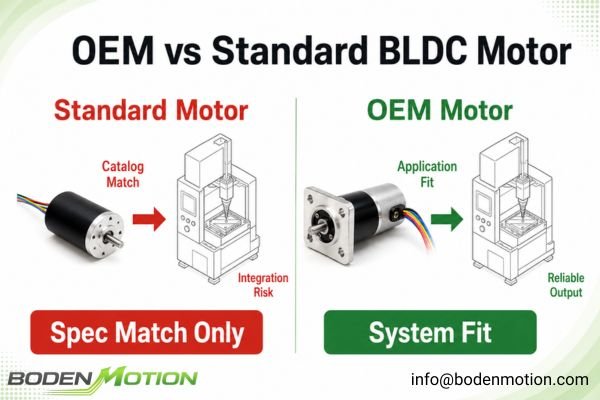
In OEM equipment development, a seemingly "perfect" standard motor can fail during system validation because its datasheet doesn't capture real-world operating conditions like load inertia, duty cycles, or thermal constraints. For OEM engineers, the question isn't just “Which motor is cheapest?” but “Which motor solution will reliably fit our product, minimize integration risk, and ensure performance over its entire lifetime1?”
What Are Standard BLDC Motors and OEM BLDC Motors?
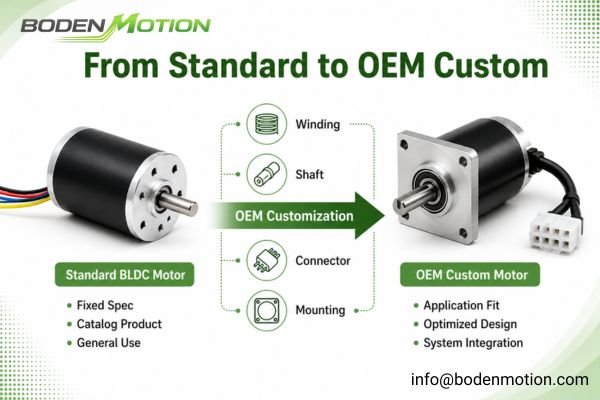
Understanding the fundamental difference between these two motor sourcing strategies is the first step in making an informed decision. Standard BLDC motors are designed as general-purpose products for a broad market. They are mass-produced with fixed specifications and are intended to be versatile.
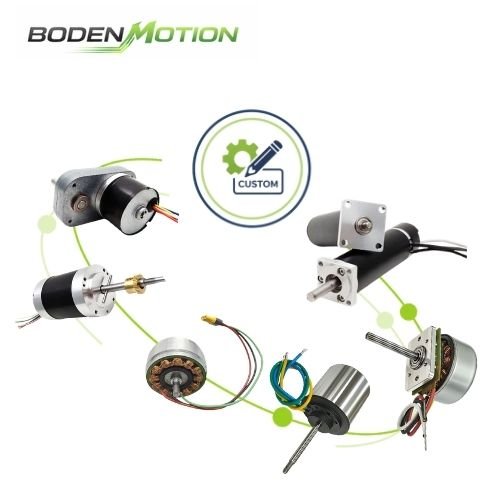
OEM BLDC motors are engineered or adapted to meet a specific customer's application requirements. This process, often managed by a specialized BLDC motor manufacturer, can range from simple modifications to a fully custom brushless DC motor design.
Typical Characteristics of Standard Motors:
- Fixed voltage options (e.g., 12V, 24V, 48V)
- Standardized dimensions and mounting patterns
- Pre-defined shaft lengths and diameters with simple features
- Generic wiring and connectors
- A fixed catalog of speed-torque performance curves
They are an excellent choice for applications where system requirements are flexible or happen to align with an existing off-the-shelf model, such as in lab equipment, simple fans, or R&D prototypes.
Common Areas for Brushless Motor Customization:
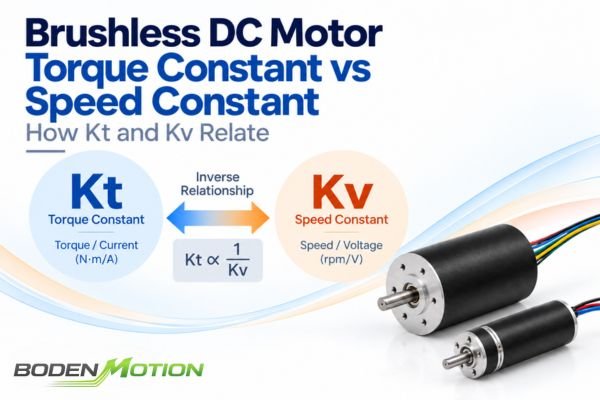
- Electrical Performance: Custom windings for a specific Kv (speed constant), torque constant (Kt), or peak efficiency at a target operating point2.
- Mechanical Integration: Modified shaft features (flats, keyways, cross-holes), custom mounting flanges, or unique form factors to simplify assembly.
- Connectivity: Custom wire harnesses, specific connectors (e.g., Molex, JST), and integrated electronics.
- Performance Tuning: Optimization for low noise, low vibration, high efficiency, or demanding thermal conditions.
- Reliability: Application-specific bearing selection, material choices (e.g., magnet grade, insulation class), and sealing for long life or harsh environments.
Why Standard BLDC Motors Often Fail in OEM Integration
A standard motor may look suitable on a datasheet but cause significant problems during integration. This is because a motor's performance in a real system is governed by dynamic interactions, not just static specifications.
These failures often represent hidden costs that delay projects and compromise product quality. They are rarely catastrophic failures at first; they are often subtle performance gaps that compromise the final product.
OEM Integration Example: Startup Torque Failure
- Application: A compact medical diagnostic device required a 24V BLDC motor to quickly rotate a sample carousel.
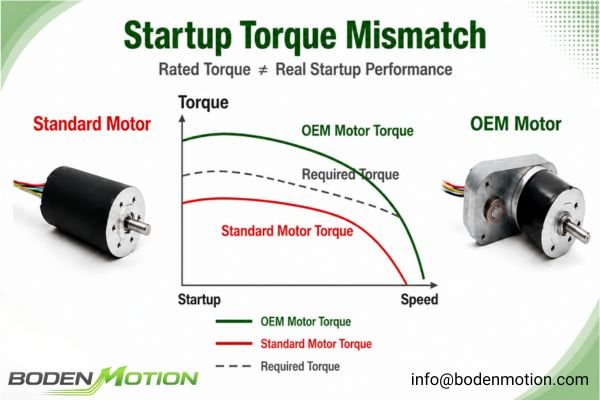
- Initial Problem: A standard catalog motor was selected because its rated torque exceeded the calculated running torque. However, during prototype testing, the motor frequently stalled on startup.
- Engineering Analysis: The team had underestimated the combined effect of the carousel's high inertia and the required acceleration3. The standard motor's torque-speed curve did not provide enough torque at near-zero speed to overcome this initial load.
- Solution: An OEM motor solution was developed with a custom winding to increase the torque constant (Kt), providing higher startup torque. The driver's startup current profile was also matched to the motor's new parameters.
- Result: The device achieved reliable, repeatable startup performance, eliminating a critical integration risk before production.
Common integration problems with ill-fitting standard motors include:
- Insufficient Startup Torque: Failure to overcome system inertia or stiction.
- Excessive Speed Droop: Motor speed falls below specification under the application's actual load.
- Mechanical Mismatches: Standard shafts or mounts require costly brackets or adapters, increasing assembly complexity and tolerance stack-up.
- Driver Incompatibility: A mismatch between the motor's electrical characteristics (inductance, BEMF) and the driver leads to control instability, audible noise, or poor efficiency.
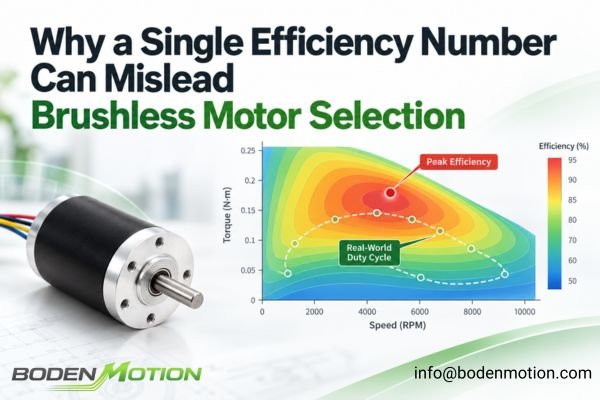
- Overheating: The motor operates outside its peak efficiency range, generating excess heat that it cannot dissipate within the product's enclosure.
- Reduced Lifetime: Standard bearings and lubricants are not suited for the application's unique duty cycle, load profile, or ambient temperature.
How OEM BLDC Motors Improve Application Matching
The goal of an OEM motor project is to de-risk integration by ensuring the motor is a perfect functional and physical fit for the system. This involves a collaborative engineering process between the customer and the BLDC motor supplier.
This structured approach ensures that the chosen motor, whether a modified standard product or a full custom design, meets the application's unique demands. It transforms a simple component purchase into a strategic engineering partnership.
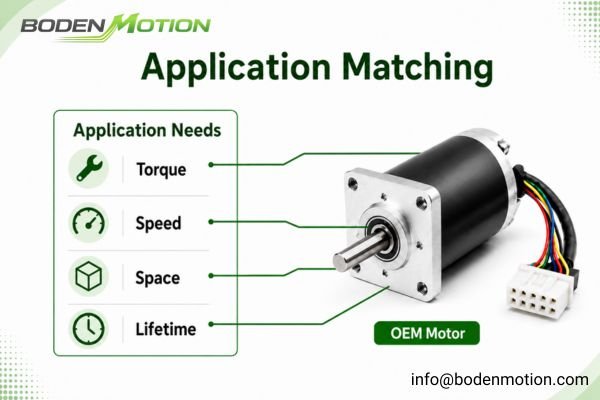
The OEM Development Process
A partner like BODENMOTION typically follows these steps to ensure a successful outcome:
- Requirement Analysis: The process begins with a deep dive into the application, including the load profile, motion cycle, thermal environment, control strategy, and lifetime targets.
- Application Evaluation: Engineers evaluate these requirements to identify critical performance parameters, such as the need for high startup torque, low noise, or high efficiency at a specific operating point.
- Solution Proposal: Based on the analysis, a decision is made. This could be a slightly modified standard motor (e.g., with a different shaft), a semi-custom solution using existing platforms (e.g., with an optimized winding), or a fully custom design.
- Prototype Manufacturing: Sample motors are produced for customer testing. This allows for verification of the design in the actual application.
- Performance Validation: Prototypes are tested against all critical parameters—thermal performance, noise, vibration, and life testing under the specified duty cycle.4 Adjustments are made if necessary.
- Production & Quality Control: Once validated, the motor moves to mass production with quality control processes designed to ensure long-term consistency for the specific project.
This process ensures that the motor's torque-speed curve is perfectly matched to the load, that its thermal performance is stable within the device's enclosure, and that its mechanical interface simplifies assembly rather than complicating it.5
Cost Comparison: Standard BLDC Motor vs OEM Customized BLDC Motor
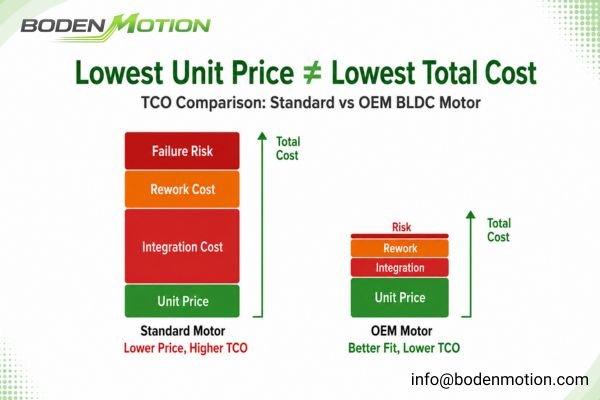
Procurement teams often focus on unit price, but for OEM products, Total Cost of Ownership (TCO) is a more critical metric. An OEM motor may have a higher unit price but can significantly lower TCO over the product's lifecycle.
The lowest-priced motor does not always lead to the lowest total project cost. Hidden costs from redesigns, additional components, complex assembly, and field failures can quickly erase initial savings.
| Comparison Metric | Standard BLDC Motor | OEM BLDC Motor |
|---|---|---|
| Unit Price | Typically lower for small quantities. | Can be higher, but often competitive at volume. |
| Development Cost | Low, but risk of high redesign costs. | May include NRE, but reduces integration risk. |
| Integration Cost | Potentially high (custom brackets, adapters). | Low (designed for direct fit). |
| Assembly Time | Can be higher due to non-optimized fit. | Lower due to simplified integration. |
| Performance | General-purpose, may be inefficient. | Optimized for application's operating point. |
| Risk of Field Failure | Higher if not a perfect match. | Lower due to application-specific validation. |
| Total Cost of Ownership | Potentially high due to hidden costs. | Often lower for volume production. |
Consider a standard motor that costs $30 but requires a $5 custom bracket and adds 2 minutes of complex assembly. An OEM motor with an integrated flange might cost $38 but drops directly into place, saving on parts and labor while improving alignment.6 For a production run of 10,000 units, the OEM solution becomes the more economical choice.
When Should OEM Buyers Choose Standard BLDC Motors?
Despite the advantages of customization, a standard BLDC motor for sale is often the right choice. The decision depends on the project's technical requirements, commercial constraints, and risk tolerance.
A standard motor is a suitable, professional choice when its specifications already meet the application's needs without introducing performance or integration risks.
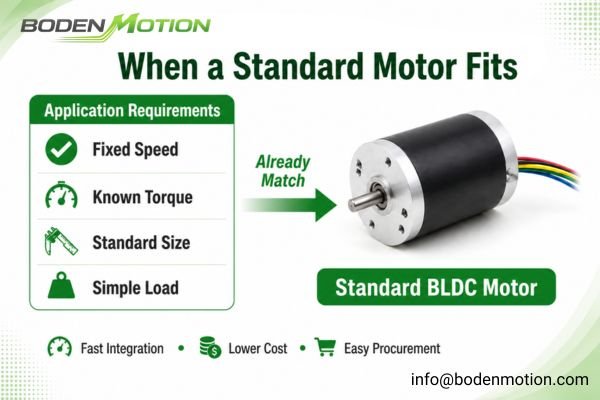
Standard motors are often a good fit for:
- Simple, well-defined loads: Applications like basic peristaltic pumps, lab stirrers, or constant-speed fans.
- Low-volume production7: When the quantity doesn't justify the development cost of a custom solution.
- Early-stage prototyping: When speed of procurement for proof-of-concept is more critical than final optimization.
- Flexible system design: When the surrounding mechanics and electronics can easily accommodate a standard motor's form factor and performance.
The key is to perform a thorough engineering evaluation to confirm that the standard motor's capabilities truly align with the application's demands.
What OEM Buyers Should Confirm Before Purchasing a BLDC Motor
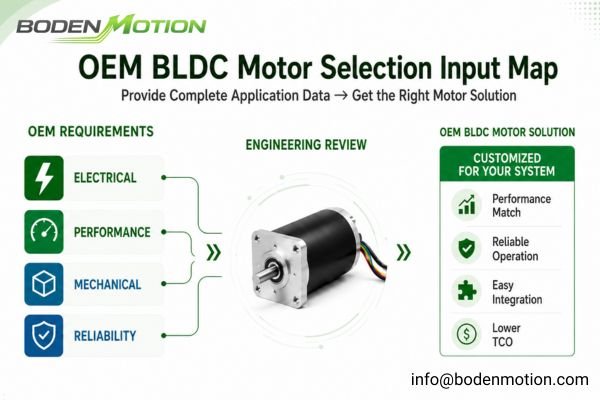
Before contacting a BLDC motor supplier, a productive first step is to define the complete application requirements. A clear set of parameters enables an engineering team to provide a meaningful recommendation quickly.
This checklist outlines the critical information needed for a proper motor evaluation, which will help a potential BLDC motor supplier understand your needs and propose an effective solution.
| Requirement | Why It Matters for Motor Selection |
|---|---|
| Operating Voltage (V) | Determines winding design and electrical compatibility with the power supply. |
| Speed (RPM) | Defines the target operating speed under load, not just the no-load speed. |
| Torque (mNm) | Specifies the continuous and peak torque needed to drive the load. |
| Startup Condition | Determines the required torque to overcome inertia and stiction at zero speed. |
| Duty Cycle | Dictates the thermal load on the motor and influences lifetime calculations. |
| Mechanical Dimensions | Ensures the motor physically fits within the product's enclosure and mounts correctly. |
| Driver Information | Crucial for ensuring control stability and electrical compatibility. |
| Lifetime Target (Hours)8 | Influences bearing selection, material choices, and overall design robustness. |
| Noise/Vibration Limits | May require tighter balancing, special bearings, or specific control schemes. |
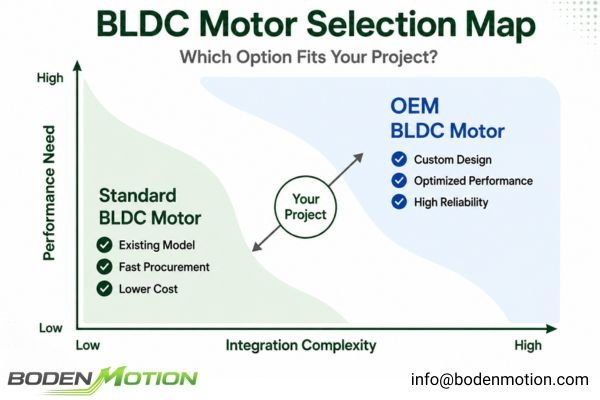
OEM BLDC Motor Selection Guide: Which Option Fits Your Project?
Use this guide to help determine which path is a better fit for your project. Choose a standard motor for speed and simplicity when requirements align, but opt for an OEM motor when integration challenges or specific performance targets are critical to your product's success.
This decision framework helps balance project risk, technical requirements, production volume, and integration complexity against cost and time-to-market.
| Project Situation | Recommended Choice | Reason |
|---|---|---|
| Immediate availability is top priority | Standard BLDC motor | Off-the-shelf procurement is the fastest path. |
| Requirements match an existing model | Standard BLDC motor | Minimizes development effort and non-recurring costs. |
| Limited space or unique form factor | OEM BLDC motor | Mechanical customization can solve challenging fitment issues. |
| Specific voltage or power efficiency target | OEM BLDC motor | Winding can be optimized for the application's electrical system. |
| High startup load or dynamic torque | OEM BLDC motor | Torque-speed curve can be tailored to the exact load profile9. |
| Strict low noise or low vibration target | OEM BLDC motor | Requires optimization of balance, bearings, and control. |
| High-volume production with critical reliability | OEM BLDC motor | Ensures long-term performance consistency and supply stability. |
OEM customization is most valuable when the motor's performance is integral to your product's value proposition. For a surgical drill, a laboratory centrifuge, or a semiconductor handling robot, the motor is not just a component—its precision and reliability are the product's performance.
Conclusion
Choosing a BLDC motor for sale is an engineering decision that affects product performance, reliability, and total cost of ownership. Standard motors are suitable when requirements already match, while OEM BLDC motors provide optimized integration when factors such as size, performance, or reliability are critical.
To evaluate the right motor solution for your application, share your key requirements, including voltage, RPM, torque, load profile, duty cycle, and installation dimensions. BODENMOTION can help determine whether a standard motor or a customized BLDC motor is the better fit for your project.
Contact us: info@bodenmotion.com
FAQ
Q1: What is the difference between an OEM BLDC motor and a standard BLDC motor?
A standard BLDC motor is a general-purpose product with fixed specifications. An OEM BLDC motor is a custom brushless DC motor designed or adapted by a manufacturer to meet a specific customer's requirements for voltage, size, performance, mechanical integration, and lifetime.
Q2: Are OEM BLDC motors more expensive?
The initial unit cost for an OEM motor can be higher, but they often reduce the total project cost by eliminating the need for redesigns, additional components, and complex assembly, while also lowering the risk of field failures. This makes them a cost-effective choice for many OEM projects.
Q3: When should I choose a standard BLDC motor?
A standard motor is a good choice when its existing specifications already match your application's needs, production volumes are low, or for early-stage prototyping where speed of procurement is more important than final optimization.
Q4: What information should OEM buyers provide to a BLDC motor manufacturer?
Provide a complete set of application requirements, including operating voltage, speed, torque (startup and running), load type, duty cycle, mechanical dimensions, driver details, environmental conditions, and lifetime targets.
Q5: Why do OEM projects often require customized BLDC motors?
Because real-world OEM systems have unique constraints related to mechanical space, load dynamics, control algorithms, thermal environments, and production processes that a standard, one-size-fits-all BLDC motor for sale often cannot reliably satisfy.
"Motor Selection Guide for OEM Engineers - TelcoMotion", https://www.telcomotion.com/knowledge-hub/motor-selection-101. Engineering best practices emphasize that selecting a motor for OEM equipment involves considering integration risk and long-term performance, not just initial cost, as highlighted in technical standards and design guides. Evidence role: expert_consensus; source type: education. Supports: OEM engineers must consider integration risk and lifetime performance, not just cost, when selecting a motor solution.. Scope note: The support is based on general engineering and design principles rather than a specific case study. ↩
"Brushless DC Motor Design and Build", https://digitalcommons.calpoly.edu/cgi/viewcontent.cgi?article=1110&context=eesp. Technical literature and manufacturer documentation indicate that customizing windings to achieve specific Kv, Kt, or efficiency targets is a standard practice in brushless motor design. Evidence role: expert_consensus; source type: education. Supports: Custom windings for a specific Kv (speed constant), torque constant (Kt), or peak efficiency at a target operating point.. Scope note: The extent of customization may depend on manufacturer capabilities and application requirements. ↩
"Estimation of Motor Startup Speed Profile Using Low ...", https://docs.lib.purdue.edu/cgi/viewcontent.cgi?article=2807&context=icec. A technical review of electric motor startup dynamics explains that high load inertia and required acceleration can significantly increase the torque needed at startup, often exceeding the rated running torque of standard motors. Evidence role: mechanism; source type: education. Supports: The team had underestimated the combined effect of the carousel's high inertia and the required acceleration.. Scope note: The source provides general engineering principles rather than a case-specific analysis of this particular device. ↩
"Electric Motor Vibration Analysis for EV Powertrains", https://epowerlabs.com/insight/electric-motor-vibration-analysis/. Engineering guidelines and industry standards recommend that prototype electric motors undergo testing for thermal performance, noise, vibration, and operational life under specified duty cycles to ensure reliability and suitability for the intended application. Evidence role: expert_consensus; source type: education. Supports: Prototypes are tested against all critical parameters—thermal performance, noise, vibration, and life testing under the specified duty cycle.. Scope note: The recommendation is general and may be adapted based on specific project requirements or industry sector. ↩
"PM Motor Parametric Design Analyses for a Hybrid Electric ...", http://large.stanford.edu/courses/2025/ph240/ye1/docs/ornl-tm-2004-120.pdf. Industry standards and engineering literature describe that a structured OEM motor development process—including requirement analysis, prototyping, and validation—can help achieve application-specific torque-speed matching, thermal stability, and mechanical integration, though results may vary depending on implementation and complexity of requirements. Evidence role: expert_consensus; source type: education. Supports: This process ensures that the motor's torque-speed curve is perfectly matched to the load, that its thermal performance is stable within the device's enclosure, and that its mechanical interface simplifies assembly rather than complicating it.. Scope note: The support is based on general engineering consensus and may not guarantee these outcomes in every case. ↩
"Tailored assembly interface for high-performance bolted ...", https://www.sciencedirect.com/science/article/pii/S0264127525013851. A technical report from a manufacturing engineering institute describes how integrated motor flanges can reduce assembly time and improve alignment, supporting the claim that such designs can lead to cost and labor savings in production environments. Evidence role: mechanism; source type: institution. Supports: An OEM motor with an integrated flange might cost $38 but drops directly into place, saving on parts and labor while improving alignment.. Scope note: The report provides general findings and may not reflect all OEM motor designs or specific cost figures. ↩
"Guide to Low Volume Manufacturing", https://formlabs.com/uk/blog/low-volume-manufacturing/. Manufacturing and engineering economics literature generally supports the use of standard components, such as motors, in low-volume production to avoid the high non-recurring engineering costs associated with custom solutions. Evidence role: general_support; source type: education. Supports: Low-volume production: When the quantity doesn't justify the development cost of a custom solution.. Scope note: This support is based on general economic principles and may not account for niche or highly specialized production scenarios. ↩
"Factors In Motor Life Expectancy", https://www.regalrexnord.com/regal-rexnord-insights/factors-in-motor-life-expectancy?srsltid=AfmBOooqh3fmqxMWmRKKc_3M6Q1kUJZX2VGggeLWUJtouOLK_0todi3p. Engineering design literature indicates that specifying a lifetime target for a motor guides decisions regarding bearing types, material selection, and overall design robustness to meet durability requirements. Evidence role: mechanism; source type: education. Supports: Lifetime Target (Hours) Influences bearing selection, material choices, and overall design robustness.. ↩
"Modeling, Dynamic Characterization, and Performance Analysis of a 2.2 ...", https://www.mdpi.com/2076-0825/14/8/400. Engineering literature describes how OEM BLDC motors can be designed with custom winding and control parameters to achieve specific torque-speed characteristics for demanding load profiles. Evidence role: mechanism; source type: education. Supports: Torque-speed curve can be tailored to the exact load profile.. Scope note: The support may be general to BLDC motor customization and not reference a particular OEM product. ↩