Engineers often chase precision with higher-resolution encoders or complex control algorithms, but selecting the right DC motor architecture is just as important. In high-end motion systems, the motor's own mechanical dynamics—not the electronics alone—frequently determine the final performance limit.
Coreless DC motors improve precision control because their ironless, low-inertia rotor enables extremely fast response, smooth cog-free motion, and low vibration, allowing the control system to make faster and more accurate corrections.
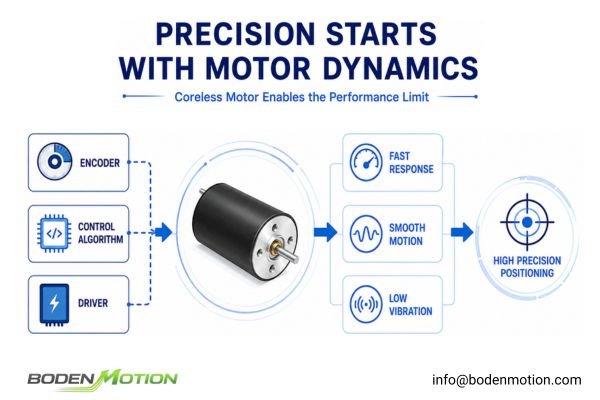
While this seems simple, the implications for system-level design are significant. The motor's fundamental architecture provides the mechanical foundation, but the final result is always a product of the entire integrated system. In applications from surgical instruments to semiconductor positioning, understanding why this mechanical structure matters is the first step toward building a truly high-precision motion system.
Why Does Motor Structure Influence Precision Control Performance?
The architecture of traditional iron-core motors, while excellent for producing high torque, introduces mechanical traits that must be managed in high-precision scenarios. These traits can force engineers into a cycle of complex compensation in the control software.
The coreless motor's ironless, self-supporting rotor structure eliminates the magnetic cogging and dramatically reduces rotor inertia found in conventional iron-core motors, providing a more linear and predictable system for the controller to manage.
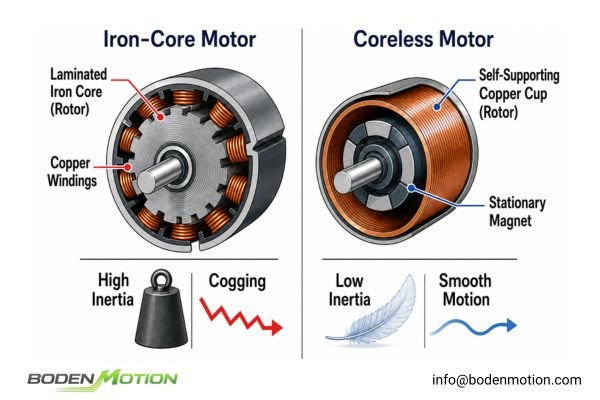
In a conventional brushed or brushless DC motor, the copper windings are wound around a heavy, laminated iron core1. This iron core is essential for concentrating the magnetic field to generate high torque, but it introduces two major obstacles to micro-precision:
- High Inertia: The iron core adds significant mass to the rotor. A heavy rotor is harder to start, stop, and change direction quickly. This mechanical lag is a fundamental barrier to rapid response.
- Cogging Torque2: The permanent magnets in the stator are naturally attracted to the iron teeth of the rotor core. This creates a "magnetic detent" or cogging torque, which results in jerky, uneven motion, especially at low speeds.
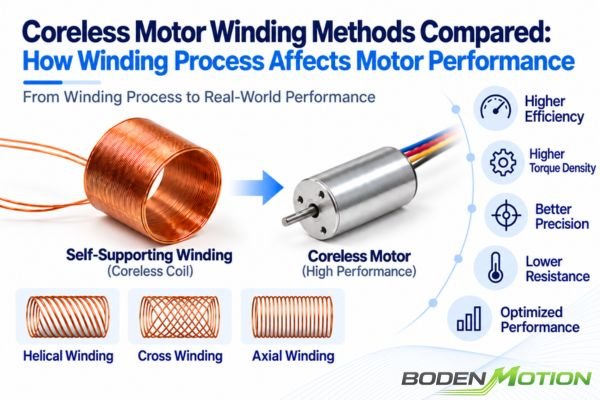
A coreless motor's design elegantly sidesteps these issues. The rotor consists only of a self-supporting copper winding, forming a hollow cylinder. This lightweight rotor spins around a stationary magnet located in its center. With no iron in the rotor, there is no magnetic attraction to cause cogging and the rotor's mass is exceptionally low.
System-Level Observation:
Precision control starts with predictable motor behavior. If the motor has inherent non-linearities like cogging torque, the controller is forced to spend most of its effort compensating for the motor's flaws rather than executing the desired motion path.
How Does Low Rotor Inertia Improve Response Accuracy?
In precision robotics or instrumentation, even milliseconds of response delay can lead to tracking errors or instability. This sluggishness often originates from the mechanical inertia of the motor and load, not a slow control algorithm.
Low rotor inertia allows the motor to accelerate and decelerate almost instantly with less torque, minimizing response delays, reducing positioning overshoot, and enabling faster settling times.
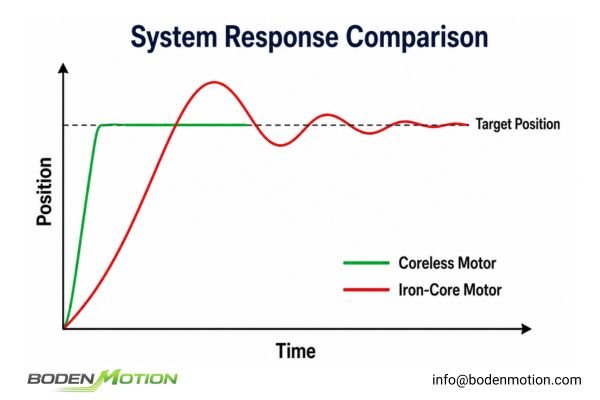
The physics are governed by T = Jα (Torque = Inertia × Angular Acceleration). This equation is a cornerstone of motion control. For a given amount of torque (T), a lower total system inertia (J)—which includes the motor's rotor and the reflected load inertia—results in much higher angular acceleration (α). A low-inertia coreless motor can change its speed or direction far more rapidly than an iron-core motor of comparable size.
This has several direct benefits in OEM applications:
- Faster Command Response: In a surgical hand tool or a camera stabilization platform, the motor must react to user input or sensor feedback instantly. Low inertia makes this possible.
- Reduced Positioning Overshoot: A low-inertia motor can stop with minimal overshoot, which is critical for system throughput where reducing settling time from 20 ms down to 5 ms can dramatically increase the number of operations per minute.
- Improved Disturbance Rejection: A low-inertia motor can make rapid, tiny corrections to counteract external forces or vibrations, leading to better holding stability.
| System Parameter | High-Inertia Motor | Low-Inertia (Coreless) Motor |
|---|---|---|
| Acceleration | Slow, requires high torque | Fast, requires less torque |
| Settling Time | Long, prone to overshoot | Short, minimal overshoot |
| Control Loop Gain | Must be lower to avoid instability | Can be higher for tighter control |
| Energy Consumption | Higher to overcome inertia | Lower for short, rapid moves |
Of course, the motor is only one part of the equation. A low-inertia motor coupled to a high-inertia load still presents a system design challenge related to inertia matching, but starting with a low-inertia motor provides a significant advantage.
Why Do Coreless Motors Provide Smoother Micro-Motion Control?
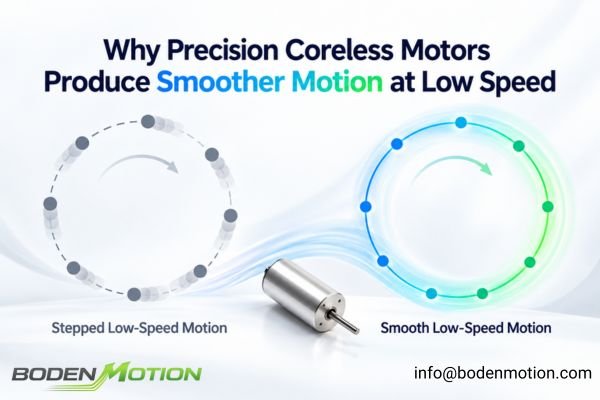
For any system performing micro-positioning, optical scanning, or fluid dosing, smooth and stable movement at very low speeds is non-negotiable. Often, a conventional motor "stutters" or jumps at crawling speeds instead of moving fluidly.
The absence of an iron core in the rotor completely eliminates cogging torque, the primary cause of this non-linear motion. This allows for exceptionally smooth and predictable micro-motion, a key reason coreless motors dominate in these applications.
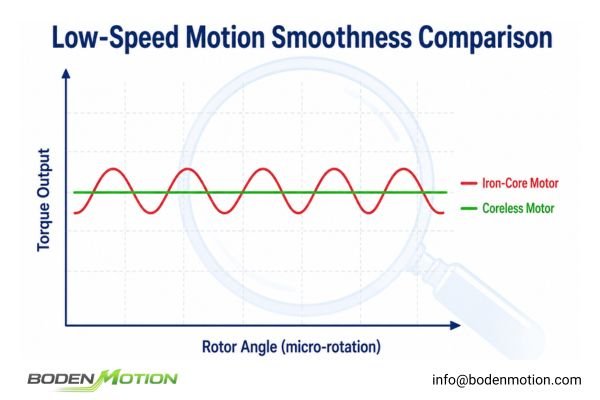
Cogging torque is a purely mechanical artifact. In an iron-core motor, it's the magnetic tug-of-war between the stator's permanent magnets and the iron "teeth" of the rotor. As the rotor turns, it passes through positions of high and low magnetic attraction, creating a cyclical torque ripple. The motor wants to "snap" into these positions.
Because a coreless motor has no iron in its rotor, this phenomenon does not exist. The torque delivery is inherently smooth and linear, even at near-zero speeds.3
Why Is Smooth Motion Important for Precision Applications?
- Optical Adjustment: In a lens focusing system, any jerkiness in motion translates directly into a blurry image, especially under high magnification like 40x, or an unstable beam position.
- Fluid Dosing Accuracy: For medical infusion pumps, smooth motor rotation ensures a constant, predictable flow rate. Torque ripple would cause pulsing.
- Imaging & Scanning: In equipment like microscopes or document scanners, cogging can cause visible banding or artifacts in the final image.4
How Do Coreless Motors Improve Closed-Loop Control Performance?
A high-resolution encoder is valuable, but its effectiveness is limited if the motor is slow to respond. The system can measure a position error with great precision, but it can only correct it as fast as the motor can physically move.
Due to their low inertia, coreless motors react to feedback corrections almost instantly. This allows the closed-loop control system to be tuned more aggressively for higher performance, but this advantage is only fully realized when the entire mechanical transmission is stiff and free of backlash.
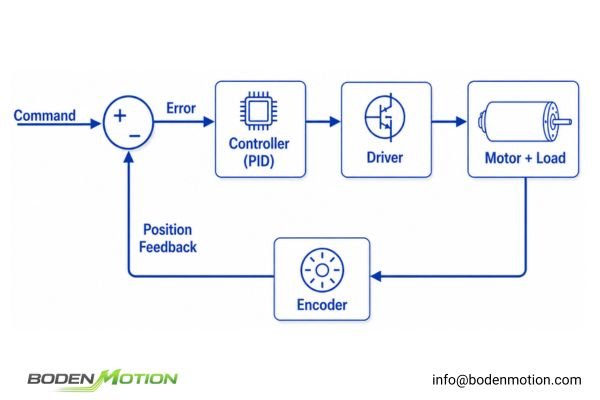
In any closed-loop system, there is a delay between when an error is measured and when the motor's corrective action takes effect. With a low-inertia coreless motor, this mechanical response is extremely fast5. This allows engineers to use a much higher control loop gain, resulting in a "stiffer" system that holds its position more tenaciously.
Real Integration Challenge:
Turning up the control loop gain on a fast motor seems like a free win for performance, but it can quickly expose weaknesses in the mechanical structure. A high-gain controller will try to make corrections so rapidly that it can excite un-damped resonant frequencies in the machine frame, often in the hundreds-of-hertz range, leading to audible humming and high-frequency oscillations that destroy precision. A stiff mechanical design is the prerequisite for aggressive control tuning.
Why Does Faster Response Improve Position Accuracy?
A faster response to feedback allows the control system to stamp out errors before they have a chance to grow. It leads to:
- Reduced Control Lag: The system tracks the desired trajectory more closely.
- Faster Settling Time: The system reaches its target and stops oscillating more quickly, increasing throughput.
- Improved Dynamic Stability: The system is better able to reject external disturbances.
How Do Vibration and Noise Influence Precision Control Quality?
In many high-end systems, mysterious measurement errors or positioning instabilities can be traced back to motor vibration.
Mechanical vibration generated by the motor can propagate through the machine structure and excite natural resonant frequencies, introducing positioning errors, destabilizing sensitive sensors, and ultimately degrading performance.
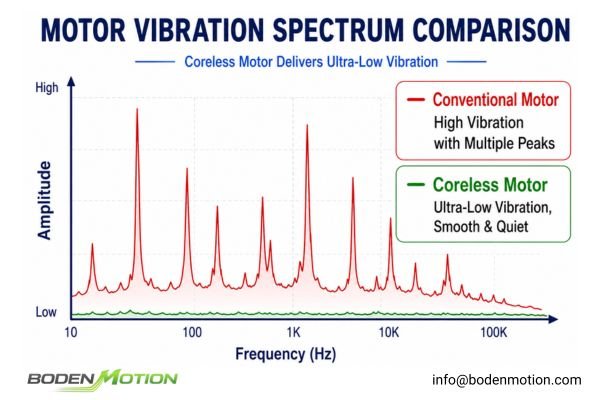
Coreless motors are inherently low-vibration devices6. The combination of a perfectly balanced cylindrical rotor and the complete absence of cogging torque results in exceptionally quiet and smooth operation, giving engineers a much more stable mechanical foundation to build upon.
Why Is Low Vibration Often More Important Than High Torque?
In many precision applications, the system's performance is limited by vibration long before it is limited by torque or speed.
- Imaging Equipment: Vibration directly causes image blur and reduces effective resolution.
- Precision Metrology: Unwanted movement can render measurements useless.
- Semiconductor Lithography: Aligning masks and wafers requires single-digit micron stability7 that is impossible in the presence of vibration.
What Common Design Mistakes Limit Precision Control Performance?
You can specify the best motor, encoder, and driver, but the system can still fail to meet its precision targets. This usually happens when the motor is treated as an isolated component rather than part of an integrated system.
Most precision-control problems originate from system-level design compromises and a failure to appreciate the interaction between mechanical and electrical components.
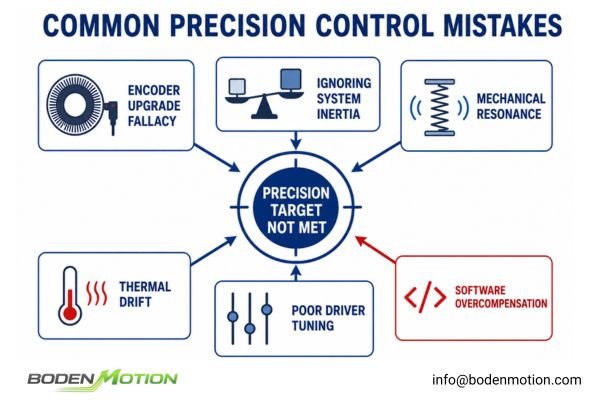
From my experience in OEM design reviews, these are the most frequent mistakes:
- The "More Megapixels" Fallacy: Upgrading from a 1000 CPR to a 4096 CPR encoder while ignoring the mechanical system's ability to respond to those fine measurements.
- Ignoring System Inertia: Selecting a motor based on its torque rating without analyzing the inertia of the load and the required acceleration.
- Overlooking Mechanical Resonance: Mounting a high-performance motor on a flimsy or poorly damped mechanical structure.
- Ignoring Thermal Drift8: As a motor and its surrounding components heat up, their physical dimensions and electrical properties can change, causing positioning to drift over time.
- Underestimating Driver Tuning: Using a driver with default settings and expecting optimal performance. PID tuning is critical to match the driver's response to the specific motor and load mechanics.
- Assuming Software Can Solve Hardware Limitations: The most common trap. Attempting to write complex control algorithms to compensate for fundamental mechanical issues like backlash, high inertia, or resonance is an inefficient and often futile exercise.
Conclusion: Why Are Coreless Motors Widely Used in High-Precision Motion Systems?
Coreless motors directly enable higher precision by addressing the root mechanical limitations of motion: their low inertia allows for faster response, their ironless design ensures smoother motion, and their balanced structure reduces vibration.
Precision is ultimately determined by how well the physical system can execute a control command. Coreless motors provide a fundamentally more responsive and predictable mechanical platform, allowing encoders and control algorithms to perform to their full potential.
If you are developing medical equipment, optical systems, semiconductor devices, or high-precision automation platforms, BODENMOTION can support OEM motor selection, motion optimization, and precision control system integration.
📧 info@bodenmotion.com
FAQ: How Coreless Motors Improve Precision Control
Why are coreless motors commonly used in precision motion systems?
Because they provide low inertia, smooth motion, fast response, and reduced vibration, all of which are foundational characteristics that improve control accuracy.
Does a coreless motor automatically improve positioning accuracy?
Not by itself. It provides a superior mechanical starting point, but final accuracy depends heavily on encoder quality, driver tuning, mechanical stiffness, and overall system design.
Why does low inertia matter for precision control?
Low inertia allows the motor to accelerate and decelerate more quickly, reducing response delay and positioning overshoot. This enables a "stiffer" and more responsive control loop.
Are coreless motors better than BLDC motors for all precision applications?
No. It's a matter of trade-offs. Coreless motors excel in fast-response and micro-motion applications, while iron-core BLDC motors often perform better in continuous high-torque or high-thermal-load applications.
Can vibration affect positioning accuracy?
Yes. Even small vibration levels can introduce measurement errors, positioning drift, and instability in sensitive systems, often by exciting a resonant frequency in the machine's structure.
Can BODENMOTION support precision motion system development?
Yes. BODENMOTION supports OEM projects involving encoder integration, motion optimization, low-vibration tuning, and compact precision motor solutions.
"DC Motor - Basics, Construction, Types & Its Application - ElProCus", https://www.elprocus.com/dc-motor-basics-types-application/. A technical encyclopedia entry on electric motors confirms that conventional brushed and brushless DC motors typically use copper windings wound around a laminated iron core to enhance magnetic field concentration and reduce eddy current losses. Evidence role: definition; source type: encyclopedia. Supports: In a conventional brushed or brushless DC motor, the copper windings are wound around a heavy, laminated iron core.. ↩
"Cogging torque - Wikipedia", https://en.wikipedia.org/wiki/Cogging_torque. A technical paper on electric motor design explains that cogging torque arises from the interaction between permanent magnets and the salient poles (iron teeth) of the core, leading to periodic variations in torque and resulting in uneven motion, particularly at low speeds. Evidence role: mechanism; source type: paper. Supports: The permanent magnets in the stator are naturally attracted to the iron teeth of the rotor core. This creates a 'magnetic detent' or cogging torque, which results in jerky, uneven motion, especially at low speeds.. Scope note: The source may focus on general electric motors, not exclusively DC motors, but the principle applies broadly. ↩
"[PDF] WAVED: A Coreless Axial Flux PM Motor for Drive Systems with ...", https://uknowledge.uky.edu/cgi/viewcontent.cgi?article=1020&context=peik_facpub. A technical review from a reputable engineering source explains that coreless motors, lacking iron in the rotor, do not exhibit cogging torque, resulting in smoother and more linear torque output compared to iron-core motors. Evidence role: mechanism; source type: education. Supports: Because a coreless motor has no iron in its rotor, this phenomenon does not exist. The torque delivery is inherently smooth and linear, even at near-zero speeds.. Scope note: Most sources discuss ideal cases; real-world manufacturing imperfections may introduce minor irregularities. ↩
"Understanding the Distinctions Among Torque Ripple, ...", https://www.automate.org/motion-control/tech-papers/understanding-the-distinctions-among-torque-ripple-cogging-torque-and-detent. A technical paper or engineering textbook describes how torque ripple or cogging in precision motion systems can introduce visible artifacts, such as banding, in imaging applications like scanners and microscopes. Evidence role: mechanism; source type: paper. Supports: In equipment like microscopes or document scanners, cogging can cause visible banding or artifacts in the final image.. Scope note: The severity of artifacts depends on system design and application sensitivity. ↩
"Low Inertia Servo Motors and Gear Heads: A Powerful Combination", https://motioncontrol.blog/low-inertia-servo-motors-and-gear-heads-a-powerful-combination/. A technical review of coreless motor design explains that reduced rotor inertia enables faster acceleration and deceleration, resulting in rapid mechanical response compared to traditional iron-core motors. Evidence role: mechanism; source type: education. Supports: With a low-inertia coreless motor, this mechanical response is extremely fast.. Scope note: The source may provide general principles and typical performance ranges, but not specific values for all motor types. ↩
"Why maxon Uses Coreless Motor Design In Precision Motion ...", https://www.electromate.com/news/post/coreless-vs-iron-core-why-maxon-uses-coreless-motor-design-in-precision-motion-control-applications. Technical reviews and engineering literature describe coreless motors as having reduced vibration due to their balanced rotor design and absence of cogging torque, supporting the claim that they are inherently low-vibration devices; however, vibration levels may still depend on application-specific factors such as mounting and load. Evidence role: mechanism; source type: education. Supports: Coreless motors are inherently low-vibration devices.. Scope note: Vibration performance can vary depending on installation and operating conditions. ↩
"Wafer alignment measurement in lithography systems based on ...", https://opg.optica.org/oe/fulltext.cfm?uri=oe-33-22-47218. Semiconductor manufacturing standards and research indicate that mask and wafer alignment in lithography processes often require stability within single-digit micron tolerances, and vibration can significantly compromise this precision; however, specific tolerance requirements may vary by process and technology generation. Evidence role: statistic; source type: research. Supports: Aligning masks and wafers requires single-digit micron stability that is impossible in the presence of vibration.. Scope note: Exact stability requirements may differ across lithography techniques and device nodes. ↩
"Controlling Thermal Expansion - Zaber", https://www.zaber.com/articles/controlling-thermal-expansion?srsltid=AfmBOormaLaftHUy3HBVQtS0xDDBXyotR1yqHFdMM5iJyHXir3p19fKa. Engineering studies and technical documentation confirm that thermal drift can affect motor positioning due to changes in physical dimensions and electrical properties as components heat up; however, the magnitude of drift depends on material properties and system design. Evidence role: mechanism; source type: research. Supports: As a motor and its surrounding components heat up, their physical dimensions and electrical properties can change, causing positioning to drift over time.. Scope note: The degree of drift varies with materials and operating conditions. ↩