Design teams across the industrial automation landscape are migrating from 24V to 48V systems to achieve greater power density. However, this transition is not a simple upgrade; it forces a shift in design priorities, introducing a different class of engineering challenges that must be managed across modern industrial automation and DC motor systems.
A 48V architecture is a powerful choice for medium-to-high power industrial applications because, assuming identical power output, it operates with half the current of a 24V system. This dramatically reduces thermal losses, cable size, and overall electrical stress on the power delivery network.
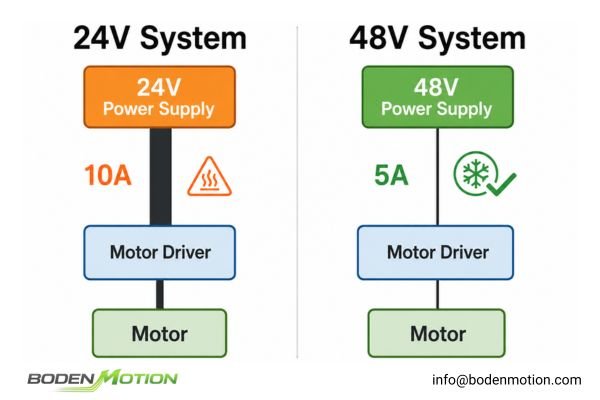
While the benefits are compelling, a successful 48V implementation requires moving beyond motor selection and adopting a system-level approach. The gains in thermal and electrical efficiency come with new challenges in driver complexity, EMI management, and electrical safety. Understanding and designing for these trade-offs is the key to a reliable deployment in applications like AGVs, robotic actuators, and other demanding industrial equipment.
Why Are 48V Systems Becoming More Common in Industrial Automation?
As industrial equipment becomes more powerful, traditional 24V systems often encounter limitations related to high current and associated heat. This creates a performance and reliability bottleneck that is difficult to design around.
By doubling the system voltage to 48V, designers can cut the operating current in half for the same power output. This is a fundamental tool for solving critical thermal and efficiency problems in power-dense applications.
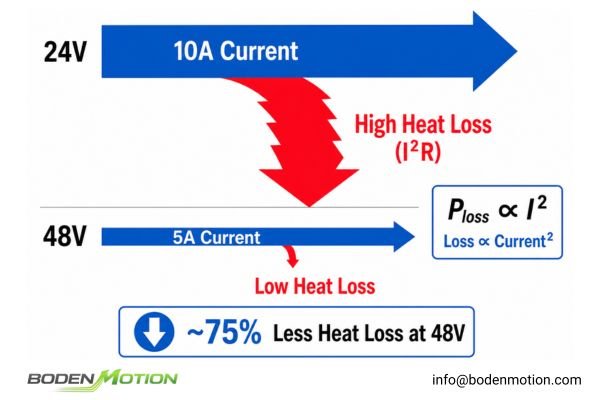
This architectural shift is largely driven by the growth of mobile automation, such as AGVs (Automated Guided Vehicles) and AMRs (Autonomous Mobile Robots)1. These systems demand significant power for drive wheels and lifting mechanisms but are constrained by battery runtime and the physical size of wiring harnesses. The engineering principle is P = V × I (Power = Voltage × Current). For a given power requirement, doubling the voltage halves the current.
A Practical Example: AGV Drive Wheel
Consider a 240W drive wheel motor for an AMR:
- 24V System: Draws
240W / 24V = 10A. - 48V System: Draws
240W / 48V = 5A.
This 50% current reduction provides system-level benefits that extend far beyond the motor itself. For many design teams, the primary motivation for adopting 48V is to escape the constraints of high current: heat, voltage drop, and bulky, expensive cabling.
How Does Higher Voltage Affect Motor Efficiency and Thermal Performance?
In high-duty-cycle industrial systems, excessive heat is a primary cause of premature failure and performance degradation. Actively managing this heat is often a central design challenge.
Higher voltage systems operate with lower current, which directly reduces resistive copper losses (P_loss = I²R). This results in cooler motor operation, less cable heating, and improved overall thermal stability under comparable operating conditions.
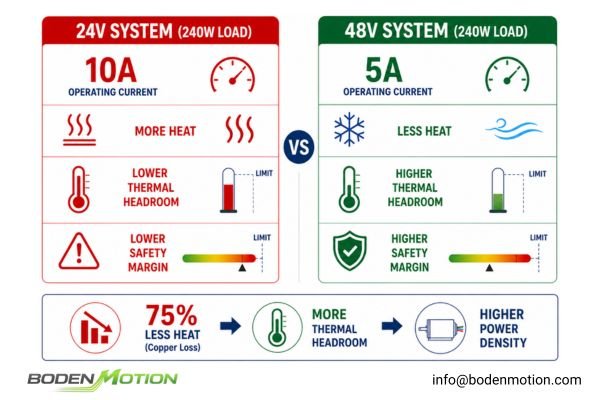
The engineering principle behind this is the relationship between current and resistive heating. Copper loss—the heat generated by current flowing through the resistance of motor windings and power cables—is proportional to the square of the current. Halving the current reduces these primary heat losses by a factor of four (75%).
| Feature | 24V System (240W Load) | 48V System (240W Load) | System-Level Impact |
|---|---|---|---|
| Operating Current | 10A | 5A | 50% reduction in current. |
| I²R Copper Losses | Proportional to 100 (10²) | Proportional to 25 (5²) | 75% reduction in primary heat source. |
| Cable Requirement | Thicker gauge (e.g., 14 AWG) | Thinner gauge (e.g., 17 AWG) | Lighter, cheaper, more flexible wiring. |
| Thermal Headroom | Lower; more sensitive to ambient temp. | Higher; more resilient to overload. | Motor can handle higher ambient temperatures or short-term overload. |
This increased thermal headroom is what unlocks greater power density. It allows an engineer to either get more power out of the same size motor or use a smaller motor for the same power output, freeing up valuable space in compact equipment.
How Do Duty Cycle and Load Profile Affect 48V Motor Selection?
While a 48V architecture provides significant thermal advantages, these benefits can be negated if the real-world operating conditions are not fully understood. A motor's nameplate power rating is only a starting point; the duty cycle and load profile are what truly determine its long-term thermal reliability.
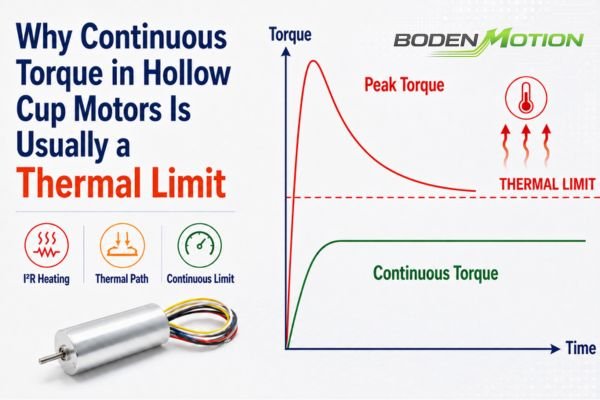
A motor's ability to survive in an application depends less on the peak load it can handle and more on the total heat it accumulates over time versus its ability to dissipate that heat.
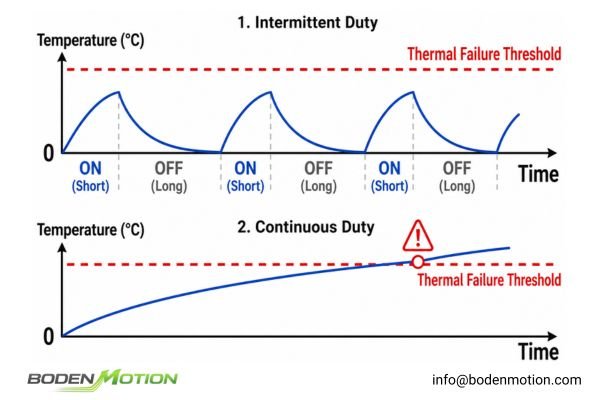
Consider two 48V motors in a logistics automation system, both with a peak power rating of 300W:
- Scenario 1: Intermittent Duty Actuator. An electric actuator diverts a package, requiring 300W of peak power for 2 seconds. It then rests for 10 seconds before the next cycle. The duty cycle is low (~17%). Here, the motor's thermal mass allows it to absorb the heat from the short burst of activity, and the long rest period gives it ample time to cool down2. The motor selection is driven by its peak torque capability.
- Scenario 2: Continuous Duty Conveyor. A small conveyor motor in the same system runs continuously at a constant 150W load to transport packages. The duty cycle is 100%. Although the power is half of the actuator's peak, the heat is generated without interruption. Here, the motor's ability to continuously dissipate heat to reach a stable, safe operating temperature (thermal equilibrium) is the critical factor.
A common integration mistake is to assume the motor sized for the actuator's peak load would be more than adequate for the conveyor. In reality, that motor would likely overheat and fail in the continuous-duty application3. Its design is optimized for short-term peak performance, not for long-term heat dissipation. This underscores why a robust motor selection process must analyze the entire load profile, not just the maximum power or torque figures on a datasheet.
48V vs. 24V BLDC Motors: A Direct Comparison
Understanding the load profile is essential because it informs the most fundamental architectural decision: choosing between 24V and 48V. This choice is a system-wide engineering trade-off between thermal efficiency, power density, cost, and design complexity.
A 48V system excels in high-power applications where efficiency and thermal management are paramount, while 24V systems often remain the pragmatic choice for lower-power, cost-sensitive equipment.
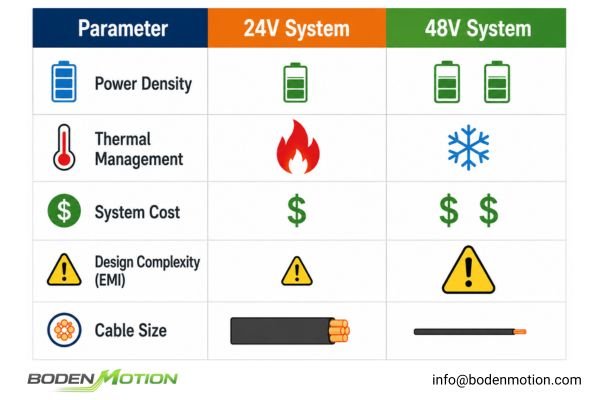
This table summarizes the key engineering trade-offs:
| Parameter | 24V Architecture | 48V Architecture | Engineering Consideration |
|---|---|---|---|
| Power Density | Lower | Higher | 48V allows more power from a given motor size due to superior thermal management. |
| Thermal Management | More Challenging | Simpler | 75% lower I²R losses at 48V significantly reduce heat generation under identical power loads.4 |
| System Cost | Lower | Higher | 24V components are cheaper and more widely available. 48V requires higher-rated, more expensive components. |
| Design Complexity (EMI) | Lower | Higher | 48V systems generate more high-frequency noise, requiring careful EMI filtering and layout. |
| Cable & Harness | Heavier & Thicker | Lighter & Thinner | Lower current at 48V allows for smaller, more flexible, and less expensive cabling. |
| Safety Margin | Higher | Lower | Components in 48V systems operate closer to their voltage limits, making them more sensitive to spikes. |
When Is 24V Still the Better Choice?
Despite the clear benefits of 48V in high-power scenarios, a 24V architecture remains the superior choice in many common applications:
- Low-Power Systems: For systems operating under ~200W, the absolute current at 24V is manageable, and the thermal benefits of 48V are less impactful.
- Short Cable Runs: In compact machines where motor-to-driver distances are less than a meter, voltage drop and cable heating are rarely problems.
- Cost-Sensitive Equipment: 24V components (power supplies, drivers, relays) are mass-produced in enormous volumes, making them significantly cheaper and more widely available.
- Existing 24V Ecosystems: If equipment must integrate into a factory infrastructure based on 24V control logic and power, adding a new voltage rail introduces complexity.
What New Challenges Appear When Moving to 48V Motor Systems?
While 48V architectures solve many current-related problems, they introduce a new set of electrical challenges. Design reviews frequently reveal that teams are caught off guard by issues related to voltage management and electrical noise.
Higher voltage increases stress on driver components, creates a greater potential for EMI, and requires more robust insulation. The engineering focus shifts from managing current and heat to managing voltage and its transient behavior.
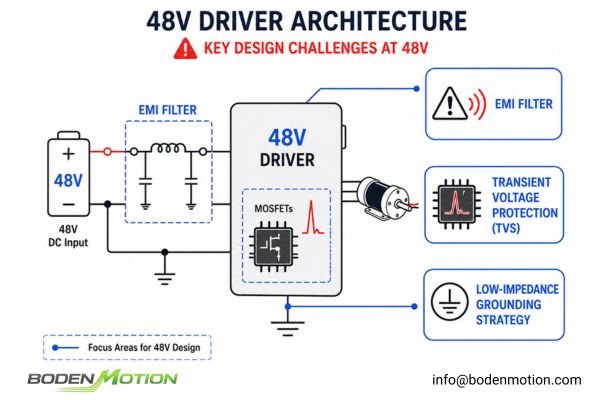
Key challenges that emerge during system qualification include:
- Increased Driver Stress: The MOSFETs in the driver experience double the voltage stress. This makes them more susceptible to failure from transient voltage spikes caused by switching or regenerative braking.
- High-Frequency EMI: The fast voltage rise and fall times (high dv/dt) of 48V switching are an efficient source of high-frequency noise. This can manifest as:
- Conducted EMI: Noise that travels back down power lines, disrupting other devices on the same bus.
- Radiated EMI: Noise that broadcasts through the air, interfering with nearby sensors, encoders, or wireless communication modules.
- Grounding Strategy: A poor ground plane can turn a chassis into an antenna, amplifying radiated EMI. A robust, low-impedance ground strategy is non-negotiable in 48V systems.5
Engineering Scenario: Regenerative Braking in an AGV Platform
Validation testing often exposes issues that datasheets cannot predict. An AGV development team upgraded their drive system to 48V. The motors ran cool and efficiently during acceleration and constant speed tests. However, during emergency braking tests, they experienced sporadic driver failures.
Analysis showed that as the AGV decelerated, the motors acted as generators, pushing a large pulse of current back onto the DC bus. This regenerative energy caused the bus voltage to spike to over 70V, exceeding the 60V absolute maximum rating of the driver's MOSFETs and causing them to fail. The solution was not a different motor, but a more robust driver design with a transient voltage suppression (TVS) circuit or a braking resistor to safely dissipate the regenerative energy.
What Common OEM Selection Mistakes Occur in 48V Motor Projects?
Field deployments sometimes expose failures that originate not from the motor itself, but from incorrect design assumptions about the surrounding system.
The most common mistake is treating the 48V upgrade as a simple voltage swap while overlooking the new system-level requirements for drivers, power supplies, and EMI management.
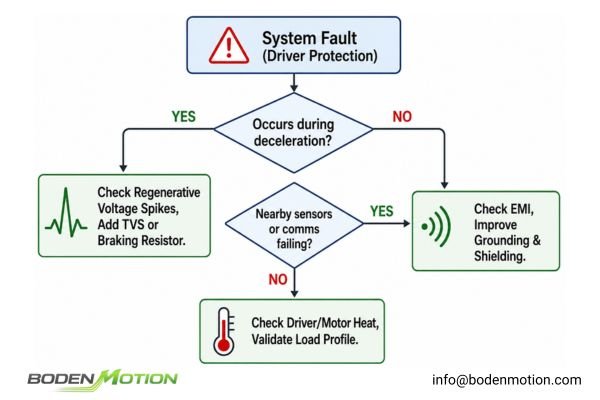
Design reviews frequently reveal these recurring oversights:
- Using 24V Design Assumptions: Applying 24V-era habits—such as using inadequately rated connectors, insufficient PCB trace clearances, and minimal EMI filtering—is a direct path to electrical failure in a 48V system.
- Ignoring Driver Thermal Requirements: While the motor runs cooler, the driver's switching losses can increase6. A common integration challenge is failing to provide an adequate thermal path for the driver, leading to over-temperature faults.
- Undersizing Power Supplies: The power supply must be specified to handle both the large inrush currents during motor startup and the voltage spikes from regenerative braking7 without entering a fault state.
- Neglecting EMI Management: Assuming that noise issues can be fixed "later" is a costly mistake. A robust EMI strategy, including filtering, shielding, and proper grounding, must be part of the initial design8.
- Focusing Only on Peak Load: Engineers design for the peak torque needed for acceleration but fail to validate the thermal performance over a full, real-world duty cycle, leading to overheating during continuous operation.
Final Engineering Review Checklist for 48V System Integration
Before committing to a 48V design, ensure your team has thoroughly reviewed these key system points:
- Load Profile & Duty Cycle: Have you defined the complete cycle, including acceleration, continuous run, deceleration, and dwell times?
- Thermal Path: Is there a clear, validated path for heat to escape both the motor and the driver within the final product enclosure?
- Cable Length & Gauge: Are cables properly sized for current and voltage drop over the full run length, especially for runs exceeding 3 meters?
- Driver Architecture: Does the driver have sufficient voltage overhead (a >60V rating is a common safety margin for 48V systems) and robust protection against transients?
- EMI Environment: Have you planned for filtering, shielding, and grounding to prevent interference with other critical system components like sensors and controllers?
Conclusion: How Should OEM Engineers Approach 48V Motor System Design?
A successful 48V implementation is a result of thorough system-level engineering, not just component selection. The core task is to leverage the clear thermal and efficiency benefits of lower current while proactively managing the new electrical challenges of higher voltage. Most field failures originate from an incomplete system analysis where these trade-offs are not fully respected.
If you are developing AGVs, industrial automation equipment, or material handling systems, the BODENMOTION team can support your 48V motor selection, driver matching, thermal optimization, and OEM system integration. We can help you navigate these engineering trade-offs to build a reliable, efficient, and robust motion system. Contact us to discuss your project.
info@bodenmotion.com
FAQ: 48V Brushless DC Motors in Industrial Systems
Why are industrial systems moving from 24V to 48V architectures?
To manage power more efficiently. At the same power output, a 48V system uses half the current of a 24V system. This dramatically reduces heat loss (I²R loss), allows for smaller wiring, and improves overall system efficiency, especially in high-power and mobile applications.
Does a 48V motor automatically produce more torque than a 24V motor?
Not necessarily. Motor torque is primarily a function of its physical design and the current it can handle. Voltage is the primary factor that determines a motor's maximum potential speed. A 48V system delivers power more efficiently, which allows a motor to sustain its torque output more effectively across its speed range.
What is the biggest advantage of a 48V motor system?
For many industrial applications, the most significant advantage is improved thermal management. The 75% reduction in resistive copper losses for the same power output means motors and cables run cooler, leading to higher reliability and greater power density.
Are 48V motor systems more difficult to design?
They introduce a different set of design challenges. While managing current becomes easier, engineers must pay more attention to voltage-related issues like EMI suppression, driver component stress (MOSFETs), transient voltage protection, and electrical insulation standards.
Which applications benefit most from 48V BLDC motors?
Applications that are power-intensive (>300W), battery-operated, or involve long cable runs benefit most. This includes AGVs, AMRs, large conveyor systems, industrial pumps, and high-performance electric actuators where efficiency and thermal performance are critical.
Can BODENMOTION support OEM 48V motor projects?
Yes. BODENMOTION's engineering team specializes in supporting OEM projects. We provide application analysis, 48V BLDC motor selection, driver matching, thermal modeling, and customized motion system development for industrial automation.
ScienceDirect. Planning and Control of Autonomous Mobile Robots for Intralogistics. ↩
Wikipedia. Electric Motor. ↩
Groschopp. Tech Tip: Troubleshooting an Overheating Motor. ↩
Analog Devices. The Power of 48 V: Relevance, Benefits and Essentials in System Design. ↩
ALLPCB. Grounding and Signal Ground in EMI Design. ↩
Virginia Tech. Switching Frequency Effects on Traction Drive Systems. ↩
University of Hawaii. Understanding Regeneration PDF. ↩
Defense Acquisition University. EMC By Design PDF. ↩