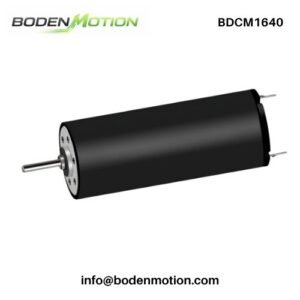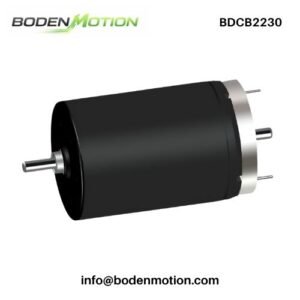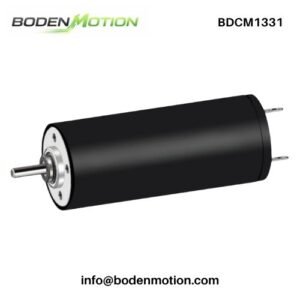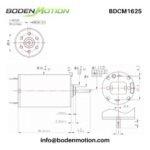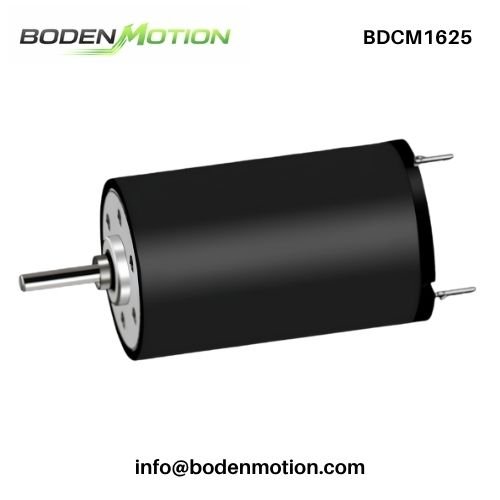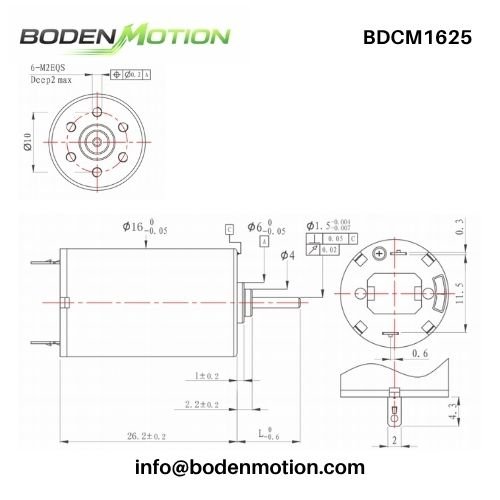
The BDCM1625 16mm coreless brushed DC motor combines a low-inertia coreless rotor with precious-metal brush commutation, delivering smooth response, low-noise operation, and straightforward DC control in a compact Ø16 × 25 mm package.
Available in 3.7V, 6V, 12V, and 24V windings, it is well suited to miniature automation, medical and laboratory equipment, optical mechanisms, and other space-constrained OEM motion systems. Optional gearbox and encoder configurations support geared and feedback-controlled applications.
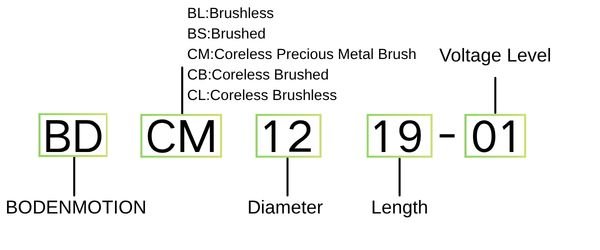
Each model suffix represents a separate winding configuration. Voltage, current, speed, torque, and resistance should therefore be evaluated as a complete operating set rather than treating the same motor winding as interchangeable across different supply voltages.
| Motor Model | Unit | BDCM1625-01 | BDCM1625-02 | BDCM1625-03 | BDCM1625-04 |
|---|---|---|---|---|---|
| At Nominal | |||||
| Nominal Voltage | V/DC | 3.7 | 6 | 12 | 24 |
| Nominal Speed | rpm | 6,800 | 7,840 | 8,640 | 8,800 |
| Nominal Current | A | 0.67 | 0.50 | 0.27 | 0.15 |
| Nominal Torque | mN·m | 2.5 | 2.8 | 2.7 | 3.0 |
| Free Load | |||||
| No-load Speed | rpm | 8,500 | 9,800 | 10,800 | 11,000 |
| No-load Current | mA | 50 | 20 | 15 | 6 |
| At Max. Efficiency | |||||
| Maximum Efficiency | % | 76.4 | 82.7 | 79.7 | 82.8 |
| Speed | rpm | 7,565 | 8,967 | 9,774 | 10,065 |
| Current | A | 0.39 | 0.22 | 0.14 | 0.07 |
| Torque | mN·m | 1.39 | 1.19 | 1.28 | 1.29 |
| At Max. Output Power | |||||
| Maximum Output Power | W | 2.82 | 3.59 | 3.81 | 4.37 |
| Speed | rpm | 4,250 | 4,900 | 5,400 | 5,500 |
| Current | A | 1.60 | 1.23 | 0.66 | 0.37 |
| Torque | mN·m | 6.34 | 6.99 | 6.74 | 7.58 |
| At Stall | |||||
| Stall Current | A | 3.15 | 2.43 | 1.30 | 0.74 |
| Stall Torque | mN·m | 12.7 | 14.0 | 13.5 | 15.2 |
| Motor Constants | |||||
| Terminal Resistance | Ω | 1.17 | 2.47 | 9.23 | 32.43 |
| Terminal Inductance | mH | 0.105 | 0.210 | 0.510 | 1.320 |
| Torque Constant | mN·m/A | 4.09 | 5.80 | 10.49 | 20.67 |
| Speed Constant | rpm/V | 2,297.3 | 1,633.3 | 900.0 | 458.3 |
| Speed/Torque Constant | rpm/mN·m | 670.3 | 701.3 | 801.4 | 725.2 |
| Mechanical Time Constant | ms | 6.3 | 6.6 | 7.5 | 6.8 |
| Rotor Inertia | g·cm² | 0.90 | 0.90 | 0.90 | 0.90 |
| Number of Pole Pairs | — | 1 | 1 | 1 | 1 |
| Number of Phases | — | 5 | 5 | 5 | 5 |
| Weight | g | 24 | 24 | 24 | 24 |
| Typical Noise Level | dB | ≤40 | ≤40 | ≤40 | ≤40 |
Not sure how to interpret model differences? See the model code breakdown below ↓
The BDCM1625 is intended for compact mechanisms, so shaft alignment and load direction become important when the motor is integrated with gears, cams, pulleys, or couplings.
Axial and Radial Loading
The sintered metal bearing supports a maximum dynamic axial load of 0.5 N and a maximum radial load of 1.5 N, measured 5 mm from the flange. External support should be considered when the transmission creates significant side loading.
Bearing Clearance
Axial play is specified at 0.05–0.15 mm, while radial play is limited to 0.012 mm. Accurate alignment helps prevent additional vibration, uneven bearing loading, and unnecessary brush stress.
Noise After Installation
The 40 dB specification represents typical motor-level acoustic performance. Brackets, enclosures, gears, and coupling misalignment can amplify vibration, so system-level noise should be checked after final assembly.
Operating Temperature
The specified ambient temperature range is −20°C to +80°C, relative humidity should remain below 90% RH at 25°C, and rotor temperature should not exceed 85°C.
Duty-Cycle Control
Repeated starts, frequent reversing, and operation near maximum-output current can accelerate brush wear and heat accumulation. Continuous and intermittent load profiles should therefore be evaluated separately.
The BDCM1625 can be adapted from a direct-drive miniature motor into a geared or feedback-enabled drive platform according to the application requirements.
| Customization Item | Available Options / Description |
|---|---|
| Winding Version | 3.7V, 6V, 12V, or 24V standard winding |
| Planetary Gearbox | Optional for lower output speed and higher transmitted torque |
| Encoder Option | Optional photoelectric or magnetoelectric encoder |
| Shaft Configuration | Shaft geometry and length can be reviewed for the driven mechanism |
| Wiring / Lead Length | Electrical connection arrangement can be adapted to equipment layout |
| Connector Type | Connector selection can be reviewed according to the controller or harness |
| Mounting Interface | Mechanical adaptation can be evaluated for the OEM assembly |
| Prototype Combination | Motor, gearbox, and optional encoder can be evaluated together before production |
The encoder and gearbox are optional configurations, not standard components of the base motor.
The BDCM1625 fits OEM equipment where compact size, simple brushed control, and moderate torque must work together within a limited mechanical envelope.
Selecting a miniature brushed motor involves more than matching dimensions. Low-voltage current demand, gearbox losses, brush wear, mounting resonance, and the actual operating cycle can all change the performance seen in the finished mechanism.
Germany | Laboratory Equipment Manufacturer
Application: compact sample adjustment module
Feedback: The Ø16 × 25 mm motor fit within the existing enclosure while providing smooth motion for repeated adjustment cycles.
Japan | Precision Equipment OEM
Application: miniature geared positioning mechanism
Feedback: The planetary gearbox allowed the motor speed to be reduced to the required actuator range without increasing the basic motor diameter.
United States | Portable Device Developer
Application: battery-powered internal actuator
Feedback: The low-voltage winding options simplified power-system matching during prototype development while keeping the overall drive assembly compact.
[BDCM1625 16mm Coreless Precious Metal Brushed DC Motor Specification PDF]
A1: The driven mechanism introduces load torque, bearing friction, gearbox losses, and possible voltage drop. Rated motor speed therefore should not be treated as the final actuator speed; the complete transmission and operating load must be considered.
A2: No. Photoelectric and magnetoelectric encoders are optional components. The standard motor can be used without an encoder, while feedback can be added when the application requires speed or position monitoring.
A3: The correct choice depends on the available battery voltage, current capability, required speed, and load. The 3.7V version fits lower-voltage architectures, while higher-voltage windings operate with different current and torque characteristics and may better match regulated DC systems.
A4: Yes. Volume pricing is available for OEM orders, with the final quotation depending on quantity, customization requirements, and production configuration.
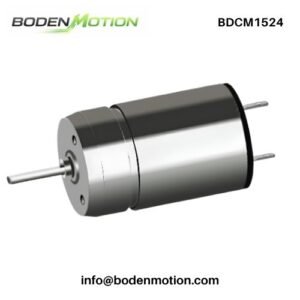
A5: Yes. The BDCM1524 uses a Ø15 × 24 mm motor body and belongs to the 2–4W power class. It is a useful alternative when installation size and lower power demand are more important than the BDCM1625’s 4–8W platform.
For compact OEM mechanisms requiring a precious-metal brushed motor, geared output, or optional feedback, BODENMOTION supports configuration selection around the complete electrical and mechanical system.
📧 Email: info@bodenmotion.com
🌐 Website: https://bodenmotion.com