Many automation systems don't fail because the motor can't spin fast enough. They fail because the DC motor cannot repeat the same motion cycle reliably under changing load, friction, and inertia.
High torque BLDC motors are used in automation systems because they provide the controllable rotational force needed for acceleration, positioning, load handling, and repeatable start-stop operation. For OEM engineers, torque should be evaluated as part of the complete motion profile rather than as an isolated datasheet value.
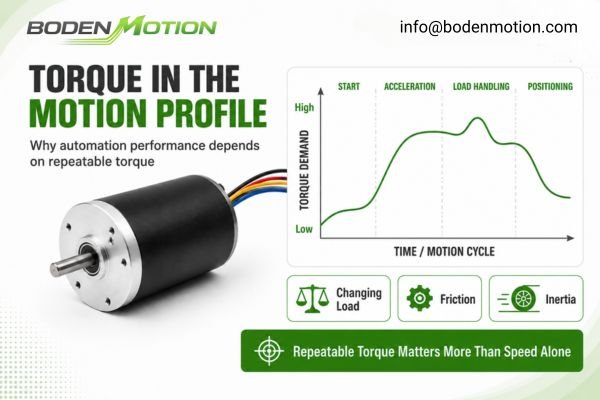
For engineers designing automated equipment, torque is the physical link between a control system's commands and the mechanical system's actual movement1. Understanding how torque affects the entire motion profile—from startup and acceleration to deceleration and positioning—is fundamental to building a reliable and efficient automation system2. This article will break down why focusing on the right torque characteristics is so critical for success.
What a High Torque BLDC Motor Means in Automation Systems
The term "high torque" in automation isn't just about raw power; it’s about having the right amount of controlled force at the required operating speed.
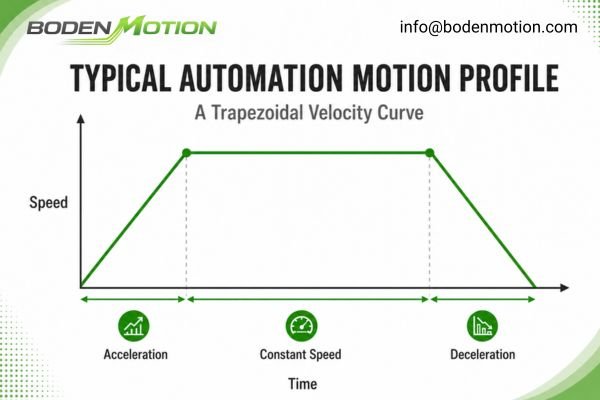
A high torque BLDC motor is designed to deliver strong, controllable rotational force, enabling precise and repeatable mechanical work. It’s not just about a high stall torque number but about providing sufficient torque density (torque per volume) and maintaining that torque throughout the required motion profile. For example, a small actuator may need to accelerate from 0 to 1,500 RPM within 200 ms, move a load for less than one second, and then stop—repeating this cycle thousands of times per shift.
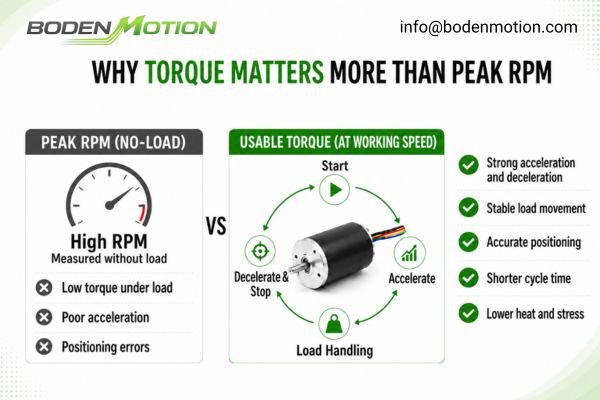
In automation systems, this usable torque supports key tasks:
- Fast Acceleration: Overcoming system inertia quickly to reduce cycle time.
- Stable Load Movement: Moving objects without speed drops or hesitation.
- Repeated Start-Stop Operation: Executing thousands or millions of cycles with reduced risk of performance degradation.
- Controlled Positioning: Moving to a precise location and holding it firmly.
- Robotic Joint Motion: Providing the rotational force for articulated arm movements.
- Compact Actuator Design3: Delivering significant force from a small motor footprint.
Why BLDC Motor Torque Matters More Than Peak RPM in Automation
Peak RPM is easy to compare on a datasheet, but in many automation tasks, it is less useful than the available torque at the required operating speed.
Real automation equipment rarely allows a motor to run at its no-load maximum speed. Instead, the motor executes a carefully defined motion profile, which typically involves starting, accelerating, moving a load, decelerating, and stopping at a precise point. During these cycles, torque stability is far more critical than maximum speed.
If a motor has insufficient torque to handle the load and inertia of the system, performance suffers directly. A system with inadequate torque may exhibit slow acceleration, speed drops under load, positioning errors, and increased heat generation as the driver pushes the motor to its limits.
| Feature | High No-Load RPM | High Usable Torque |
|---|---|---|
| Primary Benefit | Spins fast without a load. | Performs work and controls a load effectively. |
| Relevance to Automation | Often lower. Some systems use gearing or transmission design to balance speed and torque. | High. Directly supports acceleration, load handling, and positioning. |
| Impact on Cycle Time | Limited. Cycle time is often constrained by acceleration, deceleration, and settling time. | Significant. Higher usable torque can support faster acceleration and deceleration. |
| System Stability | Limited direct impact. Stability depends more on torque margin, load inertia, driver control, and feedback. | High. Provides torque reserve to handle friction, inertia, and load changes. |
How High Torque BLDC Motors Improve Motion Cycle Stability
Automation equipment is expected to perform the same action identically, cycle after cycle. However, real-world loads are never perfectly constant.
A high torque BLDC motor improves motion cycle stability by providing enough "torque margin"—the difference between the torque required for a task and the torque the motor can sustainably deliver at that operating point. From my experience, many system instabilities can be traced back to an insufficient torque margin. The system works perfectly on a new prototype but starts to fail in the field as conditions change.
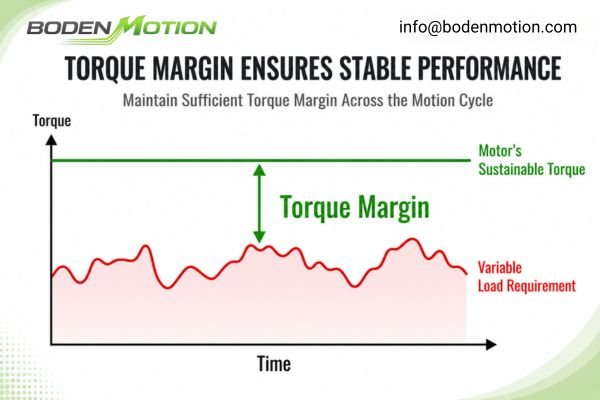
Real-world systems face constant load variations from:
- Changes in friction as components wear or lubricants age4.
- Fluctuations in belt or chain tension.
- Variations in the weight or size of the product being handled.
- Temporary overloads or bind-ups in the mechanism.
When the motor has sufficient torque reserve, the controller can maintain consistent speed and positioning behavior even when these load conditions change5. This reduces cycle-to-cycle variation and makes the entire automation process more robust.
Why Motor Torque Affects Positioning Accuracy and Repeatability
In modern automation, it's easy to think of positioning accuracy as a problem for encoders and software. But sophisticated feedback can't help if the motor lacks the physical strength to follow commands precisely.
Torque is what enables a motor to move a load to a target position without hesitation, overcome friction for fine adjustments, and hold that position against external forces. I've seen many teams try to solve a positioning problem by upgrading their encoder or tweaking PID loops, only to find the root cause was mechanical: the motor couldn't produce enough force to overcome the system's static friction predictably.
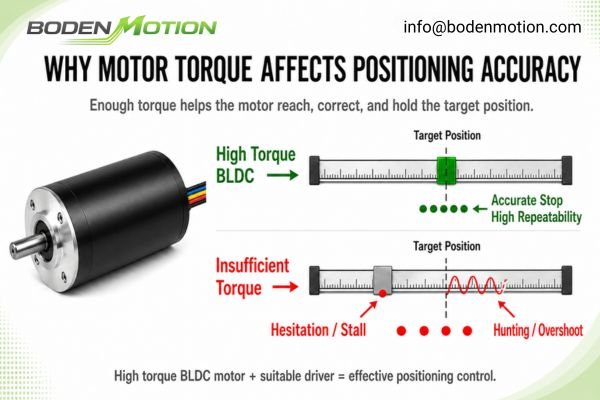
Insufficient motor torque can lead to:
- Positioning Errors: The motor stalls or hesitates just before reaching the target.
- Slow Response: The system feels sluggish because the motor struggles to initiate movement.
- Vibration or "Hunting": The motor overshoots the target and oscillates as the controller tries to correct the error.
- Inconsistent Repeatability: The stopping position varies from one cycle to the next.
A high torque BLDC motor, paired with a suitable driver, provides the muscle needed for the control system to work effectively.6
How High Torque BLDC Motors Support Long-Term Operation
Automation equipment is often expected to run for thousands of hours with minimal downtime. A properly selected high torque motor contributes to long-term reliability by operating with less electrical and thermal stress.
When a motor constantly runs near its torque limit, it draws higher current. Because copper loss increases with the square of the current (P = I²R), this leads to significant heat generation. This heat is the enemy of longevity, degrading windings, bearings, and lubricants. By selecting a motor with a healthy torque margin, it can perform the required task while drawing less current and running cooler.
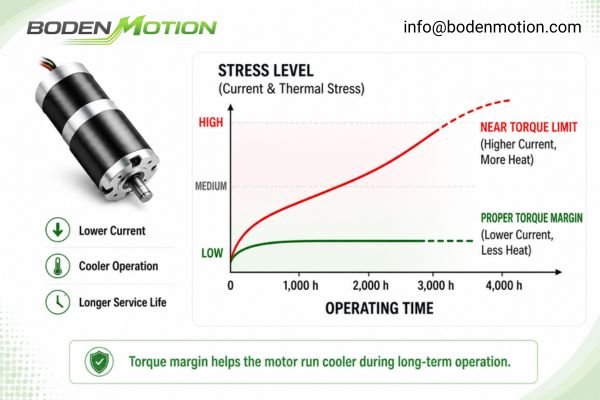
A well-matched high torque motor supports long-term operation by:
- Reducing Overload Risk: The motor can handle unexpected load spikes without stalling or overheating.
- Lowering Peak Currents: Reduces stress on the motor driver and power supply.
- Improving Thermal Stability: Cooler operation extends the life of motor components.7
- Reducing Mechanical Shock: Smooth, controlled acceleration puts less stress on the mechanical system.
What OEM Buyers Should Confirm Before Selecting a High Torque BLDC Motor
For automation applications, motor selection should begin with a detailed analysis of the motion cycle, not with a motor catalog. I always advise OEM clients to come prepared with this information before we start talking about specific motor models.
As an OEM engineer or buyer, you should provide your motor supplier with a complete picture of the application to ensure a successful motor selection process.
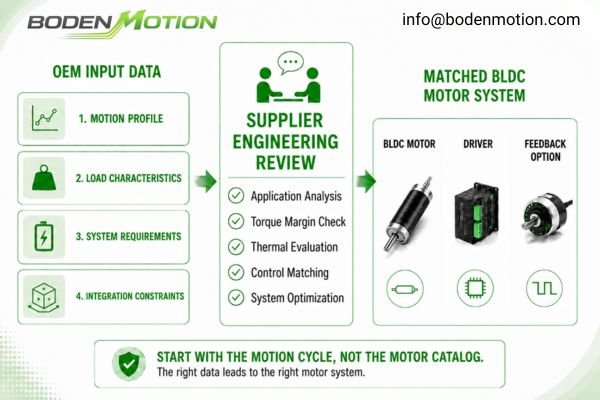
Key information to provide includes:
- Motion Profile: Required torque (continuous and peak), target speed range, and acceleration/deceleration times.
- Load Characteristics: Load mass, load inertia (if known, as T = J × α, where J is inertia and α is angular acceleration), and system friction.
- System Requirements: Target voltage, working duty cycle8, and positioning accuracy.
- Integration Constraints: Available installation space, driver control method, encoder or feedback needs, gearbox requirements, and noise/temperature limits.
The goal is not just to choose a "stronger" motor, but to select an integrated motor system that can repeat the required motion cycle reliably.
Common Mistakes When Selecting High Torque BLDC Motors for Automation
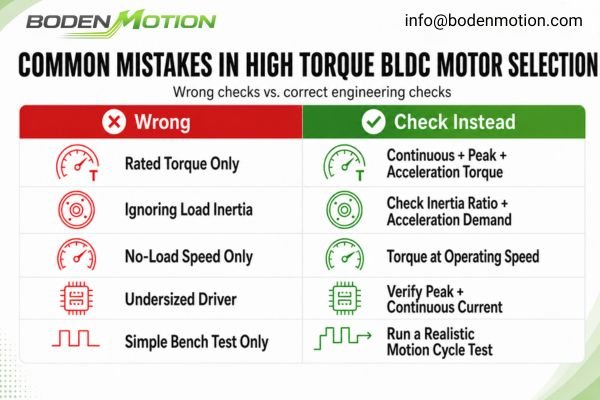
Simple selection mistakes can lead to complex and expensive system failures. In automation systems, the motor is not selected as a single component, but as part of a complete motion system that includes the load, driver, feedback device, transmission structure, and working duty cycle.
This is why many high torque BLDC motor problems do not appear during a simple no-load test. They usually appear later, when the motor is required to accelerate a real load, repeat the same cycle continuously, or maintain positioning accuracy under changing mechanical conditions. Here are some of the most common pitfalls I've seen.
-
Mistake 1: Focusing Only on Rated Torque. Automation is dynamic. You must also consider the acceleration torque needed to overcome inertia and the peak torque the motor can deliver for short periods.
-
Mistake 2: Ignoring Load Inertia. A motor might have enough torque for steady movement, but if the load's inertia is too high relative to the motor's rotor inertia, it may struggle to accelerate quickly and control the load without oscillation9.
-
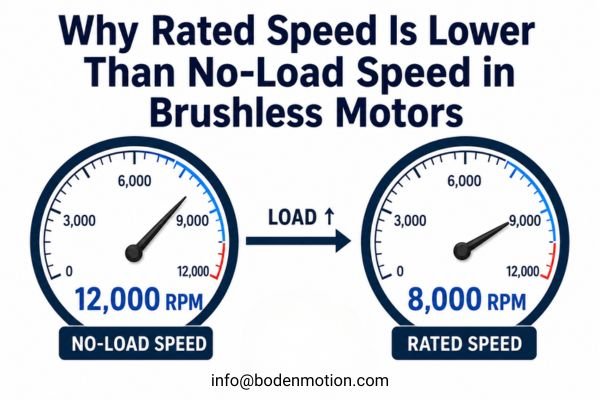
Mistake 3: Selecting Based on No-Load Speed. You need to know whether the motor can deliver the required torque at your target operating speed. Always refer to the motor's torque-speed curve10.
-
Mistake 4: Using an Undersized Driver. A high torque motor is limited by its driver. If the motion cycle requires short peak currents for acceleration, a driver selected only by its continuous current rating may not be sufficient.
-
Mistake 5: Not Testing with a Realistic Motion Cycle. A simple bench test proves very little. The only way to validate performance and thermal stability is to run the motor through its intended motion cycle repeatedly under a real or simulated load.
Conclusion
High torque BLDC motors are used in automation because these systems demand repeatable motion, stable load handling, and reliable long-term operation—all of which depend on having sufficient torque throughout the motion profile.
For OEM engineers, torque should not be viewed as an isolated number but in the context of the entire system: the motion cycle, load inertia, positioning requirements, driver capabilities, and thermal performance. A well-chosen high torque BLDC motor system ensures stable acceleration, controlled positioning, and consistent performance under real-world conditions.
If you are evaluating a high torque BLDC motor for an automation system, BODENMOTION can support motor selection based on your required speed range, torque demand, duty cycle, driver interface, feedback method, and installation space. Contact us at info@bodenmotion.com to discuss your motion profile.
FAQ
Q1: Why are high torque BLDC motors used in automation systems?
High torque BLDC motors are used in automation because they provide the controlled force needed for reliable and repeatable motion. This torque enables stable acceleration against system inertia, precise positioning without hesitation, and consistent load handling. In automation, where a machine may perform the same cycle millions of times, the motor's ability to deliver consistent torque directly impacts product quality, throughput, and machine uptime.
Q2: Is torque more important than speed in automation applications?
In many automation applications, usable torque at the required operating speed is more critical than the motor's maximum no-load speed. While speed affects cycle time, it's the motor's torque that determines whether it can accelerate the load quickly, maintain speed under load, and stop accurately. A high-speed, low-torque motor might spin fast unloaded but would likely fail to control a real-world load with the precision and repeatability required in automation.
Q3: How does a high torque motor improve positioning?
A high torque motor improves positioning by providing the necessary force to execute a controller's commands faithfully. It allows the motor to overcome static friction to initiate movement without delay, provides stiffness to hold a position against external forces, and enables fast, controlled acceleration to prevent overshoot and settling time delays. Without sufficient torque margin, the physical system cannot accurately reproduce the commands from the electronic control system, leading to positioning errors and inconsistent performance.
Q4: What information should OEM buyers provide when selecting a motor for automation?
To ensure a successful motor selection, OEM buyers should provide a complete application profile. This includes the motion profile (torque, speed, acceleration), load characteristics (mass, inertia, friction), and system requirements (voltage, duty cycle, accuracy). It's also crucial to share integration constraints like available space, driver interface, feedback needs (e.g., encoder), and environmental conditions. Providing this detailed information allows a motor supplier to recommend a properly sized and integrated motor system.
Q5: Does a high torque motor always mean better automation performance?
Not necessarily. The key is "system matching." A motor must be correctly sized for the application. An oversized motor might provide excess torque, but it can also be larger, heavier, more expensive, and have higher rotor inertia, potentially making it harder to control. An undersized motor will overheat and fail to perform reliably. The goal is to select a motor with an appropriate torque margin for the application—enough to ensure reliability without introducing other issues.
"Clemson Vehicular Electronics Laboratory: Torque Sensors", http://cecas.clemson.edu/cvel/auto/sensors/torque.html. A standard engineering reference explains that torque serves as the intermediary force translating control system outputs into mechanical motion in automated systems. Evidence role: definition; source type: education. Supports: torque is the physical link between a control system's commands and the mechanical system's actual movement.. Scope note: This explanation provides a general definition and may not cover all specialized automation contexts. ↩
"Mathematics of Motion Control Profiles: Optimizing Stepper Motor ...", https://www.pmdcorp.com/resources/type/articles/get/mathematics-of-motion-control-profiles-article. Engineering textbooks and research articles emphasize that analyzing torque throughout all phases of motion is essential for designing reliable and efficient automated machinery. Evidence role: expert_consensus; source type: education. Supports: Understanding how torque affects the entire motion profile—from startup and acceleration to deceleration and positioning—is fundamental to building a reliable and efficient automation system.. Scope note: While widely accepted, the importance of torque analysis may vary depending on the specific automation application. ↩
"Mini & Micro Linear Actuators: A Complete Guide | Xeryon", https://xeryon.com/technology/mini-micro-linear-actuators-complete-guide-to-compact-precision-motion/. Engineering literature describes how advances in materials and motor design have enabled compact actuators to achieve high force or torque outputs relative to their size, though performance is subject to thermal and mechanical limits. Evidence role: mechanism; source type: education. Supports: Delivering significant force from a small motor footprint.. Scope note: Maximum force output is constrained by heat dissipation and mechanical strength in compact designs. ↩
"Study of Friction and Wear Behavior Based on Different Lubricants ...", https://etd.auburn.edu/handle/10415/8021. Engineering tribology literature documents that friction in mechanical systems increases as components wear and lubricants degrade, affecting system performance. Evidence role: mechanism; source type: paper. Supports: Changes in friction as components wear or lubricants age.. Scope note: The degree of friction change depends on specific materials and operating conditions. ↩
"Research on Position and Torque Loading System with Velocity ...", https://www.mdpi.com/1424-8220/22/4/1329. Motor control engineering sources explain that sufficient torque reserve allows controllers to compensate for load variations, maintaining speed and positioning accuracy. Evidence role: mechanism; source type: education. Supports: When the motor has sufficient torque reserve, the controller can maintain consistent speed and positioning behavior even when these load conditions change.. Scope note: Actual performance depends on controller design and system dynamics. ↩
"Optimized Cascaded Position Control of BLDC Motors Considering ...", https://arxiv.org/html/2505.01740v1. Engineering textbooks and technical standards indicate that selecting a high torque BLDC motor and an appropriate driver is essential for achieving reliable and responsive control system performance, as insufficient torque or mismatched drivers can compromise system effectiveness; this is a general principle in motion control engineering. Evidence role: expert_consensus; source type: education. Supports: A high torque BLDC motor, paired with a suitable driver, provides the muscle needed for the control system to work effectively.. Scope note: The support is based on general engineering consensus and may not address all specific applications or exceptions. ↩
"Electric Motor Thermal Management | Transportation and Mobility ...", https://www.nlr.gov/transportation/peem-electric-motor-tm. Research in motor engineering indicates that lower operating temperatures reduce thermal stress and degradation of motor components, thereby extending their operational lifespan, although the degree of extension depends on material and usage factors. Evidence role: mechanism; source type: paper. Supports: Cooler operation extends the life of motor components.. Scope note: The relationship is influenced by specific materials and operational conditions; not all motors benefit equally from cooler operation. ↩
"Duty cycle - Wikipedia", https://en.wikipedia.org/wiki/Duty_cycle. The term 'duty cycle' is commonly defined in engineering as the proportion of time a system is active compared to the total time under consideration. Evidence role: definition; source type: encyclopedia. Supports: Target voltage, working duty cycle, and positioning accuracy are important system requirements.. Scope note: Definitions may vary slightly depending on the application (e.g., electrical, mechanical systems). ↩
"[PDF] Understanding Inertia Ratio and Its Effect On Machine Performance", https://us.mitsubishielectric.com/fa/en/support/technical-support/knowledge-base/getdocument/?docid=3E26SJWH3ZZR-41-13086. Technical literature on servo motor sizing explains that excessive load inertia compared to rotor inertia can lead to poor acceleration and control instability, including oscillations. Evidence role: mechanism; source type: education. Supports: if the load's inertia is too high relative to the motor's rotor inertia, it may struggle to accelerate quickly and control the load without oscillation. Scope note: This explanation is generally accepted in engineering practice but may vary with specific motor and control system designs. ↩
"[PDF] Understanding the importance of Torque-Speed curve and load ...", https://search.abb.com/library/Download.aspx?DocumentID=9AKK107045A5113&LanguageCode=en&DocumentPartId=&Action=Launch. Engineering textbooks and motor manufacturer guides emphasize the importance of consulting the torque-speed curve to ensure a motor can deliver the required torque at the desired operating speed. Evidence role: expert_consensus; source type: education. Supports: Always refer to the motor's torque-speed curve. Scope note: While this is standard practice, specific requirements may differ for specialized motor types. ↩