The South China International Industrial Fair (SCIIF) 2026 was a whirlwind of innovation. For OEM engineers, the pressure is on to create smaller, faster, and more precise robotic systems.
Key motor trends from SCIIF 2026 point towards miniaturization, high torque density, and integrated motion modules, driven by rapid advancements in humanoid robots, dexterous manipulation, and smart factory automation.
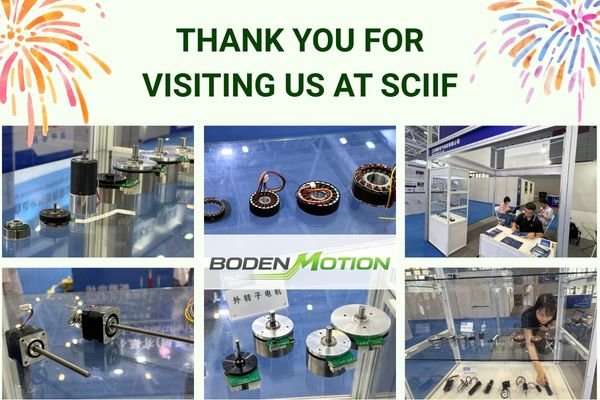
As a dc motor manufacturer, our team at BODENMOTION spent the week on the ground, talking with robotics companies and automation integrators. The conversations confirmed what we've been seeing in our own OEM projects: the motor is no longer just a component; it's the heart of the system1. The demands being placed on motion control are pushing the boundaries of what's possible, and the choices engineers make at the motor level have never been more critical. In this article, I'll share the key motor trends we observed and discuss how these developments are shaping the future of robotics.
Why Did BODENMOTION Exhibit at SCIIF Shenzhen 2026?
You need a partner who understands the challenges of modern robotics and automation. Attending and exhibiting at leading industry events like SCIIF is essential for staying connected to the real-world problems engineers are facing.
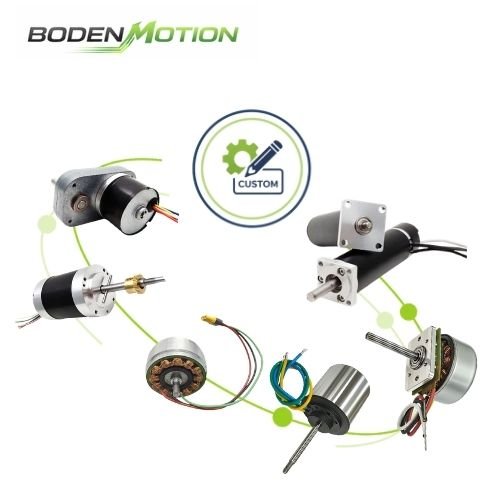
As an exhibitor at SCIIF Shenzhen 2026, BODENMOTION showcased its latest coreless motors, brushless DC motors, and stepper motor solutions designed specifically for robotics, industrial automation, medical devices, and precision instruments.
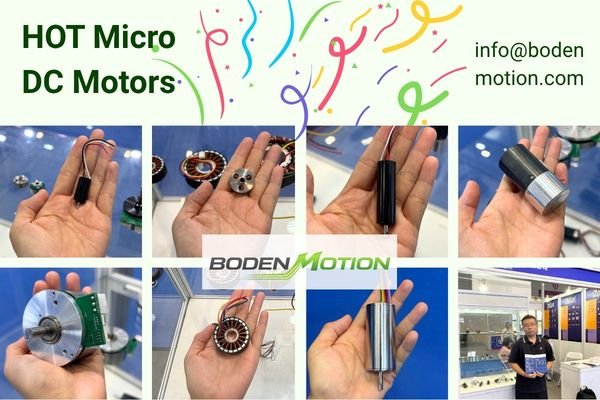
Our goal was not just to display products, but to engage in deep technical discussions. The visitors to the BODENMOTION booth included engineers and project managers from robotics startups, established humanoid robot developers, major automation equipment manufacturers, and innovative medical device companies. These exhibition discussions gave us firsthand insight into their biggest motion control hurdles.
Throughout the exhibition, we had the opportunity to discuss these challenges directly with the engineers on the front lines. These conversations revealed several common trends that are reshaping motor selection and system design in 2026, which form the basis of the insights shared in this article.
What Did We Showcase at SCIIF Shenzhen 2026?
Our presence at SCIIF was about showing practical solutions to the industry's biggest challenges. At the BODENMOTION booth, we didn't just display motors; we demonstrated how the right motion technology could solve specific engineering problems we knew our visitors were facing.
Coreless Motors for Robotic Hands
The centerpiece of our live demonstrations was our range of coreless DC motors. We showcased how their exceptionally low inertia and compact size are enabling the next generation of dexterous robotic hands and precision medical instruments2. Engineers could see firsthand the smooth, cogging-free motion that is critical for these applications.
- Diameter: Ø6–42 mm
- Rated Speed: 5400–51300 rpm
- Customization: Gearbox, Encoder, Hall sensor, Lead screw
Brushless DC Motors for Automation Systems
For the industrial automation sector, we highlighted the durability and efficiency of our BLDC motors. These motors are the workhorses for 24/7 smart factory applications, and our display focused on their proven reliability in AGVs, conveyor systems, and other continuous-duty equipment.
- Diameter: Ø16–42 mm
- Rated Speed: 1500–12600 rpm
- Customization: Gearbox, Encoder, Hall sensor
Stepper Motors for Precision Positioning
We also showed that for many applications, the stepper motor remains the most cost-effective solution for precision. Our exhibit demonstrated how modern stepper motors provide reliable open-loop positioning for lab equipment, inspection systems, and automated XYZ stages.
Why Is Robotics Becoming the Fastest-Growing Motion Control Market?
You're seeing robotics everywhere, from factory floors to coffee shops. This rapid expansion creates immense pressure to develop actuators that are smaller, lighter, and more intelligent than ever before.
Robotics is the fastest-growing motion market because of massive investment and demand for compact, high-precision actuators in humanoid robots, collaborative robots, and smart manufacturing systems that require sophisticated, lightweight motion.
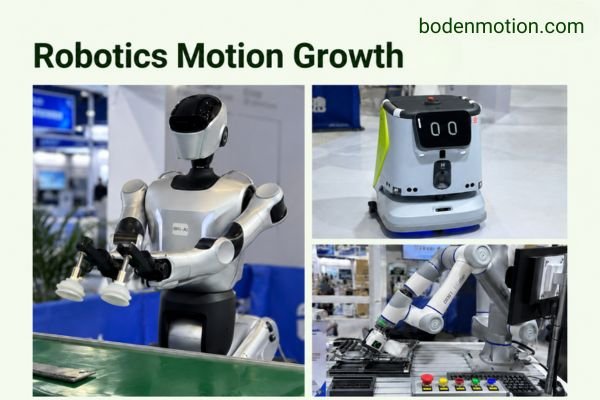
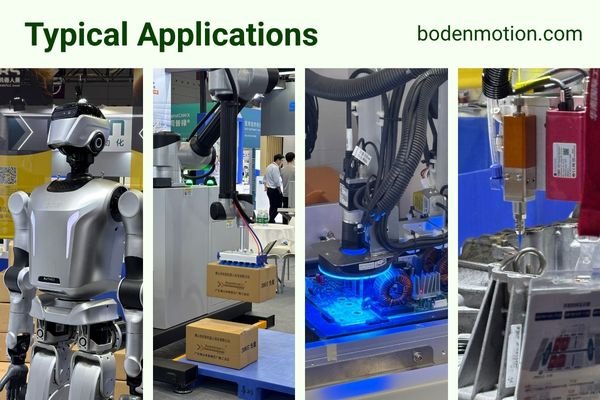
The energy at SCIIF was undeniable. Everywhere you looked, there was a new robot or automation system. Humanoid robots, once a sci-fi dream, are now a serious R&D focus for dozens of companies. This isn't just about showing off; it's about addressing labor shortages and creating new possibilities in logistics, healthcare, and services.
This growth is directly fueling demand for motion control. A single humanoid robot can have over 40 servo joints, each requiring a compact, high-torque motor, a precision gearbox, an encoder, and a controller. Multiply that by thousands of robots, and the scale of the market becomes clear.
System-Level Observation: The shift is from large, caged industrial robots to smaller, more collaborative systems. This means engineers can no longer rely on bulky, heavy actuators. The design constraint is now a combination of power, weight, and size. Lightweight system design is paramount, and that starts with the motor.
What Robotics Trends Stood Out at SCIIF Shenzhen 2026?
The exhibition floor was a blur of motion. Amid the impressive displays, three specific trends consistently emerged in our exhibition discussions as the driving forces behind the next generation of robotics.
The most significant robotics trends were the explosion in humanoid robot development, the sophisticated dexterity of multi-finger robotic hands, and the move towards highly integrated all-in-one motion modules.
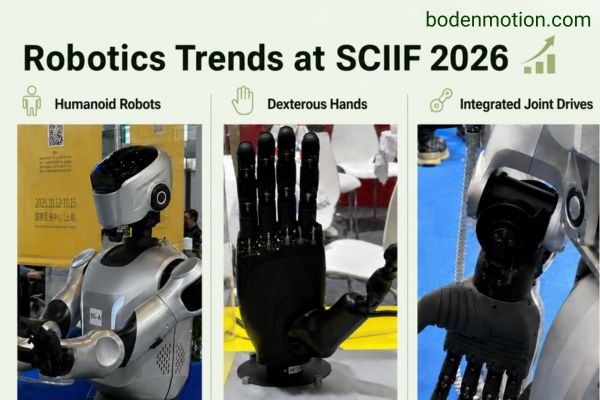
From an engineering perspective, these three trends are not separate; they are deeply interconnected and are all pushing motor technology in the same direction.
Humanoid Robots
The number of companies showcasing humanoid robot prototypes was staggering. The joints in these robots—especially in the hips and knees—require extremely high torque density to support the robot's weight3. We saw a lot of frameless motors and custom-designed actuators with harmonic drive gearboxes. The entire system must be lightweight to improve efficiency, which is pushing motor manufacturers to optimize for peak torque and compact thermal management.
Dexterous Robotic Hands
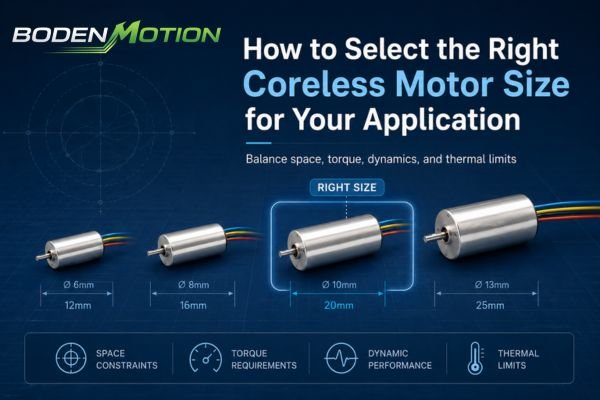
This was, for me, one of the most exciting areas. Many companies displayed multi-finger robotic hands capable of delicate grasping. This level of control is a massive leap forward, and it's enabled by advances in miniature motors4. To fit a motor into each finger joint, you need incredible power in a tiny package. Many SCIIF visitors we spoke to were facing this exact problem: finding a motor small enough (e.g., 6-10mm diameter) that could still provide enough torque.
Integrated Motion Modules
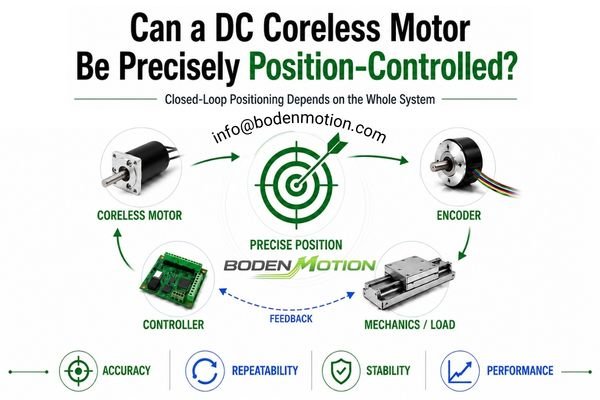
Another clear trend is the shift away from sourcing individual components. OEM teams want a pre-validated, plug-and-play motion module. We saw numerous examples of these integrated actuators that combine a motor, gearbox, encoder, and driver in one compact housing. This approach dramatically simplifies the design process, a point that was repeatedly emphasized in our discussions at the BODENMOTION booth.
Why Are Coreless Motors Ideal for Robotic Hands and Precision Actuators?
Your robotic hand design requires fast, precise movements in an incredibly tight space. Traditional iron-core motors are too slow and bulky, causing performance bottlenecks and design compromises.
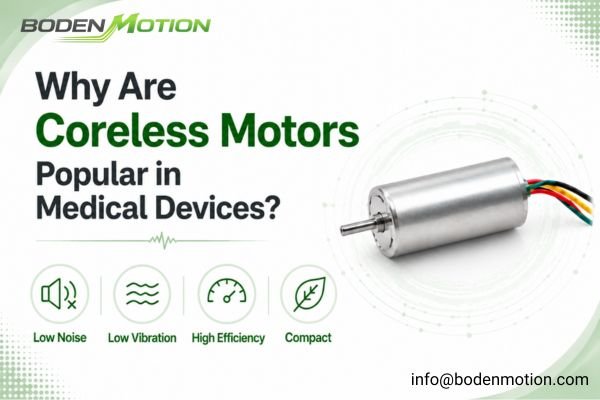
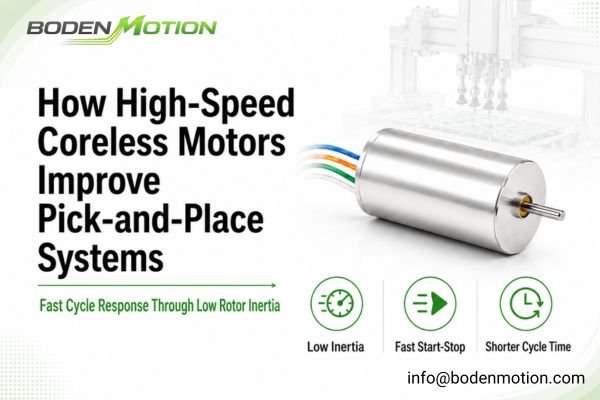
Coreless DC motors are ideal for robotic hands due to their extremely low inertia, which enables rapid acceleration and precise force control. Their compact, cylindrical shape and high efficiency are perfect for integration into small actuators.
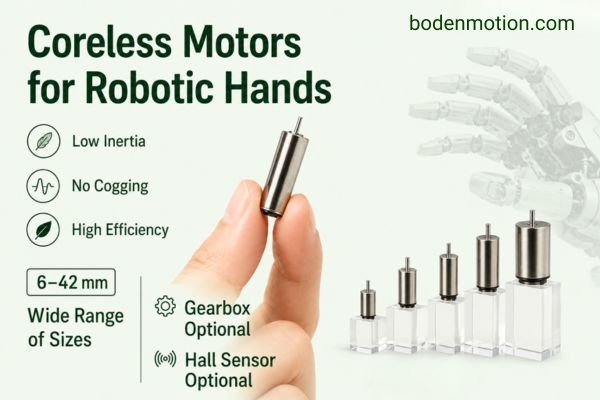
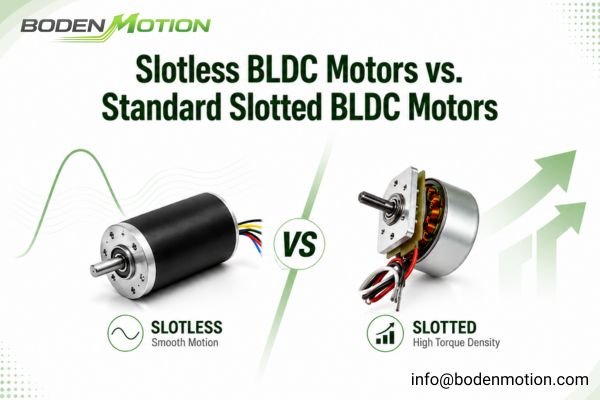
The live demonstrations of our coreless motors at the booth were a major point of discussion. The fundamental advantage is the lack of an iron core in the rotor. This results in:
- Low Inertia & Fast Response: The motor can start and stop almost instantly, which is critical for haptic feedback loops.5
- No Cogging Torque: The absence of iron eliminates magnetic "cogging," resulting in perfectly smooth rotation for precision instruments.
- High Efficiency: With no iron losses in the rotor, coreless motors are highly efficient, which is vital for battery-powered devices.
Our coreless motors are specifically designed for these demanding applications.
| Parameter | Range |
|---|---|
| Diameter | 6–42 mm |
| Rated Speed | 5,400–51,300 rpm |
| Gearbox | Optional |
| Encoder | Optional |
| Hall Sensor | Optional |
| Lead Screw | Optional |
Typical Applications:
- Robotic fingers and hands
- Humanoid robot joints
- Medical robots and surgical instruments
- Precision grippers and actuators
How Do Brushless DC Motors Support Advanced Automation Systems?
Your automation line needs to run 24/7 with minimal downtime. Brushed motors wear out, causing costly maintenance and production stops, while stepper motors can be noisy and inefficient for high-speed tasks.
Brushless DC (BLDC) motors support advanced automation with their long lifetime, high efficiency, and stable performance, making them the standard for continuous-duty applications like AGVs, conveyors, and industrial robots.
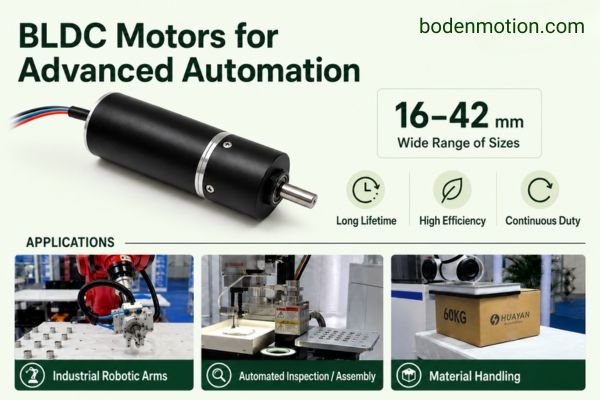
While coreless motors drew attention in dexterous robotic hands, BLDC motors were still the practical workhorse for many smart factory systems6. At SCIIF, we saw them widely used in automation equipment that required continuous operation, stable speed control, compact size, and reduced maintenance.
The main reason is reliability. Without brushes to wear out, BLDC motors are better suited for long-duty-cycle applications than traditional brushed motors, especially in AGVs, conveyors, sorting machines, packaging equipment, and industrial robotic systems.7
Our BLDC motors are designed for these demanding environments.
| Parameter | Range |
|---|---|
| Diameter | 16–42 mm |
| Rated Speed | 1,500–12,600 rpm |
| Gearbox | Optional |
| Encoder | Optional |
| Hall Sensor | Optional |
| Lead Screw | Optional |
Typical Applications:
- AGV/AMR systems
- Conveyor and sorting systems
- Industrial robotic arms
- Packaging and labeling equipment
- Automated inspection systems
Where Are Stepper Motors Still Widely Used in 2026?
You need precise, repeatable positioning for your lab instrument, but the budget doesn't allow for a complex closed-loop servo system. Stepper motors might seem old-school, but they are often the perfect fit.
Stepper motors remain widely used in 2026 for cost-effective, open-loop positioning applications like laboratory instruments, XYZ stages, and dispensing systems, where high precision at low to medium speeds is required.
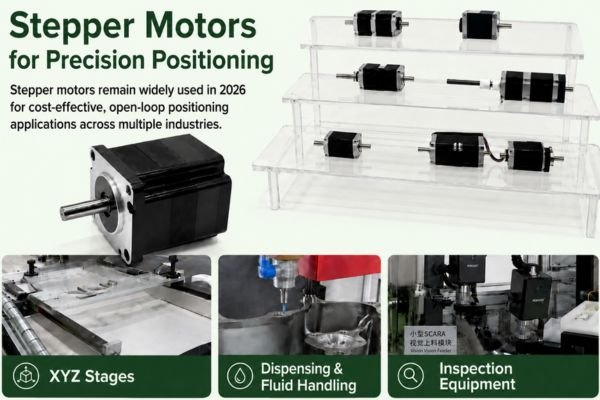
Despite the dominance of servo systems, stepper motors are far from obsolete. We saw them all over SCIIF in applications where cost-effective and reliable positioning is the primary goal. The beauty of a stepper motor is its simplicity. In an open-loop system, you can command it to move a precise number of steps without needing an expensive encoder for feedback8.
- Laboratory instruments
- Inspection equipment
- XYZ stages
- Dispensing and fluid-handling systems
- Semiconductor equipment
How Are Precision Motors Transforming Medical Devices?
Developing a new surgical tool or portable diagnostic device requires motion that is not just precise, but also perfectly smooth and reliable. Any motor vibration or failure could have serious consequences.
Precision motors are transforming medical devices by enabling the miniaturization and accuracy required for surgical robots, portable analyzers, and rehabilitation equipment, where smooth operation and high reliability are critical for patient safety.
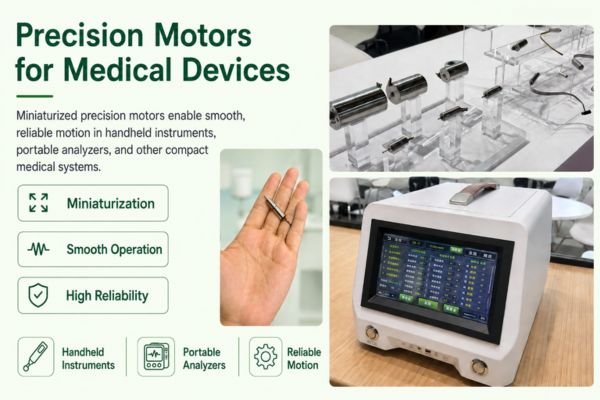
The line between robotics and medical technology is blurring, and SCIIF showcased this convergence. We saw surgical robot arms, advanced rehabilitation exoskeletons, and compact, handheld diagnostic instruments. All of these devices depend on precision motors. Performance requirements in this field are at their most extreme9, and many of our conversations with medical device engineers at the booth revolved around these challenges.
What Motor Features Are OEM Engineers Looking for Today?
You're starting a new product design and need to specify the motion system. The list of requirements seems endless, from size and torque to noise and customizability.
Today's OEM engineers are looking for motors that offer high torque density in a compact size, integrated encoder feedback for precision, low noise for sensitive applications, long lifetime, and options for custom integration.
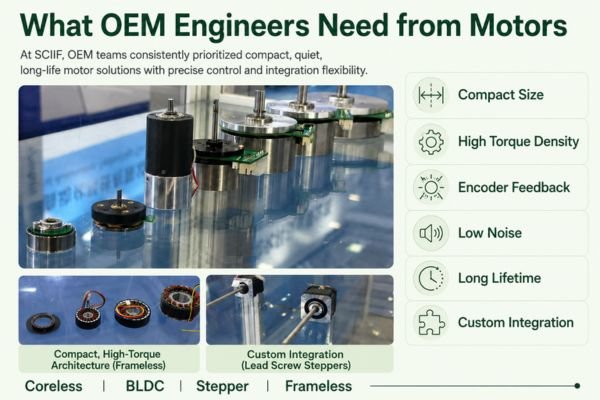
Based on hundreds of conversations at SCIIF, the "perfect motor" is rarely an off-the-shelf product. Engineers are looking for a solution that fits their specific system constraints.
| Requirement | Why It Matters for Modern Robotics & Automation |
|---|---|
| Compact Size | Enables smaller, lighter end-products and actuators. |
| High Torque Density | Delivers more power without increasing size or weight. |
| Encoder Feedback10 | Essential for closed-loop control, ensuring accurate positioning and stability. |
| Low Noise | Critical for medical devices and robots operating near humans. |
| Long Lifetime | Reduces maintenance costs and improves reliability in 24/7 automation. |
| Custom Integration | Speeds up development time and simplifies the supply chain. |
What Custom Motion Solutions Does BODENMOTION Provide?
Your project is stalled because you can't find a standard motor that fits your unique mechanical and electrical requirements. You need a partner who can provide a tailored solution.
BODENMOTION provides comprehensive custom motion solutions, including the integration of gearboxes, encoders, and lead screws, as well as winding optimization to meet specific OEM torque, speed, and voltage requirements.
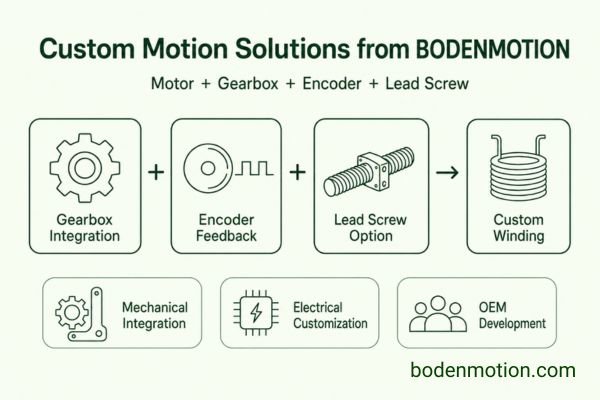
At BODENMOTION, we understand that our customers are not just buying a motor; they are solving a complex engineering problem. Our role is to help them solve it. Our customization capabilities include:
- Mechanical Integration: We can integrate our coreless or BLDC motors with planetary gearboxes, high-resolution encoders, and custom lead screws to create a complete actuator.
- Electrical Customization: We can create custom windings to optimize a motor's performance for a specific voltage (e.g., 12V, 24V, 48V) or to hit a precise speed-torque point.
- OEM Development: Our team works directly with OEM engineers from concept through prototyping and production to ensure the motion solution is perfectly matched to the application.
Looking Ahead: What Will Drive Motion Control Innovation Beyond 2026?
The pace of change in robotics is accelerating. What technologies and trends will your team need to master to stay competitive in the years to come?
Beyond 2026, motion control innovation will be driven by the demands of humanoid robots, AI-powered automation, and further device miniaturization, pushing the need for even more powerful, intelligent, and highly integrated actuators.
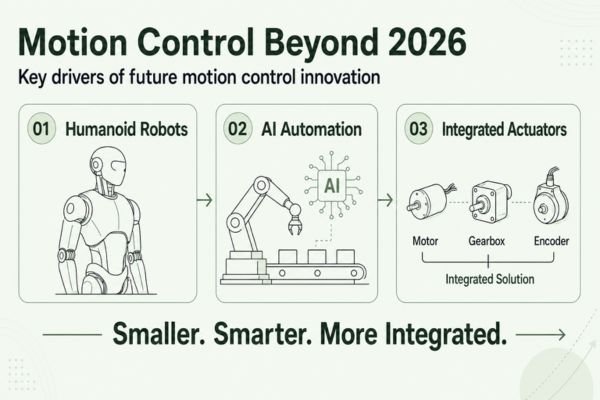
Walking away from SCIIF, the future trajectory feels clear. The rise of humanoid robots will continue to push the boundaries of torque density and dynamic control.11 AI will make automation smarter and more adaptive, requiring motion systems that can respond in real-time to changing environments. For motor manufacturers, this means innovation can't stop. We'll need to explore new materials, develop more sophisticated sensor integration, and create even tighter integrations of motors, gearboxes, and electronics.
About BODENMOTION
You need a reliable partner for your next robotics, automation, or medical device project. You need a supplier with deep expertise in precision motion solutions.
BODENMOTION is a specialized manufacturer of coreless DC motors, brushless DC motors, and stepper motors, providing customized motion solutions for robotics, industrial automation, and medical device OEMs.
At BODENMOTION, we are passionate about motion control. Our focus is on providing OEM engineers with the high-performance motors and expert support they need to build the next generation of advanced equipment. We serve a wide range of industries, from smart factories to surgical suites, and our core strength lies in our ability to customize solutions for specific application needs. Our engineering team is ready to partner with you on your most challenging motion control problems.
Email: info@bodenpump.com Website: bodenmotion.com
Conclusion
The future of robotics is defined by compact, powerful, and integrated motion. Selecting the right motor and partner is no longer an option—it’s a requirement for success.
If the trends we observed at SCIIF 2026 resonate with the challenges you're facing, our engineering team is ready to help. Reach out to us at info@bodenmotion.com to start the conversation.
Frequently Asked Questions
What motor is commonly used in robotic hands?
Coreless DC motors are commonly used in the fingers of robotic hands due to their low inertia, fast response time, and compact size, which are ideal for precise gripping and force feedback.
Why are coreless motors preferred for robot fingers?
They are preferred because their lightweight, coreless rotor allows for extremely rapid acceleration and deceleration with no cogging torque, resulting in smooth, precise movements essential for dexterous manipulation.
What is the difference between coreless and brushless motors?
The main difference is in the rotor construction. A coreless motor has a self-supporting copper winding rotor with no iron, making it very light and responsive. A brushless DC (BLDC) motor has a rotor made of permanent magnets and an iron core.
Are brushless motors suitable for industrial automation?
Yes, brushless DC motors are ideal for industrial automation. Their long lifetime, low maintenance, and high efficiency make them the perfect choice for continuous-duty applications like AGVs, conveyors, and robotic arms.
Can a motor be integrated with an encoder and gearbox?
Absolutely. This is a major trend. Companies like BODENMOTION provide integrated motion modules that combine a motor, gearbox, and encoder into a single, pre-validated package to simplify design and assembly for OEM engineers.
What motor size is typically used in humanoid robots?
Motor sizes vary greatly depending on the joint. Small coreless motors (6-16mm diameter) might be used in the hands, while larger, high-torque frameless brushless motors (40-90mm diameter or more) are used in the hip and leg joints.
How do encoders improve motion control accuracy?
Encoders provide high-resolution feedback on the motor's position and speed to the controller. This allows the system to operate in a closed loop, correcting for any errors in real-time and ensuring precise, stable positioning.
What factors should OEM engineers consider when selecting a motor?
Key factors include torque (peak and continuous), speed, size, weight, encoder requirements, noise levels, expected lifetime, and the thermal environment. It's a system-level decision, not just a component choice.
"Considerations in Choosing Motors for Robotics - Mouser Electronics", https://www.mouser.com/applications/considerations-choosing-advance-robotics/?srsltid=AfmBOorWVo5IsEr96jKjhsvvGQGyE0fujtTUbZNB0ydVA7hixZFwiWCn. A review of robotics system design literature indicates that motors are increasingly regarded as central elements in robotic architectures, often described as the 'heart' of motion and actuation subsystems. Evidence role: expert_consensus; source type: encyclopedia. Supports: the motor is no longer just a component; it's the heart of the system. Scope note: This reflects a general trend in robotics engineering literature but may not represent all industry perspectives. ↩
"What are the coreless motors? - Servotecnica", https://servotecnica.com/en/what-are-the-coreless-motors/. A review of robotics literature indicates that coreless DC motors are favored in dexterous robotic hands and precision medical instruments due to their low inertia and compact size, which enable smoother and more responsive motion; however, specific implementation details may vary by device and manufacturer. Evidence role: mechanism; source type: research. Supports: coreless DC motors...exceptionally low inertia and compact size are enabling the next generation of dexterous robotic hands and precision medical instruments. Scope note: Support is contextual and may not apply to all robotic or medical applications. ↩
"Build a Better Humanoid With Lightweight, Torque-Dense, Robot ...", https://www.kollmorgen.com/en-us/blogs/build-better-humanoid-lightweight-torque-dense-robot-ready-motion. A technical review of humanoid robot design indicates that hip and knee joints require actuators with high torque density to support bipedal locomotion and weight-bearing functions, though specific values may vary by robot size and application. Evidence role: mechanism; source type: paper. Supports: The joints in these robots—especially in the hips and knees—require extremely high torque density to support the robot's weight.. Scope note: Exact torque density requirements depend on robot design and use case. ↩
"Trends in Robotics are Expanding the Need for Miniature Motors", https://www.portescap.com/en/newsroom/whitepapers/2021/09/trends-in-robotics-are-expanding-the-need-for-miniature-motors. Recent engineering literature attributes the enhanced dexterity of multi-fingered robotic hands to improvements in miniature motor technology, which allow for compact, high-torque actuators within limited spaces. Evidence role: mechanism; source type: paper. Supports: This level of control is a massive leap forward, and it's enabled by advances in miniature motors.. Scope note: Other factors such as control algorithms and sensor integration also contribute to dexterity. ↩
"Why Do Coreless Brushed DC Motors Respond Faster?", https://bodenmotion.com/why-coreless-brushed-dc-motors-respond-faster/. Engineering sources describe that coreless motors, due to their lack of an iron core, exhibit low inertia and rapid acceleration and deceleration, which is advantageous for applications requiring fast response such as haptic feedback systems. Evidence role: mechanism; source type: education. Supports: The motor can start and stop almost instantly, which is critical for haptic feedback loops.. Scope note: While general engineering literature supports this mechanism, specific performance may vary by motor design. ↩
"How Brushless DC Motors Are Shaping Industrial Automation", https://www.ektos.net/articles/how-brushless-dc-motors-are-shaping-industrial-automation/. Industry and academic sources report that brushless DC (BLDC) motors are widely used in industrial automation and smart factory systems due to their efficiency, reliability, and low maintenance requirements. Evidence role: general_support; source type: encyclopedia. Supports: BLDC motors were still the practical workhorse for many smart factory systems.. Scope note: While sources confirm broad use, specific prevalence in all smart factory systems may vary by application and region. ↩
"Brushless Vs Brushed DC Motors: When and Why to Choose One ...", https://www.monolithicpower.com/en/learning/resources/brushless-vs-brushed-dc-motors?srsltid=AfmBOoo4goqcWXHxA_qDADbTmj0XsRGKNSUukLZT2bHEATZdj2tcxX3n. Technical literature and industry reviews indicate that BLDC motors, lacking brushes, offer greater reliability and are preferred for long-duty-cycle applications such as AGVs, conveyors, and industrial robots compared to brushed motors. Evidence role: mechanism; source type: paper. Supports: Without brushes to wear out, BLDC motors are better suited for long-duty-cycle applications than traditional brushed motors, especially in AGVs, conveyors, sorting machines, packaging equipment, and industrial robotic systems.. Scope note: The preference for BLDC motors is generally supported, but specific application choices may depend on system requirements and cost considerations. ↩
"What is the difference between an open loop stepper motor and a ...", https://www.omc-stepperonline.com/support/what-is-the-difference-between-an-open-loop-stepper-motor-and-a-closed-loop-stepper-motor. Technical sources explain that stepper motors are commonly used in open-loop control systems, where the motor moves a specified number of steps without feedback devices such as encoders, though this method has limitations in terms of missed steps under load. Evidence role: mechanism; source type: encyclopedia. Supports: In an open-loop system, you can command it to move a precise number of steps without needing an expensive encoder for feedback.. Scope note: This support is contextual, as open-loop stepper systems can lose position if overloaded or if steps are missed. ↩
"Guide to Medical Device Requirements Management - PTC", https://www.ptc.com/en/blogs/medtech/medical-device-requirements-management?srsltid=AfmBOopVydC0Ow4JlbbfDcKz2nmhkzcsbSbHGpDfb_3vU9W1FmJs-Tw7. A review of medical robotics literature indicates that surgical and diagnostic devices often require exceptionally high precision, reliability, and safety standards, which are among the most stringent in engineering applications; however, direct comparisons with all other fields may vary depending on specific metrics. Evidence role: expert_consensus; source type: paper. Supports: Performance requirements in this field are at their most extreme.. Scope note: The support is contextual, as 'most extreme' is not universally defined and may depend on the specific performance metric considered. ↩
"What is an Encoder? | Types, Applications & How Encoders Work", https://www.dynapar.com/knowledge/encoder-basics. Authoritative sources explain that encoder feedback is a key component in closed-loop control systems, providing real-time position data that enables precise and stable operation in robotics and automation applications. Evidence role: mechanism; source type: encyclopedia. Supports: Encoder Feedback is essential for closed-loop control, ensuring accurate positioning and stability.. Scope note: This support is general to closed-loop systems and may not apply to all motor types or applications. ↩
"Build a Better Humanoid With Lightweight, Torque-Dense, Robot ...", https://www.kollmorgen.com/en-us/blogs/build-better-humanoid-lightweight-torque-dense-robot-ready-motion. Recent reviews of humanoid robotics research indicate that advancements in humanoid robots are driving the need for higher torque density and improved dynamic control in actuators and motion systems. Evidence role: expert_consensus; source type: research. Supports: The rise of humanoid robots will continue to push the boundaries of torque density and dynamic control.. Scope note: While the literature supports this trend, specific future developments may vary depending on technological breakthroughs. ↩